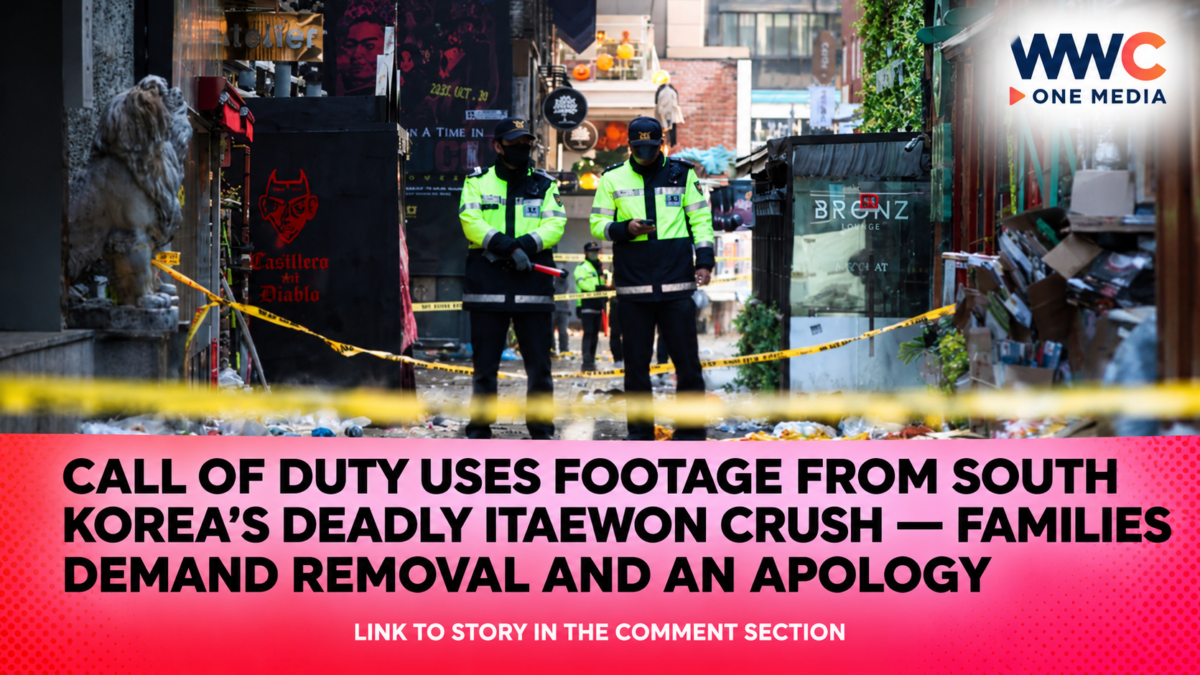
SEOUL — The latest instalment of the Call of Duty video game franchise is facing criticism in South Korea after players discovered that its opening cinematic included real news footage from the 2022 Itaewon crowd crush, a disaster that killed 159 people.
The approximately three-second clip appears in Call of Duty: Modern Warfare 4, released worldwide on October 23, 2026. It shows emergency responders and civilians performing cardiopulmonary resuscitation (CPR) on a person lying in the street.
The footage is presented as part of a fictional news-style sequence showing civilian casualties after an imagined North Korean invasion of South Korea.
For families of those who died, however, the images are not fictional. They depict scenes from a tragedy that continues to affect survivors, witnesses and bereaved relatives.
Families’ representatives and civic organisations have condemned the use of the footage and called on Activision to remove it. The controversy has also renewed debate about how video-game developers should handle real-world disasters when creating fictional military scenarios. AsiaOne+3
What happened in the controversial Call of Duty scene?
Modern Warfare 4 features a fictional conflict in which North Korea launches a full-scale invasion of South Korea.
The opening cinematic uses news-style material to establish the scale of the imagined attack and its consequences for civilians.
But players recognised that a short section of the sequence appeared to contain actual broadcast footage from the Itaewon disaster.
The clip reportedly shows a rescue scene involving CPR, with other images depicting victims lying on the street and emergency personnel responding.
The footage was incorporated into the fictional war sequence, making real scenes from the 2022 disaster appear to represent casualties of the game’s imagined invasion.
The discovery triggered criticism from South Korean players and members of the public, particularly because the footage was connected to a tragedy that remains deeply sensitive in the country. The Guardian+2
Families of Itaewon victims say the footage disrespects those who died
The Families of the Itaewon Disaster and a coalition of civic groups issued a joint statement condemning the use of the footage.
They argued that the rescue scenes should not have been repurposed as entertainment material, particularly when families and survivors continue to experience the emotional consequences of the tragedy.
The groups called for the footage to be removed and urged Activision to respond responsibly.
Cho In-young, an official representing victims’ families, told AFP that the decision showed a serious lack of sensitivity towards bereaved relatives and the dignity of those who died.
The controversy has also raised concerns about secondary victimisation. Families and campaigners say the game’s use of the images has encouraged hurtful online comments about the victims, adding to the distress surrounding the disaster’s anniversary.
The Korean Game Users Association has also called for an apology and for the footage to be replaced through a game update. The Guardian+2
Activision responds but does not confirm removal
Activision acknowledged that real-world news footage was included in the opening cinematic of Call of Duty: Modern Warfare 4.
The publisher told South Korea’s Yonhap News Agency that the footage was used to help establish the game’s fictional narrative.
The company said the production team approached the subject matter with care and respect, adding that there was absolutely no intention to reference or trivialise the Itaewon disaster or any other real-life tragedy.
However, its response did not confirm whether the controversial sequence would be removed or replaced.
That leaves the central issue unresolved: families want the footage taken out, while Activision has explained its creative purpose without announcing a corrective update.
The distinction matters because acknowledging the use of real footage is not the same as agreeing to remove it. AsiaOne+2
The Itaewon disaster remains a painful chapter in South Korea
The crowd crush happened on October 29, 2022, during Halloween celebrations in Seoul’s Itaewon nightlife district.
Large numbers of people had gathered in the narrow streets and alleyways around the popular entertainment area. A dangerous crush developed in a narrow, sloping alley, leaving people trapped and unable to escape the pressure of the crowd.
The disaster killed 159 people and injured many others.
Most of those who died were in their twenties and thirties. The tragedy triggered nationwide mourning and intense scrutiny of crowd-management arrangements and emergency responses.
The fourth anniversary on October 29, 2026, has brought renewed attention to the victims and the continuing concerns of their families.
Against that backdrop, the appearance of footage from the rescue operation in a commercial video game has been particularly upsetting for those who experienced the disaster. AsiaOne+2
A wider debate about real tragedies in fictional entertainment
The controversy raises a difficult question for game developers, filmmakers and other entertainment producers: when does using real-world material to create a realistic fictional story cross the line into exploiting an actual tragedy?
Video games frequently incorporate authentic photographs, news footage, military equipment and historical references to make fictional settings feel convincing.
But the Itaewon footage is different from generic archival material. It shows identifiable circumstances surrounding a mass-casualty event in which real people died.
The debate also echoes other controversies in South Korea involving the portrayal of sensitive historical events in entertainment.
WWC ONE MEDIA previously reported on South Korea’s historical film controversy involving The Assassin(s) and a defamation complaint, which raised questions about how fictional storytelling should handle real historical events.
The latest dispute is not about whether developers can create fictional war scenarios. Rather, it concerns the decision to incorporate footage from a specific real-life disaster into that fictional setting.
There is also a broader military context behind the game’s storyline. WWC ONE MEDIA has examined North Korea’s reported expansion of landmines and border fortifications near South Korea, illustrating how real security tensions on the Korean Peninsula continue to influence public discussion. The Guardian+1
What happens next?
For now, the demands from bereaved families remain unresolved.
Activision has explained why real news footage was incorporated into the cinematic, but it has not confirmed that the sequence will be changed.
Families’ representatives and civic groups are seeking its removal, while the Korean Game Users Association has called for an apology and replacement footage.
The dispute could also prompt wider discussion about the use of archival news material, permissions, editorial oversight and the responsibilities of international game publishers when working with images of real victims.
The central issue is no longer simply whether a video game can portray a fictional invasion of South Korea. It is whether a real tragedy that killed 159 people should have been used to make that fictional war look more realistic in the first place.