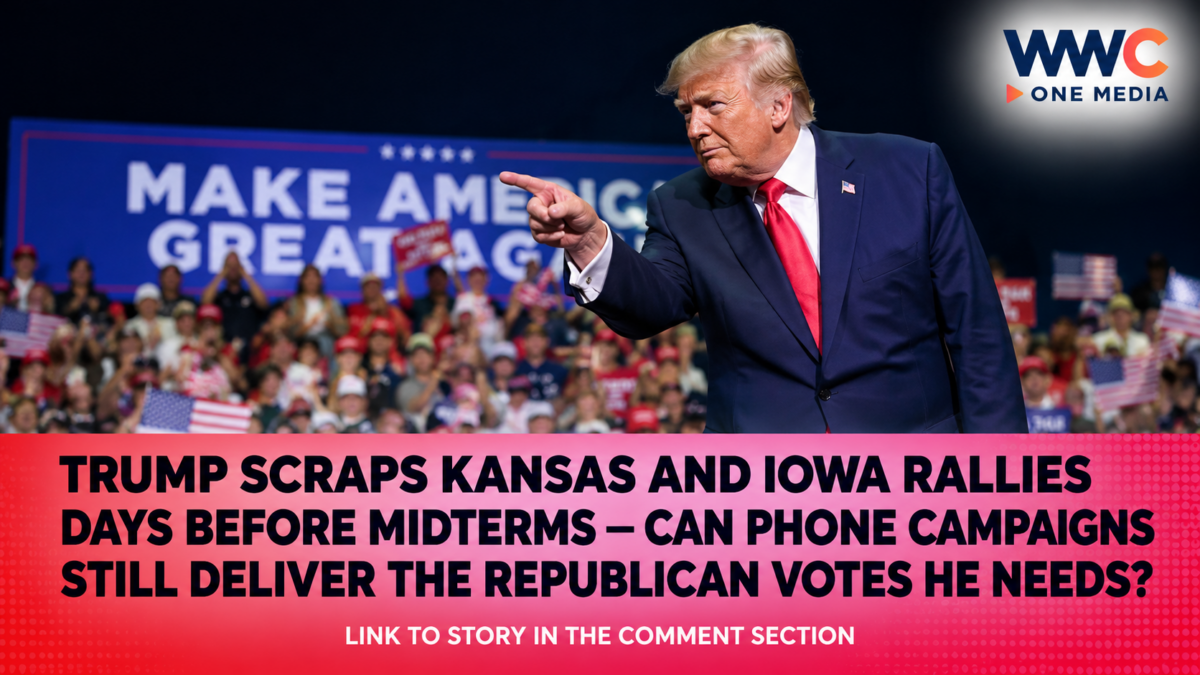
WASHINGTON, D.C. — US President Donald Trump has cancelled two planned in-person campaign rallies in Kansas and Iowa just days before the November 3 midterm elections, opting instead to reach Republican voters through a series of telephone and virtual campaign events.
The Republican National Committee (RNC) confirmed the cancellation of the planned appearances in Salina, Kansas, on Saturday, October 31, and Dubuque, Iowa, on Sunday, November 1. Trump-aligned political group MAGA Inc. said it would organise a series of so-called “tele-rallies” across at least 19 states, allowing the president to address supporters without travelling to each location. Reuters+2
The change comes during the final stretch of a closely watched election that will determine whether Republicans retain their narrow majorities in both the US Senate and House of Representatives.
Trump, who has been campaigning extensively for Republican candidates, defended the decision by saying he did not feel a personal visit to Kansas was necessary because Republican Senator Roger Marshall was doing well.
“He is doing very well,” Trump said of Marshall. “We are going to have a strong Tuesday night.” Reuters+1
The cancellations do not mean Trump is ending his campaign appearances altogether. He was still expected to travel to Florida on Friday, October 30, and had campaigned in South Carolina on Thursday.
Why Trump cancelled the Kansas and Iowa rallies
The Kansas appearance was scheduled for Salina, where Trump was expected to campaign for Republican Senator Roger Marshall.
Marshall is facing Democratic challenger Adam Hamilton in a closely watched Senate contest. The race has attracted attention because Republicans are trying to protect their narrow Senate majority ahead of the midterms.
Trump said he did not believe he needed to visit the state in person, arguing that Marshall was performing well.
The Iowa rally, scheduled for Dubuque on Sunday, was also cancelled. The state has several competitive congressional contests that could affect the balance of power in Washington.
The RNC announced that the previously planned in-person events would no longer take place as scheduled, while the party and Trump-aligned groups shifted towards telephone-based campaign outreach. Reuters+2
From 25 rallies in 19 states to a nationwide phone campaign
Trump’s change in schedule follows an intensive campaign effort.
According to Reuters, he had held 25 rallies across 19 states since October 1, frequently appearing in areas where Republican candidates needed support.
The new telephone campaign is designed to extend his reach during the final days before Election Day. MAGA Inc. said the tele-rallies would cover at least 19 states, including Kansas and Iowa, with additional states potentially included.
The strategy allows Trump to speak to supporters in several locations without spending hours travelling between campaign venues.
The White House also said Trump would continue connecting with voters through more than 20 tele-rallies before Election Day. Reuters+2
The shift is part of a broader Republican effort to use Trump’s national profile to support candidates in competitive races. WWC ONE MEDIA previously reported on Trump’s campaign appearances targeting Democrats in North Carolina, where he sought to mobilise Republican voters ahead of the same midterm elections.
Trump clashes with reporter over questions about his cancellations
The cancellations also produced a tense exchange between Trump and a Reuters reporter.
After campaigning for Republican Senator Darline Graham in Rock Hill, South Carolina, on Thursday, Trump was asked why he had cancelled the Kansas appearance and whether he was feeling well after weeks of campaigning.
Trump rejected the suggestion that his health was behind the schedule change.
He said he felt “perfect” and criticised the reporter, making personal remarks about his appearance.
The exchange drew attention because Trump had recently acknowledged the physical demands of holding frequent, lengthy campaign rallies.
While speaking in Mississippi earlier in the week, he remarked: “God didn’t make your vocal cords to do a rally every day.”
However, there has been no publicly established medical explanation for the Kansas and Iowa cancellations. Trump has denied that he is unwell, and the available reporting does not establish that health concerns caused the schedule change. Reuters+2
Republicans face closely watched races as Election Day approaches
The November 3 midterm elections will determine whether Republicans maintain control of Congress.
The party currently holds narrow majorities in both chambers, making competitive Senate and House races particularly important.
In Kansas, Republican Senator Roger Marshall is facing Democrat Adam Hamilton. In Iowa, several congressional contests are also drawing attention as both parties compete for seats.
Trump’s decision to replace some in-person appearances with tele-rallies comes as Republicans seek to mobilise their supporters and encourage turnout in the closing days of the campaign.
The president’s involvement is significant because he remains a central figure in Republican campaign messaging. His appearances and endorsements have been used to energise the party’s base and draw attention to candidates in competitive states. Reuters+2
WWC ONE MEDIA has also examined the financial side of the Republican campaign in its report, Trump and Musk Unleash Millions for Republicans in Key Battlegrounds.
Trump still expected to campaign in Florida
Despite cancelling the two weekend stops, Trump was still expected to attend a campaign event in Florida on Friday, October 30.
He had also appeared in South Carolina on Thursday to support Republican Senate candidate Darline Graham, who is facing Democratic challenger Annie Andrews.
The South Carolina contest has attracted attention amid concerns about voter dissatisfaction over economic conditions, fuel prices and the war involving Iran.
The president’s remaining campaign schedule therefore still includes in-person appearances, even as his team expands telephone outreach to other states. KPRC+2
For more on the economic issues surrounding the election, read WWC ONE MEDIA’s report on Trump’s US$47.1-billion Iran war costs and the pressure facing American taxpayers.
Why the shift to tele-rallies matters
Telephone and virtual campaign events offer a practical way for a candidate to reach supporters in multiple states without travelling to every venue.
For Trump’s campaign, the format also makes it possible to deliver messages to voters in states where Republican candidates want a last-minute boost.
But the change has attracted attention because the cancelled appearances were scheduled in states with competitive races. The Washington Post reported that campaign organisers were weighing how to allocate Trump’s limited time during the final days of the election, while other reports highlighted the Republican Party’s stated confidence in Kansas and Iowa. The Washington Post+1
The cancellations alone do not establish that Republicans are abandoning either state or that Trump is withdrawing support from the candidates. The tele-rally plan indicates that the campaign intends to maintain contact with voters there through a different format.
WWC ONE MEDIA has previously covered the wider political stakes in Trump’s promise of US$5,000 payments if Republicans win control of Congress, another major message aimed at voters ahead of the November elections.
The final question: Can phone rallies deliver the same campaign impact?
With Election Day approaching, Trump’s campaign is moving into its final phase.
The president has spent October travelling across the country, appearing at rallies and supporting Republican candidates. Now, with two weekend appearances cancelled, his allies are turning to telephone events to reach voters in more states.
Whether those events generate the same level of enthusiasm and turnout as large in-person rallies remains to be seen.
For now, the confirmed development is a change in campaign format—not a withdrawal from the midterm effort. Trump is still expected to make additional in-person appearances, while his allies prepare a nationwide series of tele-rallies before November 3.
The stakes are substantial: the election will determine control of both chambers of Congress, and the final days of campaigning could prove important in closely contested races.