SEOUL, South Korea — October 30, 2026. Samsung Electronics has delivered one of the most extraordinary quarterly performances in global technology history, reporting approximately $80 billion in operating profit as the artificial intelligence revolution drives unprecedented demand for advanced memory chips.
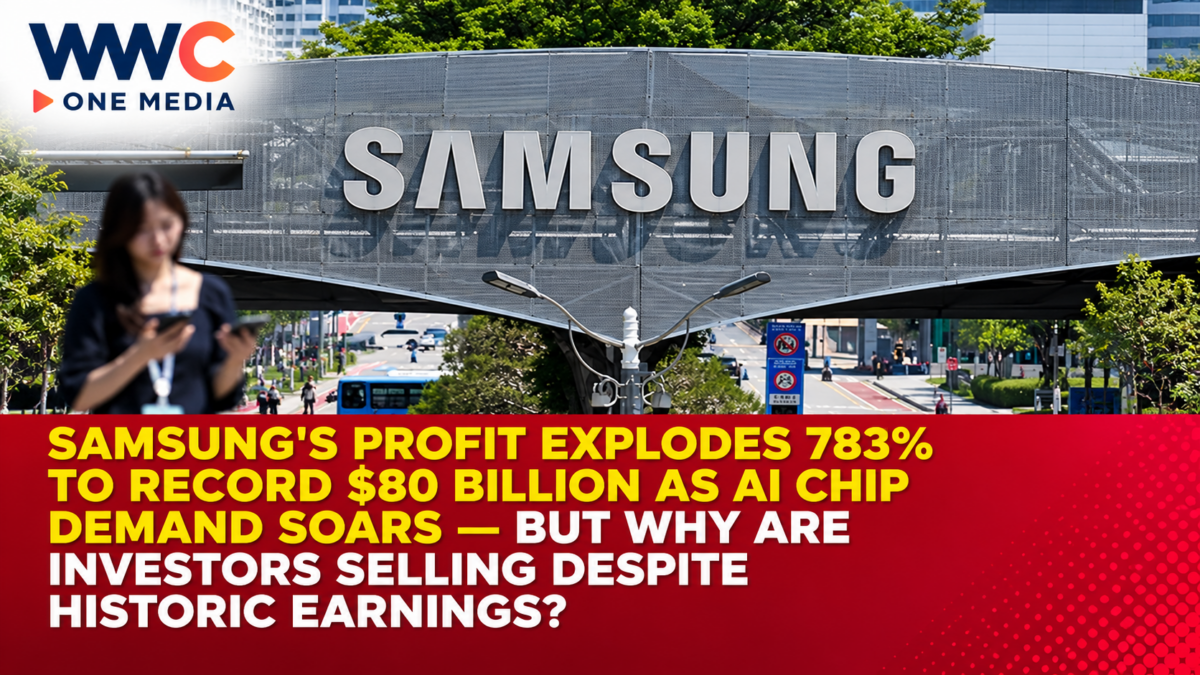
The South Korean technology giant announced on October 29 that its operating profit surged 783.1% year on year to 107.44 trillion won during the third quarter ended September 30.
Revenue soared 126.9% to 195.25 trillion won, while net profit jumped 514.6% to 75.13 trillion won.
The results mark Samsung’s fourth consecutive quarter of record performance, driven overwhelmingly by its semiconductor business.
Samsung also became the first global technology company to report more than 100 trillion won in quarterly operating profit, according to its official announcement.
But the record-breaking figures failed to satisfy every investor.
Despite the historic earnings, Samsung shares declined in Seoul trading as investors questioned the company’s shareholder-return plans and the long-term sustainability of the artificial intelligence spending boom.
The bigger question: Can Samsung turn today’s record chip prices into years of sustained profitability, or are investors already preparing for the next semiconductor downturn?
Samsung’s operating profit jumps nearly ninefold in just one year
Samsung’s latest results illustrate how dramatically the global semiconductor market has changed.
In the third quarter of 2025, the company generated approximately 12.17 trillion won in operating profit.
One year later, that figure reached 107.44 trillion won.
The increase represents a gain of approximately 783.1%, meaning quarterly operating profit was about 8.8 times the year-earlier level.
Revenue also more than doubled, rising from approximately 86.06 trillion won to 195.25 trillion won.
The results were broadly consistent with analyst expectations.
According to CNBC, citing LSEG SmartEstimates, analysts had forecast revenue of 195.79 trillion won and operating profit of 107.66 trillion won.
Samsung’s actual results were therefore slightly below those consensus estimates, despite establishing new corporate records.
The distinction matters because financial markets frequently respond to the difference between results and investor expectations rather than the size of earnings alone.
From preliminary forecast to confirmed record
Earlier in October, Samsung had projected operating profit of approximately 107.4 trillion won and revenue of around 195 trillion won.
WWC ONE MEDIA reported those preliminary figures in Samsung Flags Record US$80 Billion Quarterly Profit as AI Chip Boom Drives Memory Demand.
The October 29 announcement confirmed that the company had achieved the extraordinary result.
It also provided a clearer breakdown of the divisions responsible for the earnings surge.
The strongest contributor was Samsung’s semiconductor division, which generated nearly all of the company’s consolidated operating profit.
AI memory chips become Samsung’s biggest profit engine
Samsung’s Device Solutions division reported 147.1 trillion won in revenue and 106.5 trillion won in operating profit.
That means the semiconductor business accounted for approximately 99% of consolidated operating profit before considering the contributions and eliminations associated with other divisions.
The extraordinary performance was driven by demand for memory products used in artificial intelligence systems, cloud computing and enterprise servers.
AI infrastructure requires large quantities of high-performance memory to support the processing of enormous datasets.
Advanced memory products are especially important for the powerful graphics processing units used to train and run AI models.
As technology companies expand data centers, demand for these components has accelerated.
At the same time, production constraints have supported higher memory prices.
For Samsung, the combination of greater demand, improved product mix and stronger pricing created exceptionally favorable operating conditions.
But the company’s dependence on semiconductor earnings also creates a significant risk.
If memory prices weaken or AI spending slows, consolidated profitability could become vulnerable to a reversal.
HBM4 becomes central to Samsung’s AI strategy
One of Samsung’s most important growth areas is high-bandwidth memory, commonly called HBM.
HBM is designed to transfer data rapidly between processors and memory, making it particularly useful for advanced AI computing.
Samsung said it significantly increased HBM4 sales during the quarter while expanding its server-focused memory business.
HBM4 represents a newer generation of high-bandwidth memory designed for increasingly demanding computing applications.
The company also reported strong demand for server DRAM and enterprise solid-state drives.
Samsung is prioritizing products associated with artificial intelligence workloads as customers seek faster memory and greater computing capacity.
The strategy could help the company strengthen its position against competitors.
But the HBM market is intensely competitive.
SK Hynix has established itself as a major supplier of advanced memory for AI systems, while Micron Technology is also expanding its participation.
Samsung must continue improving performance, manufacturing yields and customer relationships to maintain its momentum.
SK Hynix challenges Samsung in the global memory race
The global memory industry is being reshaped by the race to supply advanced components for AI infrastructure.
Samsung and SK Hynix remain two of the world’s leading semiconductor memory producers.
Their competition spans high-bandwidth memory, conventional DRAM and NAND flash products.
WWC ONE MEDIA previously examined the industry’s changing competitive landscape in Samsung, SK Hynix Hold Top NAND Spots as AI Demand Sends Memory Market Soaring.
The report detailed how rising memory prices helped boost industry revenue while competitors sought to capture additional market share.
The latest earnings show that the benefits of AI demand remain substantial.
However, the high-bandwidth memory market and the NAND flash market involve different products and competitive dynamics.
Leadership in one segment does not automatically establish leadership in another.
For Samsung, maintaining profitability will depend on succeeding across several memory categories while adapting production capacity to changing customer demand.
Why Samsung shares fell despite historic earnings
Samsung’s stock market reaction provided one of the biggest surprises following the earnings announcement.
Shares fell approximately 4% on October 29, with some intraday reporting showing declines exceeding 6%.
The weakness reflected investor concerns that went beyond the latest quarter’s earnings.
One important issue was the absence of immediate additional details about the company’s shareholder-return plans.
Samsung had previously outlined a potential shareholder-return program valued between 90 trillion and 110 trillion won.
Investors were looking for greater clarity regarding future dividends, share buybacks and the timing of capital distributions.
Instead, further details were deferred.
The delay disappointed investors who had hoped the record profits would be accompanied by a more concrete return-of-capital announcement.
The share-price decline also reflected broader concerns about semiconductor valuations and the durability of AI-related investment.
This does not mean the company reported weak earnings.
It means the market was evaluating whether future financial performance and shareholder distributions would justify prevailing stock prices.
Samsung’s smartphone and consumer electronics business tells a different story
Not every Samsung business benefited equally from the AI boom.
The Device eXperience division, which includes smartphones and consumer electronics, generated a quarterly operating loss of approximately 0.8 trillion won.
Although its revenue increased by about 8% from the previous quarter, higher component costs and difficult market conditions weighed on profitability.
The division includes some of Samsung’s most recognizable consumer products, including Galaxy smartphones, televisions and home appliances.
These businesses operate in competitive markets where pricing, consumer demand and manufacturing costs can significantly influence margins.
The contrast between the semiconductor division and consumer-facing operations is striking.
While memory-chip profitability reached extraordinary levels, other divisions faced more difficult operating conditions.
This divergence raises questions about how Samsung will balance investment across its businesses.
It also illustrates why the company’s record consolidated earnings should not be interpreted as evidence that every division is thriving.
Samsung’s $1-billion AI infrastructure investment shows a wider strategy
Samsung is not limiting its AI ambitions to manufacturing chips.
In September, Samsung Electronics and five affiliated companies announced a combined $1-billion investment in Helix Digital Infrastructure, a company associated with global investment firm KKR.
Samsung Electronics committed $500 million, while the remaining amount was allocated among affiliated businesses.
The investment expands Samsung’s exposure to the physical infrastructure required for artificial intelligence.
Data centers depend on more than semiconductors.
They require electricity, cooling systems, networking equipment, storage and sophisticated facilities capable of supporting large computing workloads.
WWC ONE MEDIA examined this strategy in Samsung Makes $1 Billion AI Infrastructure Bet as Data Center Demand Surges.
The investment could position Samsung to participate in additional segments of the expanding AI economy.
However, it also introduces risks associated with infrastructure development, construction costs and future utilization.
Investment commitments do not automatically translate into guaranteed returns.
Mistral AI partnership expands Samsung’s technology ambitions
Samsung has also strengthened its relationship with French artificial intelligence company Mistral AI.
The companies announced cooperation involving the use of AI technologies within semiconductor operations, including chip design and manufacturing.
Samsung also participated in Mistral’s Series D financing round.
The partnership is intended to explore ways artificial intelligence can improve industrial processes and support future technology development.
For Samsung, using AI in semiconductor manufacturing could potentially help improve efficiency and optimization.
But the financial benefits have not yet been separately quantified in the earnings release.
The partnership should therefore be viewed as part of Samsung’s longer-term technology strategy rather than a demonstrated cause of its third-quarter profit surge.
That surge was primarily driven by memory demand and pricing.
Can Samsung’s foundry business become another profit engine?
Samsung’s semiconductor ambitions extend beyond selling memory products.
The company also operates a foundry business that manufactures chips designed by other companies.
This places Samsung in competition with Taiwan Semiconductor Manufacturing Company and other advanced chip manufacturers.
The growing importance of artificial intelligence has created substantial demand for advanced semiconductor manufacturing and packaging technologies.
Samsung has been seeking to expand its foundry customer base and increase its exposure to high-performance computing.
WWC ONE MEDIA previously explored these plans in Samsung Eyes Fourfold Foundry Customer Growth by 2029 as AI Chip Demand Reshapes Its Strategy.
Samsung’s long-term objective is to strengthen its foundry operations alongside its memory business.
However, achieving profitable growth in advanced chip manufacturing requires significant capital investment, technical improvements and customer commitments.
Strong memory earnings provide financial resources, but they do not automatically ensure that the foundry business will become equally profitable.
Global AI spending could keep memory demand elevated through 2027
Samsung expects demand for AI infrastructure to remain strong.
In its October 29 outlook, the company projected that industry-wide investment in artificial intelligence infrastructure could reach historic levels during 2027.
It also expects AI-related demand to grow faster than semiconductor supply.
This imbalance could continue supporting demand for advanced memory products.
The company plans to expand sales of HBM, server DRAM and solid-state drives while improving its product mix.
However, these projections remain forecasts.
The actual outcome will depend on technology company spending, manufacturing capacity, macroeconomic conditions and customer requirements.
Earlier industry analysis also highlighted electricity availability as a major constraint on data center expansion.
WWC ONE MEDIA examined the issue in Bank of America Predicts $2.1-Trillion AI Data Center Explosion by 2028 — But Could a Global Power Shortage Bring the Boom Crashing Down?.
The report discussed how power shortages, equipment constraints and construction bottlenecks could slow infrastructure deployment.
For Samsung, these risks matter because memory demand ultimately depends on customers deploying and operating increasingly sophisticated computing systems.
Could the AI memory boom eventually reverse?
The semiconductor industry has historically experienced cycles of shortages, rising prices, capacity expansion and subsequent periods of oversupply.
The current AI boom is unusually strong, but investors are questioning how long the favorable conditions can persist.
If technology companies continue expanding AI infrastructure, memory demand may remain elevated.
But if spending slows or manufacturers increase production faster than demand grows, pricing conditions could become less favorable.
Samsung’s record margins therefore present both an opportunity and a risk.
The company can use strong cash generation to invest in technology, improve manufacturing capacity and strengthen its competitive position.
However, expanding too aggressively could increase exposure to a future downturn.
Analysts will be watching whether the company’s earnings become less dependent on exceptionally high memory prices.
The central issue is not whether Samsung can generate record profits during a supply shortage.
It is whether the company can maintain attractive returns when the memory market eventually becomes more balanced.
What investors should watch after Samsung’s historic quarter
Several factors will determine whether Samsung can maintain investor confidence.
First is the durability of AI memory demand.
Second is the company’s ability to expand HBM4 production and strengthen relationships with major computing customers.
Third is the performance of its non-memory businesses, particularly smartphones, consumer electronics and semiconductor foundry operations.
Fourth is capital spending.
Advanced semiconductor fabrication and infrastructure projects can require enormous investments, making cash-flow discipline increasingly important.
Finally, shareholders will be watching for further details of Samsung’s capital-return program.
Investors may welcome stronger dividends or buybacks, but any distribution plans must be evaluated alongside future investment requirements.
Samsung’s extraordinary third-quarter earnings have created a strong financial position.
They have also raised expectations that management must now meet.
The bigger question: Has Samsung reached a new era of profitability?
Samsung’s third-quarter 2026 results demonstrate the scale of the financial transformation taking place across the global semiconductor industry.
Artificial intelligence has created exceptional demand for high-performance memory, allowing Samsung to report quarterly operating profit of more than 107 trillion won.
The company has also expanded its role in AI-related infrastructure and technology partnerships.
But the market reaction highlights an important distinction between record profits and investor confidence.
Samsung’s results were broadly in line with expectations, and shareholders continue to seek clarity on future capital returns.
Its consumer electronics businesses also face challenges even as semiconductor earnings soar.
For Samsung, the next phase will depend on maintaining technological leadership, controlling investment costs and managing the risks of an increasingly concentrated AI-driven earnings cycle.
Samsung has already crossed a threshold few technology companies have approached. But whether its $80-billion quarterly operating profit represents the beginning of a new era—or the most extraordinary peak of another semiconductor cycle—remains the question investors cannot ignore.