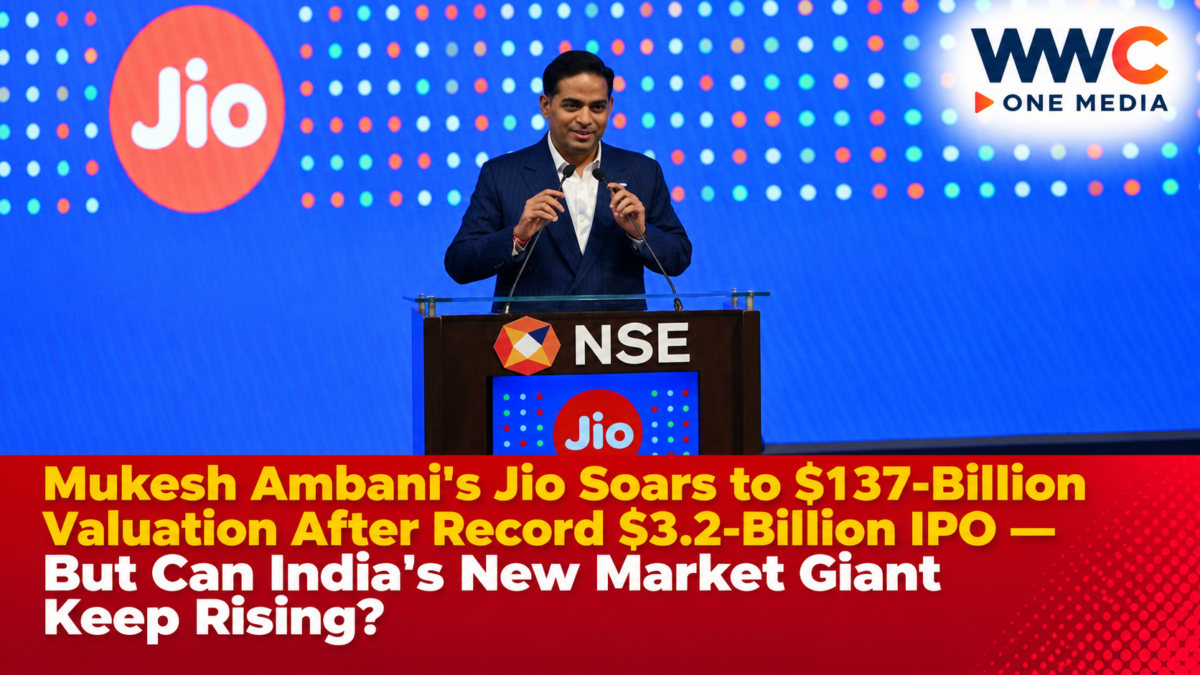
MUMBAI, India — October 30, 2026. Indian billionaire Mukesh Ambani has achieved one of the most remarkable stock market milestones in his business career after Jio Platforms made a spectacular Mumbai trading debut, soaring to a market valuation of approximately $137 billion and becoming India’s second-most valuable publicly listed company.
The telecommunications and digital technology giant raised approximately $3.2 billion through India’s biggest initial public offering, attracting intense investor demand despite volatile global financial markets.
Jio shares climbed nearly 27% above their IPO offer price on October 28, pushing the company past some of India’s biggest corporate names and cementing the Reliance conglomerate’s position at the top of the country’s business rankings.
The landmark listing also carried an emotional moment for Ambani, who was visibly moved as his three children—Akash, Isha and Anant—spoke about the family’s vision for the next generation of the Reliance empire.
But behind the celebrations lies a question that could determine whether investors are witnessing the beginning of another extraordinary growth story or the peak of an expensive market rally.
Can Jio justify a valuation comparable to major American telecommunications operators while expanding into artificial intelligence, cloud computing and digital services?
Jio’s $3.2-billion IPO rewrites Indian stock market history
Jio Platforms began trading on India’s stock exchanges on Wednesday, October 28, following a record-breaking public offering worth approximately ₹30,213 crore, equivalent to around $3.2 billion.
The company priced its shares at ₹1,119 apiece.
At the opening bell, Jio shares debuted at ₹1,358, representing a premium of approximately 21.4% over the offer price.
Investor enthusiasm continued throughout the session.
By the close, shares had reached ₹1,417.50, a gain of approximately 26.7% from the IPO price.
The rally lifted Jio’s market capitalization to approximately $137 billion, placing it second only to Reliance Industries among Indian listed companies at the time.
The achievement also made the offering particularly significant for the Ambani family.
It was the Reliance conglomerate’s first major stock market listing in approximately two decades.
For investors, the successful IPO provided a new way to own shares directly in the business that helped transform India’s telecommunications industry.
However, the rally also increased expectations for future earnings.
A strong opening day reflects investor demand and market sentiment, but it does not guarantee that shares will continue rising.
From $108 billion to $137 billion: How Jio’s valuation surged
Before its listing, Jio was already attracting extraordinary attention from institutional investors.
The offering had been priced at a valuation of roughly $107 billion to $108 billion, below earlier market expectations that had exceeded $150 billion.
The lower valuation helped make the IPO more attractive to investors seeking exposure to India’s rapidly expanding digital economy.
WWC ONE MEDIA covered the early offering in Mukesh Ambani’s $3.2-Billion Jio IPO Triggers $16-Billion Investor Frenzy — But Will Its $108-Billion Valuation Survive the Market Debut?.
That report examined the strong institutional demand and concerns about whether the company could sustain its proposed valuation.
By October 28, Jio had answered one question decisively: investors were prepared to pay substantially more than the IPO price during its first trading session.
However, the jump to a $137-billion valuation also meant that prospective buyers faced a more expensive entry point.
The gap between the IPO valuation and the post-listing market capitalization represents a change in market value, not additional cash raised by Jio through the IPO.
BlackRock and global investors help fuel the Jio frenzy
The offering attracted major global investment institutions.
Its institutional allocation generated intense demand from investors seeking exposure to Indian telecommunications and digital infrastructure.
Among the international names associated with the offering were BlackRock, Fidelity and major sovereign wealth investors.
The IPO attracted bids far exceeding the number of shares offered, underlining the market’s appetite for a business combining a huge telecommunications subscriber base with ambitions in artificial intelligence and cloud services.
WWC ONE MEDIA previously examined the buildup in Jio IPO Sparks $25-Billion Investor Frenzy as BlackRock and Global Giants Rush In — But Can Ambani’s $107-Billion Bet Deliver?.
The extraordinary demand helped establish Jio’s IPO as a major event in international capital markets.
But bids should not be confused with the actual funds raised.
Institutional investors can request allocations much larger than the available offering.
The company ultimately raised approximately $3.2 billion, not the total value of all investor applications.
Ambani’s emotional moment puts family succession in the spotlight
The market debut was also a symbolic occasion for the Ambani family.
Mukesh Ambani, chairman of Reliance Industries, was visibly emotional during the listing celebrations as his children discussed Jio’s journey and the long-term direction of the conglomerate.
His eldest son, Akash Ambani, serves as managing director of Jio Platforms and has become a central figure in the family’s telecommunications and digital strategy.
Isha Ambani and Anant Ambani also hold important leadership responsibilities within the wider Reliance business empire.
During the ceremony, the younger generation emphasized the importance of continuing the group’s growth and delivering value to investors.
Their remarks drew attention to Reliance’s succession plans.
The family is managing the transition of a conglomerate whose operations span energy, retail, telecommunications, entertainment and technology.
Jio’s public listing may make corporate governance and leadership continuity increasingly important.
Public shareholders will expect transparent disclosures, clear accountability and decisions that protect the interests of investors beyond the founding family.
However, the emotional ceremony does not establish that Mukesh Ambani has relinquished control or that a new group-wide succession structure has been finalized.
Reliance Industries remains Jio’s controlling shareholder.
Reliance and Jio become India’s two most valuable listed companies
Jio’s spectacular debut transformed India’s corporate market capitalization rankings.
Reliance Industries remained the country’s most valuable publicly traded company.
Its newly listed digital subsidiary immediately occupied second place.
The combination helped lift the wider Reliance conglomerate’s reported market capitalization to approximately $320 billion, overtaking the Tata Group when comparing the aggregated market values of listed companies.
The milestone is a major symbolic victory for the Ambani family.
But the financial interpretation requires care.
Because Reliance Industries owns a controlling stake in Jio, combining the market values of the parent and subsidiary can involve overlapping economic interests.
The aggregated market capitalization should therefore not be interpreted as a consolidated enterprise valuation or the total net worth of Mukesh Ambani.
It is a comparison of the market values of separately listed companies associated with the conglomerate.
The ranking also changes as share prices move.
Nevertheless, the listing demonstrates the enormous market value investors now place on Reliance’s technology and consumer-focused businesses.
More than 530 million customers underpin Jio’s business
Jio’s extraordinary valuation rests heavily on the size of its telecommunications network.
The company serves more than 530 million subscribers through its Indian telecom operations, making it the country’s largest mobile operator by customer base.
Since its commercial launch in 2016, Jio has reshaped the market through low-cost mobile services, extensive network investment and the rapid expansion of digital connectivity.
Its aggressive strategy helped accelerate smartphone adoption and mobile internet usage across India.
The business has also expanded into broadband, enterprise connectivity and digital technology services.
For investors, this scale creates opportunities for recurring revenue, customer retention and additional services.
However, subscriber numbers alone do not determine profitability.
The amount customers spend, the cost of serving them and the capital required to maintain the network are equally important.
Jio must continue demonstrating that its substantial customer base can generate sustainable earnings and cash flow.
Why $2.89 billion of IPO proceeds matters for debt reduction
One important element of Jio’s public offering is its planned use of proceeds.
According to Reuters, the company intends to apply up to approximately $2.89 billion of net IPO proceeds toward repaying borrowings associated with its telecommunications business.
Reducing debt could lower future interest expenses and improve financial flexibility.
That matters because telecommunications operations require substantial capital investment.
Mobile networks need towers, fiber-optic connections, spectrum rights, equipment and continuing upgrades.
Jio has invested heavily in its nationwide 5G network.
As that investment cycle becomes less intensive, analysts expect the company to have more opportunities to strengthen free cash flow.
However, debt repayment does not automatically guarantee stronger profits or higher dividends.
The company must still fund infrastructure maintenance, network expansion and its newer digital businesses.
Investors will be assessing whether reduced leverage translates into improved cash generation over subsequent reporting periods.
Google and Meta are among Jio’s strategic investors
Jio’s rise has attracted major international technology companies.
Meta Platforms and Alphabet’s Google invested in Jio Platforms in 2020 as part of a wider fundraising exercise that brought global financial and strategic investors into the business.
Google’s involvement supports Jio’s ambitions around digital services and the wider Android ecosystem.
Meta’s relationship reflects the importance of India’s enormous digital consumer market.
These investments have helped connect Jio with major global technology businesses.
However, backing from well-known companies does not guarantee the performance of Jio shares.
Investment outcomes depend on the company’s financial results, market conditions, valuation and execution of its business strategy.
Neither Google nor Meta should be described as having acquired control of Jio through the IPO.
Reliance Industries retained more than 64% ownership following the offering.
Artificial intelligence could become Jio’s next growth engine
Beyond telecommunications, Jio is seeking a larger role in India’s artificial intelligence industry.
Its strategy includes digital platforms, cloud infrastructure, enterprise technology and AI-related services.
These sectors could allow Jio to generate revenue beyond traditional mobile subscriptions.
The opportunity is significant because India has a large population of mobile internet users and a growing demand for digital business solutions.
However, AI infrastructure can require substantial investment in computing equipment, electricity, cooling systems and data centers.
Commercial success will depend on whether customers are willing to pay enough for those services to justify the costs.
Jio’s 530-million-plus telecommunications customer base gives it a potential distribution advantage.
But reaching a large number of users does not automatically mean that its AI products will generate significant profits.
Investors will be watching for measurable revenue contributions and operating results rather than relying solely on technology announcements.
Starlink could create another competitive threat
Jio also faces uncertainty over the future of satellite broadband in India.
Elon Musk’s Starlink is seeking to expand internet connectivity through low-Earth-orbit satellite technology.
Satellite services could reach communities that are difficult or expensive to connect through conventional mobile towers and fiber-optic networks.
Jio and rival Bharti Airtel have explored arrangements to distribute Starlink services in India.
At the same time, questions remain about spectrum policy, government approvals and the longer-term competitive implications of satellite connectivity.
WWC ONE MEDIA previously examined the issue in Elon Musk Accuses Indian ‘Oligarchs’ of Blocking Starlink — But Jio and Airtel Are Also Supposed to Help Sell It.
The potential competition demonstrates how quickly the telecommunications industry can evolve.
Even a dominant operator must continue investing in technology while responding to changing consumer expectations.
For Jio, maintaining market leadership may require balancing network expansion with profitability.
Is Jio becoming as valuable as American telecom giants?
At approximately $137 billion, Jio’s market capitalization reached a level comparable to major United States telecommunications businesses.
CNBC reported that AT&T was valued at approximately $139 billion and Verizon Communications at roughly $179 billion based on market data available at the time.
The comparison illustrates the scale of investor expectations surrounding Jio.
However, market capitalization alone does not establish that Jio generates the same revenue, earnings or free cash flow as its American peers.
Each company operates in different regulatory environments, serves different customer markets and faces different capital requirements.
India’s telecommunications market is also highly price-sensitive.
Increasing average revenue per user can support profitability, but price increases may affect customer demand and competition.
Analysts have warned that Jio’s valuation already incorporates substantial optimism.
The company’s future financial performance will therefore need to justify the expectations embedded in its share price.
What Jio’s IPO means for Asian technology stocks
Jio’s landmark listing also carries implications for Asian companies considering public offerings.
It demonstrates that large digital businesses can attract substantial international investor interest when they combine scale, recognizable brands and clear growth opportunities.
The development comes shortly after the Philippines celebrated its own record-breaking technology-related stock market debut.
GCash operator Mynt completed a public offering valued at up to ₱60.9 billion, including its overallotment option, and began trading on the Philippine Stock Exchange on October 20.
WWC ONE MEDIA covered the transaction in GCash’s Record ₱60.9-Billion IPO Draws BlackRock, Citadel and Global Investors — But the Real Test for Philippine Tech Begins Now.
The Jio and GCash offerings took place in different markets and involve companies with substantially different business models and valuations.
But both illustrate growing investor interest in large Asian digital platforms.
The successful capital raising also does not guarantee positive returns for investors who purchase shares after listing.
The long-term test remains earnings, cash generation and disciplined investment.
Investors now face a much more expensive Jio
Jio’s first-day surge created a striking contrast between the investors who received IPO allocations and those considering purchasing shares after the listing.
IPO investors acquired shares at ₹1,119.
By the end of October 28, the market price had reached ₹1,417.50.
That represents a paper gain of approximately 26.7% before transaction costs and taxes for investors who acquired shares at the offer price and continued holding them at the close.
Investors purchasing at higher prices face different potential returns and risks.
The share price may rise if Jio delivers strong earnings and sustains investor confidence.
But it may also fall if the company underperforms expectations or market sentiment changes.
For a company valued at more than $100 billion, seemingly modest changes in investor expectations can produce substantial movements in market capitalization.
The IPO’s success should therefore be evaluated separately from the investment performance of shares bought in secondary-market trading.
The bigger question: Can the Ambani empire sustain its digital transformation?
For Mukesh Ambani, Jio’s stock market debut represents another major chapter in the transformation of Reliance.
A conglomerate historically associated with oil refining, petrochemicals and energy now controls two of India’s most valuable listed companies, including a telecommunications and digital services giant with more than half a billion customers.
The listing also places the next generation of the Ambani family in a more visible leadership role.
But the successful IPO creates substantial expectations.
Jio must continue improving subscriber monetization, generate stronger free cash flow, manage its debt and demonstrate that newer digital businesses can deliver attractive financial results.
Its future growth will also depend on competition, regulation and the pace of technology investment.
The $3.2-billion IPO has made Jio a stock market sensation and helped propel the Reliance empire to the top of India’s corporate rankings. The challenge now is whether Jio can turn that extraordinary valuation into lasting financial performance—or whether the market has already priced in too much of Ambani’s digital ambitions.