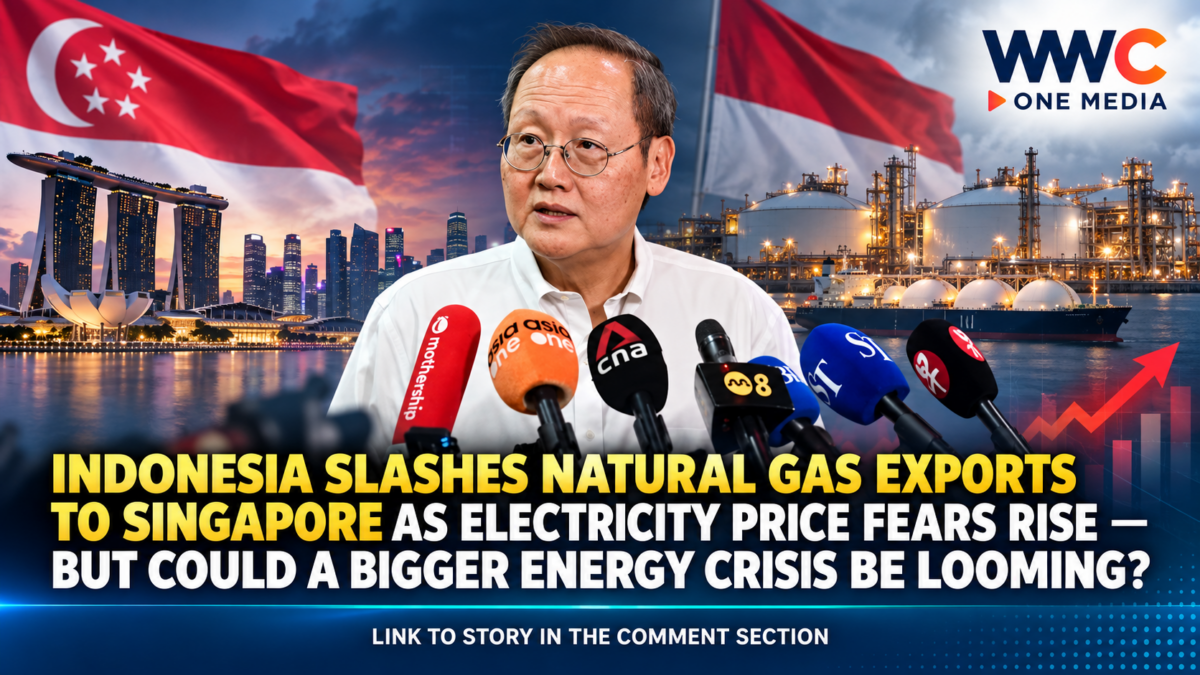
SINGAPORE | October 25, 2026 — Indonesia’s decision to reduce natural gas exports to Singapore has sparked fresh questions about electricity prices, energy security and the future of Southeast Asia’s cross-border energy trade. But Singapore’s government insists that households and businesses are unlikely to face a significant short-term price impact.
Minister for Energy, Trade and Industry (Energy and Industry) Tan See Leng said on Sunday that the city-state has sufficient replacement supplies and emergency measures to handle the reduction.
The reassurance followed Indonesia’s decision to redirect some natural gas previously destined for Singapore to meet its own electricity requirements, beginning Saturday, October 24.
Although the immediate disruption represents less than 2% of Singapore’s total daily gas demand, the development has brought renewed attention to the country’s heavy dependence on imported natural gas — and whether future disruptions could pose a greater challenge.
Indonesia Reduces Natural Gas Exports by 31 Million Cubic Feet Daily
Indonesia’s upstream oil and gas regulator, SKK Migas, confirmed that the country reduced pipeline gas exports to Singapore by approximately 31 million standard cubic feet per day.
According to Reuters, the reduction amounts to roughly 9% of Indonesia’s pipeline gas exports to Singapore.
The cuts affect two major supply sources:
- Natuna gas fields: 15 million standard cubic feet per day.
- Sumatra gas fields: 16 million standard cubic feet per day.
The redirected gas is intended to support domestic electricity requirements in Batam, Bintan and Sumatra.
Singapore’s Energy Market Authority (EMA) said the reduction amounts to about 17 billion British thermal units per day over an 18-day period, equivalent to less than 2% of Singapore’s total daily gas requirements.
For Indonesia, the decision reflects a growing emphasis on domestic energy security as President Prabowo Subianto’s administration seeks to ensure that local industries and electricity producers receive sufficient supplies.
Will Singapore Electricity Prices Increase?
Despite public concern surrounding the interruption, Tan said electricity prices should not change significantly in the immediate future because of this particular supply reduction.
Speaking after the People’s Action Party conference on October 25, he explained that international natural gas prices are a more important factor in determining electricity costs.
Singapore purchases significant quantities of natural gas under pricing arrangements linked to global energy benchmarks.
As a result, changes in international fuel markets can influence the country’s electricity costs even when physical gas supplies remain adequate.
This means the Indonesian reduction does not automatically translate into higher electricity bills.
However, sustained increases in global natural gas prices could eventually create additional cost pressures for electricity retailers, businesses and consumers.
The crucial distinction is that Singapore currently faces a manageable supply reduction, not a confirmed nationwide electricity shortage.
Singapore Activates Its Energy Security Safeguards
Singapore has spent years strengthening its natural gas supply system to reduce dependence on any single supplier.
According to Tan, the government maintains several safeguards, including access to international liquefied natural gas (LNG), standby import facilities and emergency fuel reserves.
Singapore GasCo is also operationally prepared to import additional LNG when necessary.
Power generation companies are required to maintain diesel reserves to support electricity production during significant gas supply interruptions.
These measures are intended to allow the country to replace disrupted pipeline imports without compromising electricity reliability.
Tan said Singapore has previously managed temporary gas supply reductions successfully.
The government therefore maintains that sufficient energy resources remain available to meet national demand.
Lawrence Wong Warns That Gas Supply Contracts Must Be Honored
Beyond the immediate supply situation, the reduction has raised questions about commercial obligations between Indonesian suppliers and Singaporean importers.
Prime Minister Lawrence Wong said on October 25 that parties involved in natural gas supply agreements are expected to fulfill their contractual commitments.
Singapore’s gas importer, Gas Supply Private Limited (GSPL), is examining the situation and may pursue contractual remedies if violations are established.
The company, which is wholly owned by Singapore’s investment company Temasek, has acknowledged that temporary reductions have affected deliveries to some customers.
However, a reduction in gas deliveries does not automatically establish a contractual breach.
The importer must first assess the terms of its agreements, including any provisions dealing with interruptions or changes in supply.
The issue could become commercially significant if disagreements emerge over delivery commitments, compensation or the duration of the disruption.
Why Indonesia Is Prioritizing Domestic Energy Needs
Indonesia’s decision comes as the government reviews how its natural gas resources should be distributed between international customers and domestic industries.
Indonesian Energy and Mineral Resources Minister Bahlil Lahadalia has indicated that the government intends to prioritize domestic demand and review energy export arrangements.
According to Indonesia’s Antara news agency, approximately 70% of the country’s natural gas production is consumed domestically, while around 30% is exported.
Jakarta is pursuing policies designed to strengthen its downstream industrial sector, including petrochemical production and other energy-intensive manufacturing activities.
The latest export reduction also follows electricity reliability problems in parts of Indonesia’s Riau Islands earlier in October.
These developments help explain why Jakarta views domestic energy availability as an increasingly important strategic priority.
Is the Gas Dispute Connected to Regional Haze Tensions?
The timing of the gas reduction has also attracted attention because Indonesia and its neighbors have recently faced tensions surrounding transboundary haze pollution.
AFP reported that the export cuts occurred amid disagreements linked to smoke from Indonesian forest and land fires affecting surrounding countries.
President Prabowo Subianto and other Indonesian officials have publicly criticized countries perceived as disrespectful toward Indonesia.
However, Singapore’s Tan See Leng did not conclude that the gas reduction was retaliation for comments about haze pollution.
He emphasized that Singapore and Indonesia maintain strong bilateral relations and acknowledged Indonesia’s domestic supply challenges.
There is currently insufficient verified evidence to establish that the gas cuts were imposed as punishment against Singapore.
The confirmed explanation from Indonesia’s upstream regulator is that the gas is being redirected toward domestic energy needs.
Why Singapore Remains Vulnerable to Global Gas Market Volatility
Natural gas generates approximately 95% of Singapore’s electricity, making it the dominant fuel in the city-state’s power system.
In 2025, approximately 43% of Singapore’s natural gas imports arrived through pipelines from Indonesia and Malaysia, while 57% came from overseas LNG suppliers.
This diversified structure gives Singapore flexibility when one source experiences a disruption.
Nevertheless, the country remains exposed to international energy prices because LNG is traded in a competitive global market.
Major supply disruptions, rising fuel demand or geopolitical tensions elsewhere could increase the cost of securing replacement gas.
The government is therefore working to diversify Singapore’s energy system beyond conventional natural gas.
Potential alternatives include solar power, biomethane, geothermal energy and regional electricity imports.
Singapore is also studying the feasibility of nuclear energy, although no decision has been made to adopt it.
Could Southeast Asia Face Bigger Energy Supply Problems?
The Indonesia-Singapore gas development highlights a broader challenge facing energy-importing economies across Asia.
As countries prioritize domestic industries and electricity security, the reliability of cross-border fuel arrangements may become increasingly important.
For Singapore, the immediate priority is maintaining uninterrupted energy deliveries while protecting its commercial interests.
For Indonesia, the challenge is balancing export obligations against expanding domestic energy requirements.
The situation also demonstrates why regional energy security involves more than simply obtaining enough fuel. Reliable contracts, infrastructure investment, international cooperation and diversified energy sources are equally important.
A prolonged or substantially larger reduction could put additional pressure on Singapore’s energy supply arrangements, although the present disruption is too small to establish that such an outcome is imminent.
What Happens Next?
Three developments will determine whether the situation remains a temporary operational challenge or evolves into a more significant commercial dispute.
First, authorities will monitor whether Indonesia maintains, reduces or expands the current export restrictions.
Second, Singapore’s gas importer will assess whether the supply changes violate existing contractual commitments.
Third, global natural gas price movements will remain an important factor in the electricity costs paid by Singapore’s consumers and businesses.
For now, Singapore’s government says there is no reason to expect a major immediate electricity price shock directly attributable to Indonesia’s latest gas reduction.
The bigger unanswered question is whether growing domestic energy demands across Southeast Asia could eventually test the long-term reliability of regional gas supply agreements.
For Singapore, the immediate supply challenge appears manageable. The longer-term task is ensuring that its electricity system can withstand disruptions regardless of where they originate.