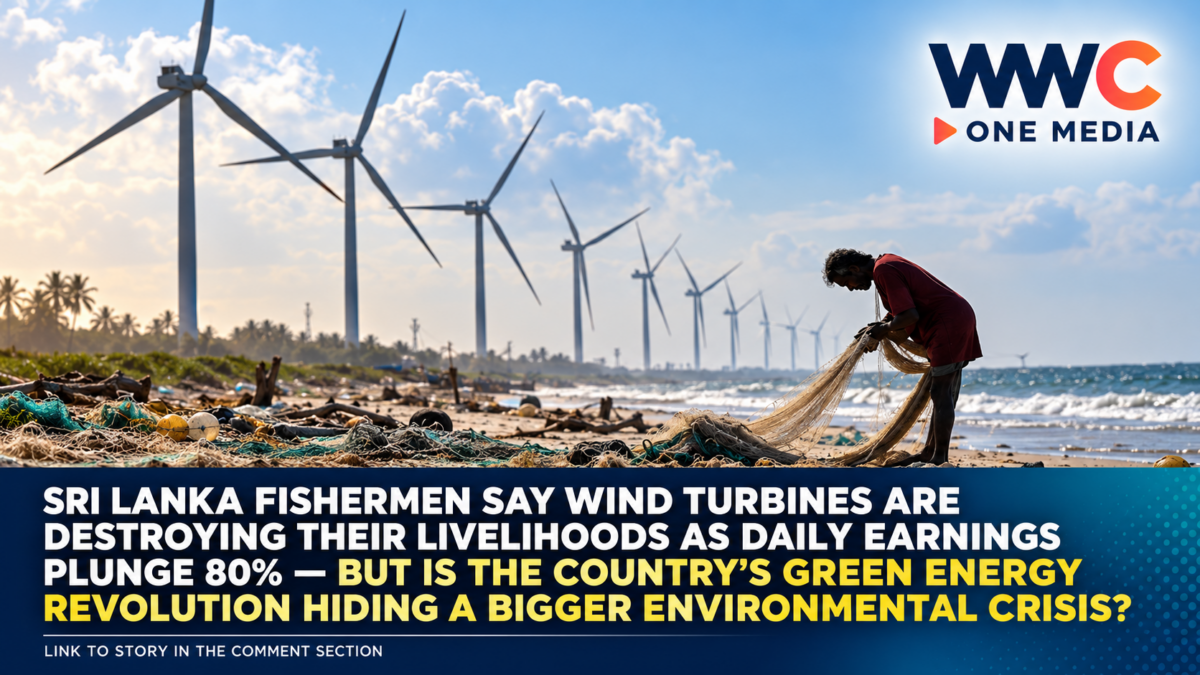
MANNAR, SRI LANKA — Sri Lanka’s ambitious renewable energy expansion is facing growing resistance after fishing families on the Mannar peninsula reported shrinking catches, falling incomes and recurring floods that they fear are linked to a major coastal wind power project.
The controversy centres on the Thambapavani wind farm, whose first phase began operating in 2020 with 30 turbines generating a combined 104 megawatts. Although the project supports Sri Lanka’s clean energy goals, residents say its development has raised serious questions about the protection of coastal livelihoods.
Fishermen report dramatic income losses
According to an AFP report carried by Channel NewsAsia on October 25, fishing cooperative leader A. Stanislas Peries said some fishermen previously earned up to 5,000 Sri Lankan rupees per day but now struggle to earn more than 1,000 rupees.
That comparison represents an approximately 80% decline in reported daily earnings, although the figures are not a verified regional average.
Longtime fisherman Venkatasamy Kalimuththu, 65, believes fish are staying away from the shoreline because of shadows cast by rotating turbine blades. However, he acknowledges that he has no scientific evidence establishing a causal connection. Fishermen also cite competition from Indian trawlers.
Flooded villages raise further concerns
Residents have raised separate concerns about flooding. Benedict Mary Vijiliya, a local women’s community leader, alleges that infrastructure associated with turbine construction has interfered with natural drainage.
She reports damaging floods, overflowing toilets and problems with household well water.
These concerns predate the latest report. The Hindu reported in August 2026 that Mannar residents feared adverse effects from renewable energy expansion, including reduced fishing catches, noise and recurring flooding.
Sri Lanka’s Sunday Times documented similar complaints and opposition to the project’s expansion in 2025.
Court battle puts environmental safeguards under scrutiny
The legal dispute has also intensified.
According to the Daily FT on October 19, 2026, Sri Lanka’s Court of Appeal allowed a challenge by the Wildlife and Nature Protection Society to proceed.
The organisation alleges that aspects of the wind farm extension breach environmental safeguards, including restrictions intended to protect bird populations. Those allegations remain subject to judicial consideration.
Government weighs energy goals against local opposition
Sri Lanka’s government has acknowledged community concerns.
Energy Minister Anura Karunathilaka said authorities were studying possible responses to flooding and had pledged to proceed in Mannar only with projects already approved.
Construction on another 14 turbines had begun, according to AFP. An earlier 52-turbine project awarded to India’s Adani group was cancelled in 2025 following a dispute over electricity pricing.
Are wind turbines really causing the declining catches?
The wider decline in fishing catches remains a scientific question.
In August 2026, Deputy Fisheries Minister Rathna Gamage said the National Aquatic Resources Research and Development Agency had been directed to examine changing fish populations and habitats.
Possible factors raised included warmer seas, pollution, changes in ocean conditions and unsustainable fishing practices. That broader inquiry does not establish that Mannar’s wind turbines caused the reported losses.
A national clean energy ambition faces a local test
Sri Lanka aims to generate 70% of its electricity from renewable sources by 2030, making wind energy important to its efforts to reduce dependence on expensive imported fuels.
But the dispute on Mannar highlights a difficult challenge: how to develop cleaner power without leaving fishing communities, farmers and coastal residents carrying unaddressed costs.
For Mannar’s residents, the key questions are whether authorities will independently investigate the causes of falling catches and flooding, enforce environmental safeguards and deliver effective remedies.
Until those answers emerge, the conflict between renewable energy development and local livelihoods is likely to continue.