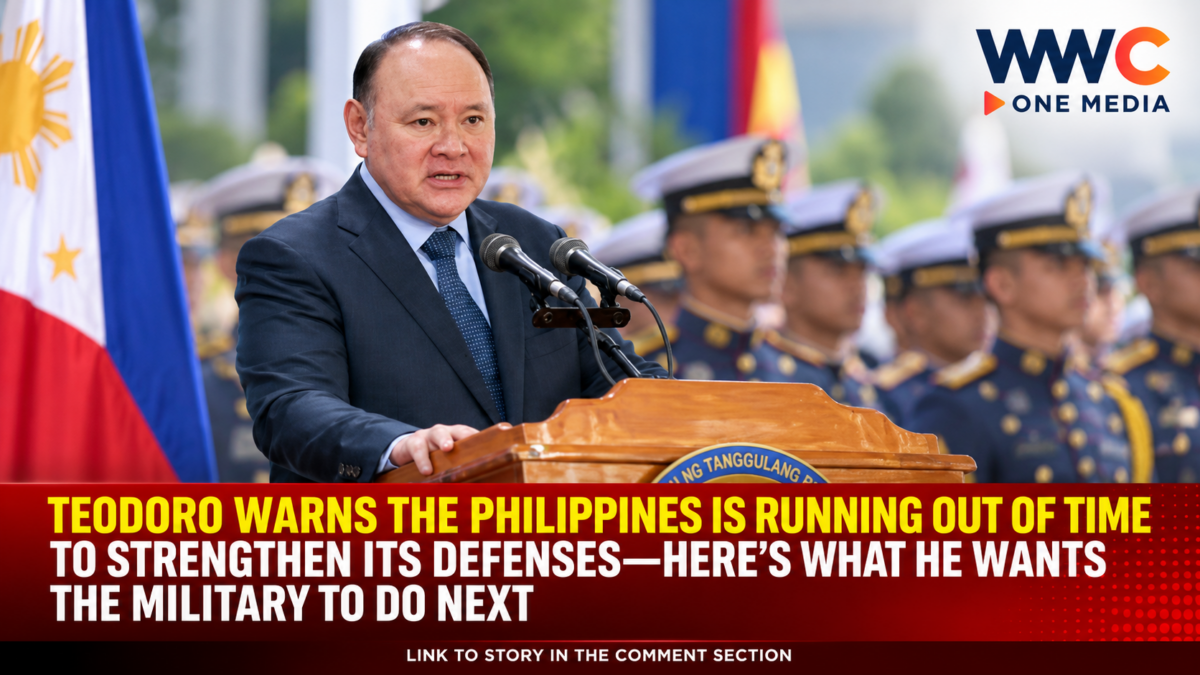
BAGUIO CITY, Philippines — Defense Secretary Gilberto Teodoro Jr. has challenged future military leaders to reject defeatism and pursue more ambitious national defense plans, warning that the Philippines cannot afford to move slowly while security threats continue to evolve.
Speaking at the Philippine Military Academy’s (PMA) 128th founding anniversary on October 24, 2026, Teodoro emphasized that the country must accelerate efforts to strengthen its military capabilities, protect its sovereignty, and enforce its laws across its vast maritime domain.
His message was direct: the Philippines must become more ambitious and move faster in preparing for present and future security challenges.
Teodoro argued that ambitious national security plans should have been implemented years ago, but the country must now make up for lost time by accelerating its efforts.
He warned that the Philippines cannot afford a passive or overly conservative approach when its territory and sovereignty are at stake.
Why Teodoro Wants the Philippines to Move Faster
The defense chief’s remarks reflect the growing urgency surrounding the country’s military modernization and its efforts to strengthen external defense capabilities.
The Philippines faces a changing regional security environment, particularly in the South China Sea, where tensions with China have repeatedly raised concerns about maritime rights, territorial security, and the country’s ability to protect its interests.
Teodoro stressed that the Philippines must improve its ability to operate across a vast maritime area while adapting to emerging technologies, new operational domains, and the growing use of information as a tool of conflict.
He also emphasized that the military must be capable of anticipating threats rather than simply reacting to them.
For the PMA, this means preparing cadets to become officers who can lead under rapidly changing conditions, make informed decisions, and help build a more capable Armed Forces of the Philippines (AFP).
PMA’s Role Goes Beyond Training Soldiers
Teodoro underscored the importance of the Philippine Military Academy in producing academically competent graduates and mission-ready officers.
He described the academy as a specialized institution responsible for providing a world-class education while preparing future military leaders for operational responsibilities.
The defense chief distinguished education from training: education develops knowledge and understanding, while training equips personnel with the practical skills required to perform their duties.
Both, he argued, are essential to building a professional and effective military organization.
The PMA must therefore continue adapting its educational programs to meet the demands of modern warfare, including technological advances, complex security threats, and the challenges of leading organizations through rapid change.
The goal is to produce officers who can think strategically, respond effectively, and help the military maintain its readiness in an increasingly uncertain environment.
The Modernization Challenge: Ambition Must Be Backed by Funding
Teodoro’s call for faster and more ambitious defense planning comes as the government confronts the financial and technological challenges of modernizing the AFP.
In August 2026, GMA News reported that the Department of National Defense was seeking approximately ₱126.97 billion for AFP modernization requirements in 2027, significantly more than the ₱50 billion allocated for the program under the proposed 2027 National Expenditure Program.
The additional requirement reflects existing contractual obligations and priority new acquisitions, highlighting the gap between the military’s modernization needs and the proposed funding.
The defense department has also emphasized the importance of information technology, cybersecurity, and command-and-control systems. Modern military readiness depends not only on acquiring ships, aircraft, and other equipment, but also on integrating those assets into an effective operational network.
In separate reporting in August, Philstar’s Interaksyon, citing Reuters, reported that the Philippines was looking to expand its unmanned capabilities, including drones, while pursuing additional major defense assets to improve external defense.
These developments illustrate a central challenge facing the government: translating ambitious defense objectives into funded programs, modern equipment, capable personnel, and sustainable operational readiness.
Protecting the Philippines’ Maritime Interests
Teodoro’s remarks also align with the country’s broader shift toward strengthening external defense.
The Philippines is an archipelago with extensive territorial waters and an exclusive economic zone. Protecting its maritime interests requires coordination among naval, air, land, intelligence, and cyber capabilities.
In an October 22 report, the BusinessMirror covered Teodoro’s directive for the AFP to expand its operational footprint across the country and develop a credible, sustainable deterrent posture.
The report highlighted the Comprehensive Archipelagic Defense Concept, a strategy intended to improve the country’s ability to defend its territory and maritime interests through coordinated capabilities across multiple operational domains.
Such efforts are particularly significant amid continuing tensions in the West Philippine Sea and the wider South China Sea.
A stronger defense posture is intended to improve the country’s ability to monitor its maritime domain, respond to security incidents, enforce Philippine laws, and deter potential threats.
The Message to Future Military Leaders
Beyond weapons and budgets, Teodoro placed responsibility on the people who will lead the AFP in the coming years.
He called on cadets and academy leaders to remain focused on their mission and understand the responsibilities that come with military service.
His appeal to reject defeatism was a call for confidence, ambition, and a willingness to confront difficult national security challenges rather than accept existing limitations as permanent.
The challenge, however, extends beyond the PMA. Building a credible defense force requires sustained government investment, effective planning, technological adaptation, professional military education, and the ability to turn policy commitments into real capabilities.
Teodoro’s message at the academy’s anniversary underscored the urgency of that task.
For the Philippines, the question is no longer simply whether stronger defenses are necessary. It is how quickly the country can develop and sustain the capabilities needed to protect its sovereignty in a rapidly changing security environment.