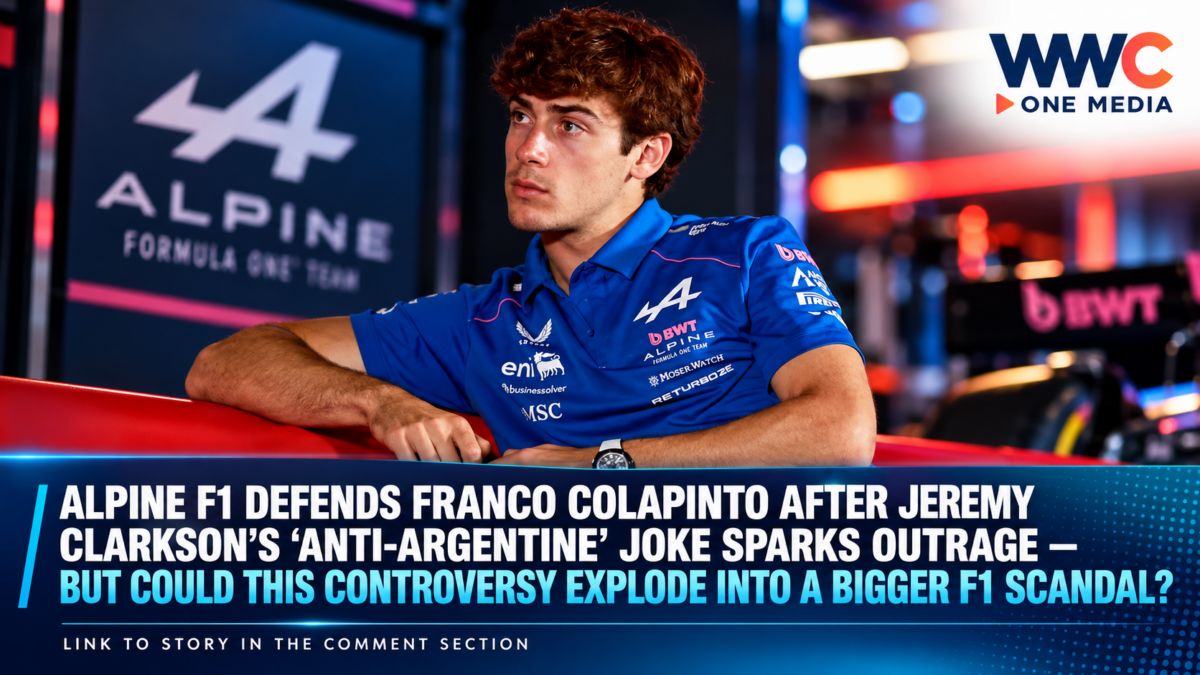
AUSTIN, TEXAS — October 25, 2026 — Formula One has been thrust into a fresh controversy after British television personality and former Top Gear host Jeremy Clarkson made a joke about Argentine racing driver Franco Colapinto’s nationality, prompting an immediate defense from the Alpine F1 Team and criticism from the driver’s management.
What began as a lighthearted television interview ahead of the 2026 United States Grand Prix has reignited a decade-old dispute involving Clarkson and Argentina, raising questions about respect, national identity and the responsibilities of prominent personalities in international motorsport.
The controversy erupted on Saturday, October 24, at the Circuit of the Americas in Austin, where Clarkson was attending the race weekend as a guest of Alpine.
Clarkson’s Argentine Joke Sparks Backlash
During a live appearance on Sky Sports F1, Clarkson was discussing Alpine’s prospects when the conversation turned to Colapinto’s grid penalty for Sunday’s United States Grand Prix.
Clarkson suggested that the Argentine driver deserved a penalty simply because of his nationality.
He then referred to his previous experience filming in Argentina, linking the remark to a controversial Top Gear episode in 2014.
The comments quickly attracted criticism, particularly among Argentine motorsport supporters, who considered the joke inappropriate and disrespectful.
The incident was especially awkward for Alpine because Clarkson was attending the event as the team’s guest.
Alpine Breaks Silence and Backs Its Driver
Facing questions over the televised remarks, Renault-owned Alpine issued a statement distancing itself from Clarkson’s comments.
The team stressed that the remarks reflected the guest’s personal opinions rather than Alpine’s position or values.
Alpine emphasized its commitment to kindness and respect, declaring that Colapinto continued to enjoy the organization’s full support.
The statement was significant because it publicly rejected the sentiment behind the comments without explicitly naming Clarkson.
For Alpine, the response also demonstrated the delicate balance between welcoming high-profile celebrity guests and protecting its drivers from inappropriate public commentary.
The Real Reason Colapinto Received a 10-Place Grid Penalty
Despite Clarkson’s joke, Colapinto’s actual grid penalty had nothing to do with his nationality.
The Argentine driver was handed a 10-place grid drop for the October 25 United States Grand Prix following changes to regulated power-unit components.
Additional motorsport reporting identified the relevant change as the introduction of a fourth control electronics unit during the 2026 season.
Formula One imposes grid penalties when teams exceed permitted allocations of specified technical components.
Such penalties are determined under sporting regulations, not a driver’s background or citizenship.
The sanction added another challenge to Colapinto’s race weekend at the Circuit of the Americas, where he faced the prospect of battling through the field.
Why Clarkson’s 2014 Argentina Controversy Matters
Clarkson’s reference to Argentina carried historical baggage.
In 2014, the television presenter and his Top Gear colleagues traveled to Patagonia to film an episode of the popular British motoring program.
During the production, Clarkson drove a Porsche bearing a registration plate that some Argentines interpreted as a reference to the 1982 Falklands War.
The Falkland Islands, known in Argentina as the Malvinas, remain the subject of a longstanding sovereignty dispute between Britain and Argentina.
The incident triggered protests and forced the production team to leave the area amid escalating tensions.
Clarkson and the show’s representatives maintained that the controversial registration plate had not been deliberately selected to provoke Argentina.
More than a decade later, his remarks about Colapinto have brought that episode back into the spotlight.
Colapinto’s Manager Condemns Remarks
Colapinto’s manager, Jamie Campbell-Walter, publicly criticized Clarkson’s remarks, arguing that jokes targeting a driver’s nationality have no place in Formula One.
He emphasized that respect should apply equally to everyone associated with the championship, from competitors and team personnel to influential visitors.
His response highlighted a broader concern: prominent figures can amplify harmful attitudes even when comments are framed as humor.
The criticism also comes during a period when Colapinto’s team has been trying to discourage online hostility surrounding the Argentine driver’s performances.
Alpine Already Facing Online Abuse Concerns
The Clarkson controversy did not emerge in isolation.
Colapinto has repeatedly urged supporters to stop directing abusive messages toward rival drivers, teammates and members of his own team.
Earlier during the Austin race weekend, he acknowledged that criticism had crossed acceptable boundaries, revealing that mechanics and engineers working to support him had received hostile messages.
The problem had already become serious enough for Alpine to speak out against online abuse following an incident involving Colapinto, teammate Pierre Gasly and McLaren driver Lando Norris at the Azerbaijan Grand Prix in September.
That collision sparked heated debate on social media and prompted Alpine to defend those involved from personal attacks.
The latest incident places renewed attention on the distinction between legitimate sporting criticism and comments that attack individuals because of their identity.
A Wider Question for Formula One
Formula One has increasingly positioned itself as a global entertainment and sporting championship, attracting audiences from different cultures and nationalities.
Celebrity appearances are now a familiar feature of Grand Prix weekends, bringing additional visibility to drivers, sponsors and teams.
However, Clarkson’s comments illustrate the reputational risks that can arise when celebrity humor crosses cultural or national boundaries.
For Alpine, the immediate priority is ensuring that Colapinto remains focused on racing rather than being distracted by controversy.
For Clarkson, the incident adds another chapter to his complicated history with Argentina.
And for Formula One, it raises an important question about the standards expected of public figures who participate in the sport’s international spotlight.
What Happens Next?
As the United States Grand Prix approaches, Colapinto faces two very different challenges: recovering from his technical grid penalty and navigating an unwanted controversy that has attracted international attention.
Alpine has made its position clear by backing its Argentine driver and rejecting the remarks.
What remains uncertain is whether the criticism will fade after the race weekend or fuel a wider discussion about nationality, humor and respect in Formula One.
One thing is certain: the headlines surrounding Colapinto are no longer just about his performance on the racetrack.