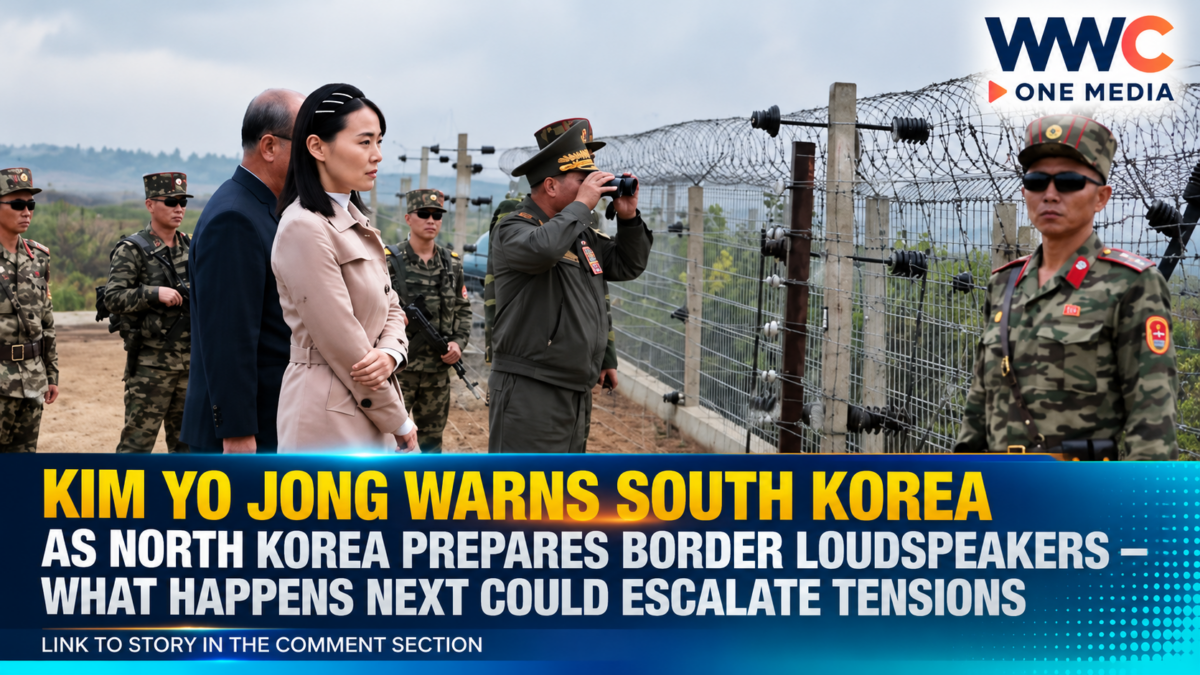
North Korea is preparing to resume anti-South Korea propaganda broadcasts along the heavily fortified border, with Kim Yo Jong, the sister of leader Kim Jong Un, warning that Pyongyang will respond forcefully if it believes its territory or troops are threatened.
In statements reported by North Korean state media, Kim said loudspeakers used for psychological warfare against South Korea would be operational along the entire border before the end of October. She also said North Korean tactical units were moving into new positions as the country strengthened its frontier defenses.
The announcement, reported by Reuters and The Associated Press on October 21 and 22, respectively, marks another escalation in tensions between the neighboring countries, whose relations have deteriorated despite recent efforts by Seoul to promote dialogue.
Kim warned that South Korean warning shots could provoke a severe response if they caused actual harm to North Korean territory or military personnel.
South Korea, meanwhile, has said it would take proportionate measures in response to developments along the border.
North Korea’s loudspeaker threat raises tensions
Propaganda loudspeakers have long been used by both Koreas as a form of psychological warfare. The broadcasts can include political messages, criticism of the opposing government and other material intended to influence people across the border.
The two countries have periodically activated the systems during periods of heightened hostility, turning the border into an arena for psychological pressure without direct combat.
South Korea suspended its own loudspeaker broadcasts after President Lee Jae Myung took office in 2025, as his administration pursued measures intended to reduce tensions with Pyongyang.
North Korea subsequently stopped its own broadcasts, but Kim’s latest announcement threatens to reverse that de-escalation.
The planned reactivation could also increase anxiety among communities living near the Demilitarized Zone, where earlier loudspeaker campaigns and other cross-border tactics have disrupted daily life.
Land-mine explosions add to the confrontation
The latest warning follows a series of incidents involving border fortifications and land-mine explosions.
South Korea has blamed North Korean-planted mines for explosions on September 21 that injured three South Korean soldiers. Seoul has called on Pyongyang to acknowledge responsibility and address the danger posed by remaining mines.
North Korea has denied responsibility for the explosions and rejected South Korean allegations concerning its troops’ movements across the Military Demarcation Line.
Seoul has said its forces fired warning shots when North Korean soldiers working on border fortifications crossed the line. South Korean military officials have reported approximately 50 such crossings this year.
Pyongyang disputes Seoul’s account and has accused the South of using the allegations as a pretext for hostile actions.
The competing claims have made it more difficult for either side to ease tensions, with each government portraying its own military actions as defensive.
Kim Yo Jong delivers another warning
Kim Yo Jong has become one of the most prominent voices articulating North Korea’s policy toward South Korea and the United States.
Her latest statements emphasized that North Korean troops were prepared to respond if South Korean actions threatened their safety or sovereignty.
North Korea has also continued reinforcing the border with mines, barbed-wire fences and anti-tank barriers, presenting the work as part of a broader effort to make the frontier more secure.
The fortification campaign reflects Kim Jong Un’s increasingly hard-line approach toward Seoul. North Korea’s leader has declared South Korea a hostile adversary and moved away from the long-standing official goal of peaceful reunification.
The renewed loudspeaker threat therefore comes amid a broader political freeze, rather than an isolated dispute over military procedures.
South Korea says it will respond proportionately
South Korean officials have expressed concern over Pyongyang’s announcement.
Defense Ministry spokesperson Chung Binna said Seoul would take proportionate measures in response to North Korea’s actions, although officials did not immediately detail what those measures might involve.
South Korea’s military leadership has also stressed the need to respond firmly to potential provocations.
The challenge for Seoul is balancing deterrence with its stated interest in preventing another cycle of retaliation.
If both countries restore their psychological-warfare broadcasts and increase military readiness, even a localized border incident could become more difficult to contain.
However, the announcement does not by itself establish that armed conflict is imminent. The immediate concern is the deterioration of trust and the possibility that confrontational actions could trigger further responses.
What happens next?
North Korea’s plan to reactivate its loudspeakers before the end of October will be an important development to watch. Whether the systems are deployed across the entire border, and how South Korea responds, could shape the next phase of tensions.
The broader risks extend beyond loudspeakers. Border fortifications, disputed troop movements, land mines and increasingly hostile political rhetoric have all contributed to an atmosphere in which misunderstandings could carry serious consequences.
For South Korean border communities, a return to propaganda broadcasts could mean renewed noise and psychological pressure. For both governments, it presents another test of whether deterrence can be maintained without triggering a wider confrontation.
Will North Korea’s loudspeaker campaign remain a psychological-warfare tactic, or will the latest threats push the two Koreas into another dangerous cycle of escalation?
For now, both sides remain at odds over the events driving the confrontation, and the next moves along the border could prove decisive.