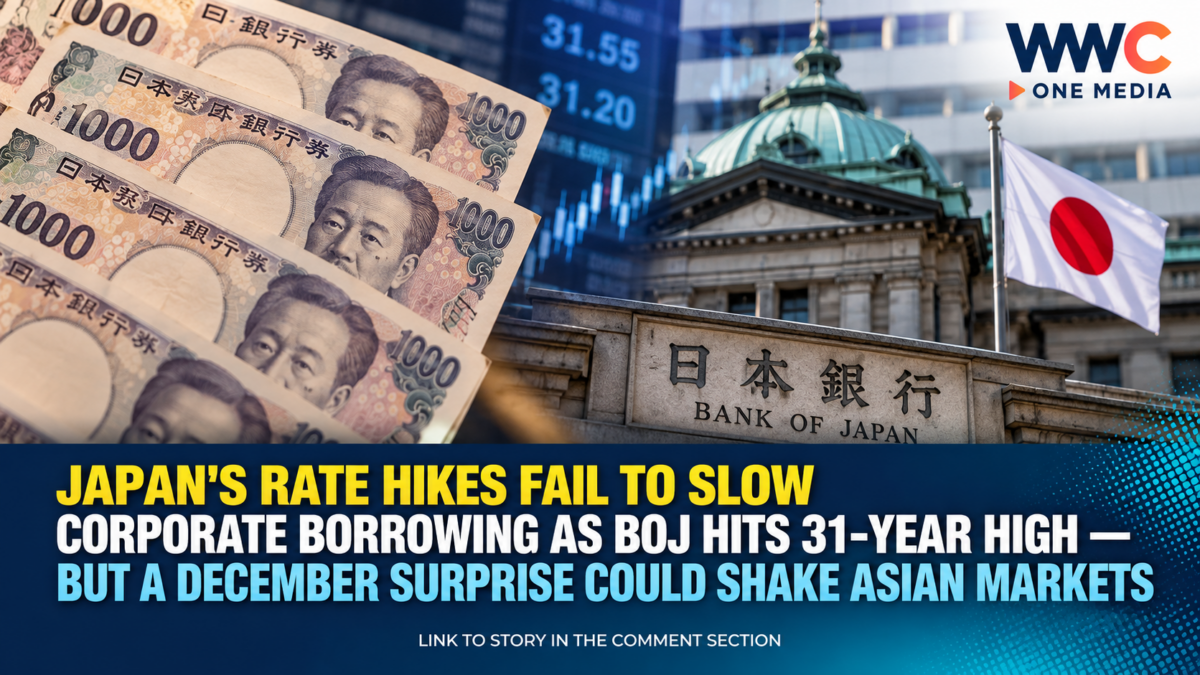
TOKYO, JAPAN — Japan’s economy is showing surprising resilience to rising borrowing costs, with a new Bank of Japan survey revealing that corporate demand for funds has increased despite the central bank lifting interest rates to their highest level in 31 years.
The findings, released on Thursday, October 22, 2026, suggest that the Bank of Japan’s monetary tightening campaign has yet to meaningfully restrict access to financing for Japanese businesses.
According to the survey, major Japanese lenders reported stronger demand for corporate loans compared with three months earlier, indicating that businesses continue to seek financing for operations, expansion and investment.
The development comes after the Bank of Japan raised its benchmark policy rate to 1.25% on September 18, as policymakers sought to prevent inflation from exceeding the central bank’s 2% target.
But the latest data create a difficult question for Japan’s monetary authorities: If businesses are still borrowing freely despite higher rates, will the Bank of Japan need to tighten monetary policy further?
The answer could have implications for the Japanese yen, Asian financial markets, government bond yields and investment flows across the region.
Corporate Loan Demand Rises Despite Higher Interest Rates
The Bank of Japan’s quarterly survey of senior loan officers was conducted between September 9 and October 13.
The results showed that a key diffusion index measuring changes in corporate funding demand rose to +3, compared with -1 three months earlier.
A positive reading means that more surveyed banks reported rising corporate demand for financing than reported falling demand.
The improvement suggests that Japan’s lending environment remains relatively accommodative, even after successive interest-rate increases.
However, the index is a measure of banks’ assessments of the direction of loan demand, not a direct measurement of the percentage increase in borrowing or the total value of new corporate loans.
The distinction matters because a move from -1 to +3 does not mean corporate borrowing increased by four percent.
Rather, it indicates a modest but meaningful improvement in the balance of lenders reporting stronger demand.
Bank of Japan’s 1.25% Rate Marks a Major Monetary Shift
Japan spent decades maintaining exceptionally low interest rates in an effort to combat weak demand and persistent deflationary pressures.
That policy environment is changing.
On September 18, the Bank of Japan increased its benchmark policy rate to 1.25%, the highest level in approximately 31 years.
The central bank is increasingly focused on ensuring that inflation does not remain above its target for an extended period.
Higher interest rates typically make borrowing more expensive, potentially slowing investment, consumer spending and economic growth.
Yet Japan’s latest lending survey suggests that the effects of previous rate increases have not fully restrained corporate demand for credit.
For policymakers, this could indicate that monetary conditions remain supportive enough to accommodate additional tightening if inflation risks persist.
What Is a Neutral Interest Rate — and Why Is It Important?
The Bank of Japan is closely monitoring financial conditions to determine how far its current policy rate is from the economy’s so-called neutral interest rate.
A neutral interest rate is the level at which monetary policy neither significantly stimulates nor restrains economic activity.
When interest rates are below the neutral level, financing conditions may continue encouraging borrowing and investment.
When interest rates rise above that level, financing can become restrictive enough to slow demand and inflation.
The challenge is that the neutral rate cannot be observed directly.
Central banks estimate it using economic data, inflation expectations, financial conditions and models of underlying economic activity.
The latest loan survey is therefore one piece of evidence that the Bank of Japan can use to assess whether its policy remains accommodative.
But one survey alone cannot establish precisely how much further interest rates need to rise.
BOJ Deputy Governor Signals More Rate Hikes May Be Needed
The loan data followed remarks by Bank of Japan Deputy Governor Ryozo Himino on October 21.
Speaking in parliament, Himino said that underlying inflation was approaching the central bank’s 2% target, while real borrowing costs remained low.
He also pointed to continued growth in bank lending as evidence that monetary conditions were still accommodative.
Himino warned that delaying necessary interest-rate adjustments could allow inflationary pressures to become more entrenched.
His remarks reinforced expectations that the BOJ could increase rates again before the end of 2026.
However, the deputy governor’s comments were a policy signal, not an announcement that another hike had already been approved.
AI Boom and Semiconductor Demand Add Pressure to Japan’s Economy
Japan’s economic outlook is also being influenced by expanding global investment in artificial intelligence.
Demand for semiconductors, advanced electronics and related manufacturing equipment has supported parts of the country’s export and industrial sectors.
The AI investment boom can strengthen business confidence and encourage companies to invest in new facilities, technology and equipment.
But stronger demand can also place upward pressure on costs, particularly when capacity is limited.
This creates another challenge for the Bank of Japan.
Healthy corporate investment supports economic growth, but policymakers must assess whether it is contributing to inflation that could remain above target.
Deputy Governor Himino specifically identified strong global AI demand as one factor supporting exports and capital expenditure.
Japan’s Latest Business Survey Sends Mixed Signals
The October 22 financing report follows the Bank of Japan’s Tankan business confidence survey released earlier this month.
That survey found improving sentiment among large Japanese manufacturers, supported partly by strong semiconductor-related demand.
Confidence among large manufacturers climbed to +24, its highest level since March 2018.
However, sentiment among large non-manufacturers slipped from +37 to +35.
The contrast illustrates the uneven condition of Japan’s economy.
Some manufacturers are benefiting from international technology demand, while other businesses continue facing higher operating expenses and uncertainty over consumer spending.
The October loan survey adds another piece to that picture: despite higher interest rates, the financing environment has not tightened sharply.
Will the Bank of Japan Raise Rates in December?
Financial markets are increasingly focused on the possibility of another interest-rate hike before the end of the year.
A Reuters poll published October 20 found that nearly 70% of surveyed economists expected the central bank to raise its benchmark rate to 1.50% in December.
Some forecasters also anticipate the policy rate reaching approximately 2.00% by mid-2027.
These are economist forecasts, not official Bank of Japan commitments.
The BOJ’s next policy decision is scheduled for October 30, when economists generally expect rates to remain unchanged.
Officials may nevertheless revise their inflation outlook and offer additional guidance about future tightening.
A weaker yen or renewed increases in import prices could also influence the timing of future decisions.
Why the Japanese Yen Matters
Interest-rate decisions can influence demand for the Japanese yen.
All else being equal, higher Japanese rates can make yen-denominated assets more attractive relative to currencies with lower risk-adjusted returns.
Changes in the interest-rate gap between Japan and other major economies can also affect borrowing and investment strategies.
One important example is the yen carry trade, in which investors borrow in relatively low-interest-rate yen and invest in higher-yielding assets elsewhere.
A significant rise in Japanese funding costs can change the economics of those strategies and contribute to financial-market volatility.
However, the yen does not necessarily strengthen after every rate hike.
Exchange rates are also influenced by global risk sentiment, trade flows, expectations for other central banks and developments in Japan’s economy.
Energy Prices and Inflation Remain Major Risks
Japan is heavily dependent on imported energy, making its economy sensitive to developments in international oil and natural gas markets.
Higher energy costs can increase transportation expenses, production costs and household bills.
A weaker yen can compound these pressures by making imported commodities more expensive in local-currency terms.
Reuters reported on October 20 that Bank of Japan officials were considering raising their inflation forecast as oil prices remained elevated.
The central bank must therefore balance two competing risks: tightening too quickly and damaging economic activity, or acting too slowly and allowing inflation to persist.
What the Findings Mean for Asia and the Philippines
Japan is a major investor and trading partner across Southeast Asia.
Its monetary policy can influence international bond markets, currency movements and investment decisions.
For the Philippines, changes in Japanese financing conditions may be relevant to Japanese-funded infrastructure projects, manufacturing investment and companies with yen-denominated obligations.
A stronger yen could increase the peso value of some yen-denominated payments, while higher Japanese interest rates could affect the cost of new borrowing.
However, the impact depends on financing contracts, exchange rates, hedging arrangements and broader market conditions.
The latest BOJ survey does not establish that Philippine interest rates will rise or that Japanese investments in the Philippines will decline.
The Bigger Question: How Much Tightening Is Enough?
The latest findings reinforce the Bank of Japan’s central challenge.
After decades of ultra-low interest rates, Japanese businesses are adapting to a more normal financing environment.
The central bank has raised rates, but credit demand remains relatively strong.
That suggests policymakers may have room for additional tightening, although the appropriate timing and scale remain uncertain.
The October 30 policy meeting and economic data released over the coming weeks will help determine whether the BOJ maintains its current approach or signals a faster path toward higher rates.
The bottom line: Japan’s corporate borrowing environment remains accommodative despite the Bank of Japan’s September increase to 1.25%. A rise in banks’ loan-demand diffusion index from -1 to +3 strengthens the case that previous hikes have not significantly restricted financing. But another rate increase remains a possibility, not a confirmed decision.