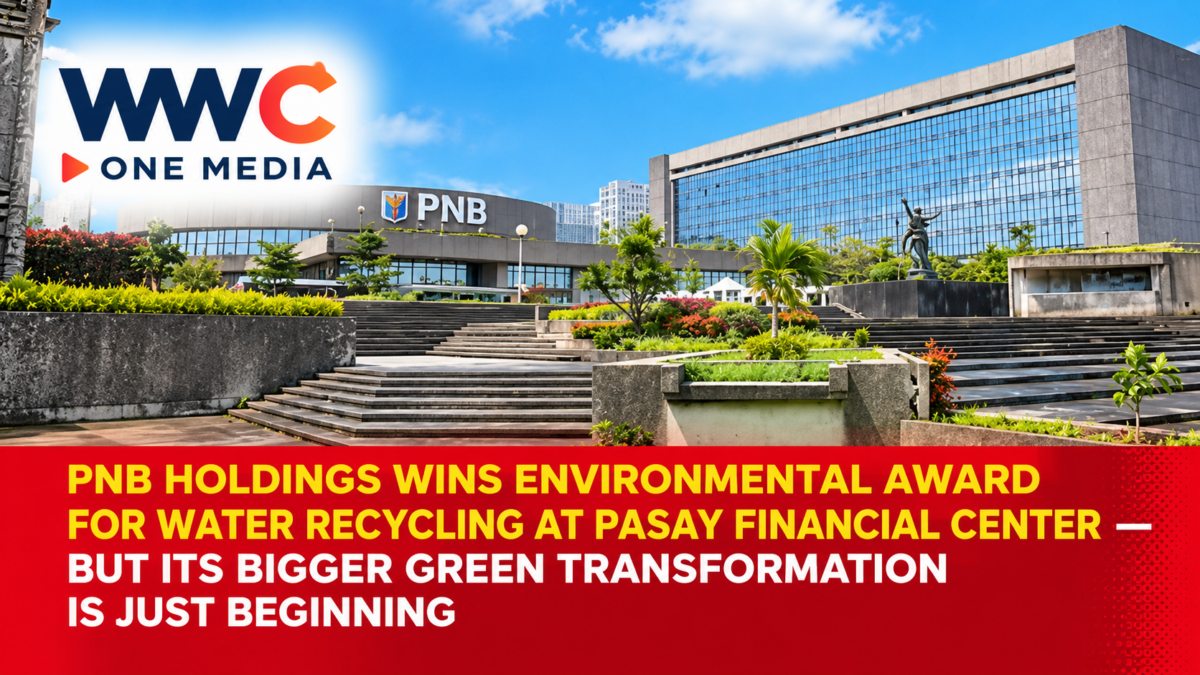
MANILA, PHILIPPINES — PNB Holdings Corporation is strengthening its position in sustainable property management after receiving environmental recognition for a wastewater recycling initiative at its flagship PNB Financial Center in Pasay City.
The property company, associated with the Lucio Tan-led LT Group, received the Bantayog para sa Kalikasan Award at the 2026 Bantayog ng Lawa Awards organized by the Laguna Lake Development Authority (LLDA).
The recognition highlights the company’s efforts to conserve water, improve resource efficiency and reduce the environmental impact of commercial building operations.
But the award is only one part of a broader transformation.
PNB Holdings has also expanded renewable energy procurement, introduced recycling programs and pursued improvements across its portfolio of commercial properties in Metro Manila.
As Philippine property developers face growing pressure to manage energy consumption, water resources and operating expenses, the company’s initiatives illustrate how sustainability is becoming an increasingly important part of real estate management.
PNB HOLDINGS RECEIVES MAJOR ENVIRONMENTAL RECOGNITION
According to InsiderPH’s October 21 report, PNB Holdings received the Bantayog para sa Kalikasan Award under the LLDA’s Bantayog ng Lawa Awards 2026.
The recognition acknowledges environmental initiatives that support natural resource conservation and responsible management of resources associated with the Laguna de Bay region.
PNB Holdings was recognized for its water management practices at the PNB Financial Center, a major commercial development in Pasay City.
The award was one of three distinctions presented under the program.
For the company, the recognition reflects efforts to incorporate environmental responsibility into the everyday operation of its properties.
Instead of treating sustainability as a separate corporate activity, PNB Holdings is increasingly integrating resource conservation into building maintenance and operational planning.
The development comes as environmental performance becomes an important consideration for commercial property owners, tenants and investors.
WATER RECYCLING TAKES CENTER STAGE AT THE PNB FINANCIAL CENTER
At the center of the company’s award-winning initiative is an onsite sewage treatment plant operating within the PNB Financial Center.
The facility processes wastewater before discharge and allows appropriately treated water to be reused for landscape maintenance and other non-potable applications.
The approach helps reduce dependence on freshwater for activities that do not require drinking-quality water.
It also supports more efficient water use across the approximately 10-hectare property complex.
Commercial developments can consume significant volumes of water through sanitation facilities, landscaping, cleaning and other operational requirements.
By reusing treated wastewater for suitable purposes, property operators can reduce the amount of fresh water needed for certain activities.
The system also demonstrates how wastewater treatment can become part of broader resource management rather than serving only as a discharge-control measure.
However, PNB Holdings has not publicly provided, in the reporting reviewed, a verified annual figure for the volume of water recycled or the resulting financial savings.
The environmental benefits are therefore best understood as the demonstrated implementation of a water reuse system, rather than a quantified reduction in consumption.
WHY WATER CONSERVATION MATTERS TO COMMERCIAL PROPERTY OWNERS
Water management is becoming an increasingly important issue for large commercial buildings.
Office complexes and mixed-use properties require dependable water services to support tenants, employees, visitors and daily maintenance.
Rising operating expenses, environmental regulations and growing awareness of resource conservation have encouraged developers to explore more efficient systems.
Wastewater recycling can provide several potential benefits.
It can reduce demand for fresh water, support landscaping activities and improve the efficiency of building operations.
Proper treatment can also help ensure that wastewater discharged from a property meets applicable environmental requirements.
However, these systems require regular monitoring, maintenance and compliance with water quality standards.
Recycled water must be used only for appropriate applications.
Treatment and reuse systems do not automatically establish that a building’s wastewater is suitable for drinking or other potable purposes.
The PNB Financial Center initiative focuses on reuse for landscaping and other non-potable activities.
PNB HOLDINGS EXPANDS ITS SUSTAINABILITY STRATEGY BEYOND WATER
The company’s environmental initiatives extend beyond its award-winning water recycling system.
According to PNB Holdings’ September 2026 sustainability report, the company has been pursuing improvements involving renewable energy, waste management, energy efficiency and the modernization of existing properties.
Its strategy emphasizes extending the useful life and relevance of established commercial buildings while incorporating more efficient operational practices.
This approach has become increasingly relevant as property owners reassess older assets in major business districts.
Rather than depending entirely on new construction, developers can invest in building improvements, more efficient utilities and upgraded facilities.
Such projects may help properties remain competitive while reducing certain resource requirements.
However, the total environmental impact depends on the scale of improvements and the emissions, energy use and materials associated with redevelopment.
TWO FLAGSHIP PROPERTIES SHIFT TO RENEWABLE ELECTRICITY
One of PNB Holdings’ most significant sustainability developments occurred in August 2026.
The company announced an agreement with First Gen Group to supply more than five megawatts of geothermal electricity to two major properties.
These are the PNB Financial Center in Pasay City and the PNB Makati Center along Ayala Avenue.
The electricity is sourced from First Gen’s geothermal operations in Tongonan, Leyte.
PNB Holdings said the arrangement supports its transition to renewable electricity for the two properties.
The partnership demonstrates how property owners can pursue cleaner power procurement without having to develop their own large-scale generating facilities.
Geothermal electricity is particularly relevant because it can provide a steady source of renewable power, unlike sources whose output varies with sunlight or wind conditions.
However, an electricity supply agreement does not mean the buildings physically operate on a separate power grid or that all operational greenhouse gas emissions have been eliminated.
The arrangement specifically concerns renewable electricity procurement.
RECYCLING PROGRAM RECORDS MORE THAN 32,100 DEPOSITS
PNB Holdings has also expanded its recycling initiatives through a partnership with technology-enabled waste management company Rezbin.
The collaboration introduced EcoStation, a program designed to make recycling more accessible and measurable across the company’s properties.
EcoStation uses collection systems and incentive-based features intended to encourage tenants, employees and visitors to segregate recyclable materials.
The initiative also incorporates monitoring tools that allow property managers to track recycling activity.
According to InsiderPH’s September 2026 report, the program had recorded more than 32,100 recyclable deposits diverted from landfills since its launch in 2025.
The figure describes reported recycling deposits rather than 32,100 metric tons of recovered waste.
The program reflects a growing focus on changing everyday behavior alongside investing in environmental infrastructure.
For commercial property managers, consistent participation can be an important factor in improving waste segregation.
However, the long-term environmental benefits will depend on sustained participation, proper collection and the verified processing of recyclable materials.
PNB HOLDINGS’ PROPERTY PORTFOLIO INCLUDES MAJOR METRO MANILA ASSETS
PNB Holdings owns, manages and develops strategically located commercial properties in Metro Manila.
Its major assets include the PNB Financial Center in Pasay City and the PNB Makati Center along Ayala Avenue.
The company also holds an approximately 8,000-square-meter property along the Buendia-Paseo de Roxas corridor in Makati.
Its portfolio consists of office, retail and event spaces, as well as properties that may offer redevelopment opportunities.
These assets are important because established commercial districts continue to attract businesses seeking accessible office locations and supporting services.
For property companies, maintaining occupancy and tenant satisfaction often requires ongoing investment in infrastructure and building operations.
Environmental initiatives may support that goal by improving operational efficiency and aligning properties with the sustainability expectations of certain tenants.
However, the financial benefits of individual sustainability measures depend on implementation costs, maintenance expenses, utility savings and market demand.
COMPANY MAKES ITS PHILIPPINE STOCK EXCHANGE DEBUT
PNB Holdings entered a new phase of its corporate history when its shares began trading on the Philippine Stock Exchange on September 25, 2026, under the ticker symbol LTL.
The company listed through a listing by way of introduction, rather than a conventional initial public offering.
This distinction means its stock exchange debut was not structured as a traditional public sale of newly offered shares.
According to an October 21 analysis published by Esquire Philippines, the company’s listing followed an earlier transaction in which Philippine National Bank transferred major real estate assets to PNB Holdings in exchange for shares.
The transaction eventually led to a property dividend distribution involving PNB shareholders.
The stock exchange listing provides a public market for the company’s shares, while also introducing the disclosure and governance expectations associated with a publicly traded company.
For investors, sustainability initiatives may form part of a broader assessment of the company’s operating strategy.
However, environmental awards alone do not establish that a stock is undervalued or that future financial performance will improve.
BUSINESS PERFORMANCE AND SUSTAINABILITY BECOME LINKED PRIORITIES
Earlier reporting from InsiderPH indicated that PNB Holdings’ first-half 2026 net income increased approximately 85.3%.
The improvement was attributed to revenue growth across its property portfolio and stronger operating discipline.
Its commercial assets were also reported to have a combined appraised value of approximately ₱80.9 billion.
These figures provide context for the scale of the company’s operations and its broader property management strategy.
However, the reported earnings improvement should not be attributed entirely to wastewater recycling, renewable electricity procurement or other sustainability measures.
The available reporting does not establish a direct causal relationship between those initiatives and the company’s overall profit growth.
Instead, PNB Holdings’ environmental projects should be viewed as part of its efforts to modernize operations, manage resources and maintain the long-term relevance of its assets.
GREEN BUILDINGS ARE BECOMING MORE IMPORTANT IN THE PHILIPPINES
The PNB Holdings initiative reflects a wider movement within Philippine property management.
Developers and property operators are increasingly exploring measures that could reduce energy consumption, improve waste handling and conserve water.
These initiatives may include renewable electricity procurement, building automation, efficient lighting, water reuse and improvements to heating, ventilation and air-conditioning systems.
Large commercial properties face significant operating costs, making resource efficiency a potentially important business consideration.
For corporate tenants, environmental performance may also influence decisions about office locations.
Businesses with sustainability commitments may prefer properties that offer credible information on energy use, resource consumption and environmental management.
However, sustainability claims must be supported by reliable data.
Awards and announcements can demonstrate progress, but independent measurements of energy use, water savings and emissions reductions remain important for evaluating overall environmental performance.
WHAT THIS MEANS FOR FILIPINO PROPERTY OWNERS AND BUSINESSES
PNB Holdings’ initiatives provide examples of practical approaches that may be relevant to other Philippine commercial property owners.
Wastewater recycling can help reduce demand for fresh water in suitable applications.
Renewable power procurement can support efforts to reduce electricity-related environmental impacts.
Recycling systems can improve waste segregation when tenants and building users participate consistently.
These practices may be relevant to shopping centers, office buildings, hotels, industrial facilities and mixed-use developments.
However, the economic feasibility of each project depends on the size of the building, available technology, local utility costs and applicable regulations.
A treatment plant suitable for a large commercial complex may not be economically appropriate for a small building.
The broader lesson is that sustainability measures should be matched to actual operational needs and supported by measurable performance indicators.
THE BIGGER QUESTION: CAN SUSTAINABILITY BECOME A COMPETITIVE ADVANTAGE?
PNB Holdings’ recognition by the Laguna Lake Development Authority highlights the growing relationship between environmental management and commercial real estate.
The company’s wastewater treatment initiative demonstrates how existing developments can incorporate resource conservation into everyday operations.
Its renewable electricity partnership and recycling program also show that sustainability can involve several interconnected activities.
For the company, the next challenge will be sustaining these programs, measuring their environmental benefits and balancing operating improvements with long-term financial performance.
As Philippine real estate companies face growing expectations from tenants, regulators and investors, credible sustainability initiatives may become increasingly important to business competitiveness.
PNB Holdings has earned recognition for improving water management at its Pasay financial complex, but the larger transformation extends across electricity procurement, recycling and the modernization of commercial properties.
And with more developers exploring the potential benefits of sustainable operations, one question is becoming increasingly relevant:
Could environmental efficiency become one of the strongest competitive advantages in Philippine commercial real estate — or will the biggest test be proving that green investments deliver measurable long-term results?