
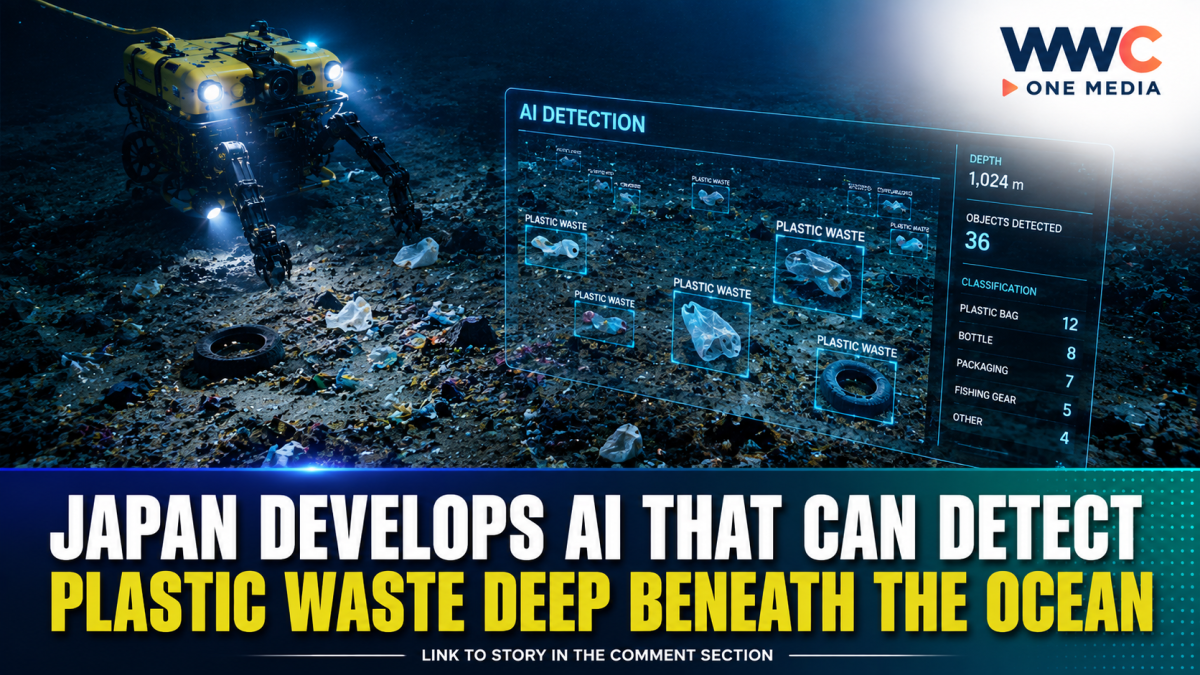
TOKYO — A new artificial intelligence system developed by Japanese researchers could dramatically change how scientists track one of the ocean’s most difficult pollution problems: plastic waste accumulating thousands of meters beneath the sea.
The Japan Agency for Marine-Earth Science and Technology (JAMSTEC) has developed DeepLitterAI, an AI system capable of automatically detecting, identifying and counting marine litter—including plastic bags, bottles and beverage cans—from deep-sea video footage.
The breakthrough could help scientists map plastic pollution across vast areas of the ocean floor without spending weeks manually reviewing underwater footage.
AI searches where humans struggle
Monitoring plastic pollution in the deep sea has long been a painstaking task.
Researchers commonly use remotely operated vehicles and other underwater systems to record video of the seafloor. Scientists then have to watch the footage, often stopping and replaying sections to identify and count individual pieces of debris.
That becomes especially difficult when litter appears small in wide-angle underwater footage or resembles rocks, marine organisms and other natural features.
DeepLitterAI was designed to address exactly that problem.
JAMSTEC researchers built a dataset called J-Litter, containing 12,029 original images extracted from more than four decades of deep-sea footage collected by the agency. The dataset includes both litter and non-litter images, allowing the AI to learn how to distinguish waste from objects naturally found on the seafloor.
The researchers deliberately included images in which litter was small and difficult to distinguish—conditions that conventional AI systems can struggle with.
The results were striking
Tests using real deep-sea survey footage showed that DeepLitterAI’s litter counts were close to those produced by experienced researchers.
Across the tested footage, the difference between AI-generated and expert counts was approximately 10 percent, according to JAMSTEC.
The system was also substantially faster.
DeepLitterAI processed the footage 2.1 times faster on average, with the researchers recording a maximum speed advantage of 3.1 times compared with manual visual analysis.
The technology was tested using footage collected at depths ranging from roughly 860 meters to more than 5,600 meters around Japan.
That means the system is not simply identifying obvious plastic floating near the ocean surface—it has been tested against the challenging conditions of the deep seafloor.
A major upgrade over earlier AI systems
The research team says one of the biggest problems with earlier AI approaches was their training data.
Previous models were often trained using images in which litter appeared large and clearly visible. But real deep-sea surveys can capture debris that occupies only a small portion of the image.
DeepLitterAI’s training dataset specifically included these smaller objects.
According to the published research, the new model achieved approximately 1.6 times better detection performance than the comparison model trained primarily on large, clearly visible litter.
The system also uses object tracking to follow individual pieces of debris across consecutive video frames. That is important because simply detecting an object in every frame could result in the same piece of plastic being counted repeatedly.
By tracking the object, the system can estimate the number of individual pieces of litter more reliably.
Why the deep sea matters
Plastic pollution does not disappear when it sinks beneath the waves.
The deep ocean is considered a major sink for marine litter, meaning waste entering the marine environment can eventually settle on the seafloor and remain there for extended periods.
JAMSTEC has previously documented deep-sea debris through underwater surveys, including observations using deep-sea submersibles and camera systems. The agency maintains a public deep-sea debris database containing images and video collected during decades of research.
But the enormous scale of the ocean makes comprehensive monitoring difficult.
Researchers cannot realistically examine every hour of underwater video manually.
That is where AI could make a major difference.
From weeks of work to just days
JAMSTEC estimates that manually analyzing 100 hours of underwater video could require nearly a month of work.
With DeepLitterAI, the same volume of footage could potentially be analyzed in only a few days.
The researchers say the technology could eventually be used to create detailed maps showing where marine litter is accumulating on the deep seafloor.
Those maps could help scientists identify pollution hotspots and provide governments and environmental organizations with better data for designing cleanup and prevention strategies.
The technology could eventually work in real time
The researchers are already looking beyond laboratory and post-survey analysis.
One future possibility is integrating DeepLitterAI directly into underwater vehicles so that litter could be detected and counted in real time during deep-sea missions.
That could allow researchers to identify areas with unusually high concentrations of debris while an expedition is still underway.
Instead of waiting until researchers return to shore and manually examine hours of footage, scientists could potentially receive information about pollution hotspots much faster.
But AI is not a complete solution
The breakthrough does not mean scientists can suddenly see every piece of plastic in the world’s oceans.
The current DeepLitterAI model was developed primarily using data collected around Japan. JAMSTEC says it plans to collaborate with research institutions in other parts of the world and expand the training dataset with imagery from different ocean environments.
That step will be important because underwater visibility, seafloor composition, marine life and types of debris can vary significantly from one region to another.
The peer-reviewed study also identified limitations. Under simulated conditions with the highest level of turbidity, the false-negative rate increased, showing that difficult underwater visibility can still affect detection performance.
A new weapon in the fight against ocean plastic
The research comes as scientists and governments continue looking for better ways to measure and reduce marine plastic pollution.
JAMSTEC says large-scale, standardized monitoring will be crucial for determining whether international efforts to curb plastic pollution are actually producing measurable results.
DeepLitterAI could provide one piece of that puzzle by turning enormous volumes of underwater video into usable data much faster than traditional manual analysis.
The technology does not remove the plastic itself.
But by revealing where the waste is, how much is there and what types of debris are accumulating, researchers may gain a much clearer picture of a pollution problem that has remained largely hidden beneath the ocean surface.
And that could be the first step toward figuring out where the world’s plastic waste is ultimately ending up—and what can be done about it.




Leave a Reply