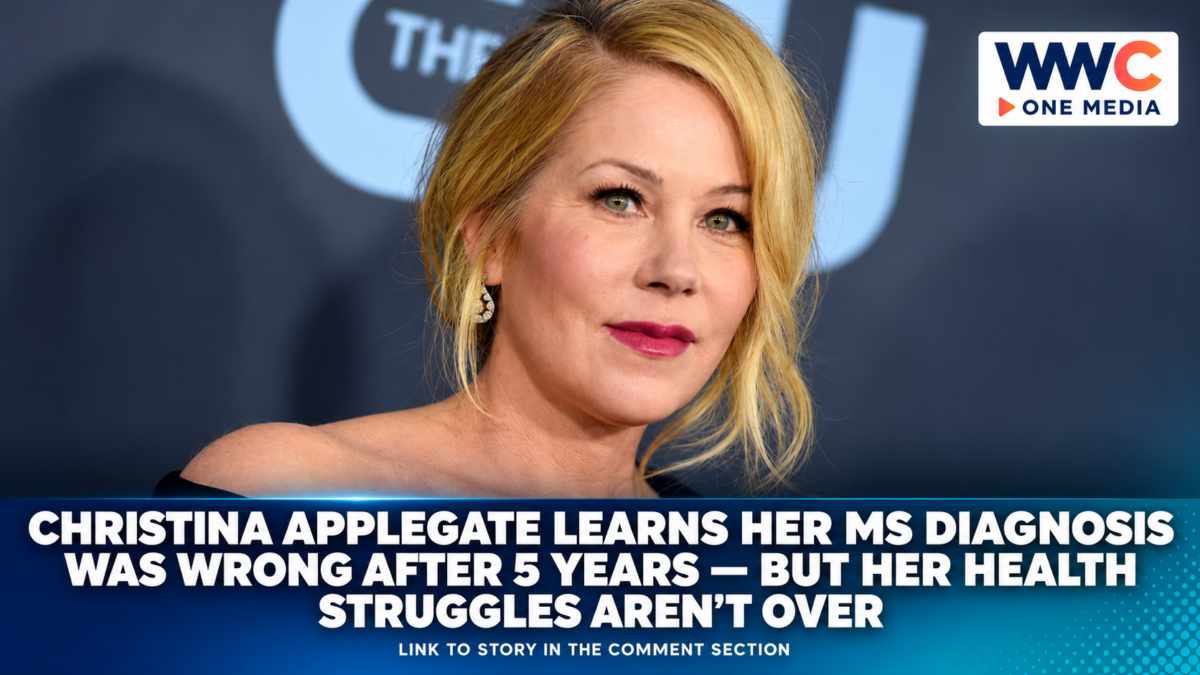
Emmy-winning actress Christina Applegate has revealed a shocking turn in her health journey: her doctors have determined that she does not have multiple sclerosis (MS), the condition she believed she had been living with since 2021. But instead of bringing relief, the news has left her struggling with unanswered questions as her debilitating symptoms continue.
The Dead to Me star, 54, shared the revelation in a new episode of her podcast, MeSsy, which she co-hosts with fellow actress Jamie-Lynn Sigler. Applegate said the news was difficult to process because she continues to experience serious physical problems despite being told that her original diagnosis was incorrect.
“You don’t get misdiagnosed and then all of a sudden I’m better,” Applegate explained, describing how her condition has continued to affect her daily life.
A diagnosis that changed everything
Applegate publicly disclosed her multiple sclerosis diagnosis in 2021 after experiencing symptoms that included tingling and numbness in her feet. She said she underwent medical examinations, including MRI scans and a spinal tap, during the diagnostic process.
Over the following years, she became an outspoken advocate for people living with MS, openly discussing the challenges of navigating life with a chronic neurological condition.
Her health struggles also affected her acting career. During the production of Netflix’s Dead to Me, adjustments were made to accommodate her physical limitations. She has previously spoken about mobility difficulties and the use of assistive devices.
The latest development, however, has forced Applegate to reconsider what she and her doctors believed about her condition for more than five years.
Why doctors reconsidered her MS diagnosis
According to Applegate’s account on MeSsy, her medical team began reviewing her diagnosis after examining how her body responded when an infusion treatment was stopped so her B-cell levels could be monitored.
When the expected changes did not occur, her doctor began investigating the original diagnosis further. Applegate said her doctor eventually informed her that she did not have MS.
The announcement stunned the actress, who recalled being told, “Congratulations, you don’t have MS.”
Rather than feeling immediately relieved, Applegate said she was unhappy and confused. Without a confirmed explanation for her symptoms, she now faces another search for answers.
She emphasized that her physical difficulties have not disappeared simply because the diagnosis has changed. She continues to experience serious mobility problems and said her symptoms have, in some respects, become worse.
Why the revelation has been emotionally difficult
Applegate also spoke about the emotional weight of the news, particularly because she had spent years sharing her experience with the MS community.
She admitted feeling as though she had let people down after becoming a public advocate for those living with the condition.
Sigler, who has her own MS diagnosis, reassured her co-host that Applegate’s efforts to raise awareness and support others remain meaningful regardless of the change in her medical diagnosis.
Applegate’s experience highlights an important distinction: learning that a particular diagnosis was incorrect does not mean a person’s symptoms are imaginary or that their health problems have been resolved.
For the actress, the uncertainty surrounding her condition remains a major challenge.
Why multiple sclerosis can be difficult to diagnose
Multiple sclerosis is a disease affecting the central nervous system, including the brain and spinal cord. It can cause symptoms such as numbness, weakness, fatigue, balance difficulties and problems with movement, although the symptoms and severity vary widely.
Diagnosing MS can be complicated because other neurological conditions may produce similar symptoms. Doctors generally consider a person’s medical history, neurological examinations, MRI findings and, when appropriate, spinal fluid testing and other investigations.
There is no single test that independently confirms every case of MS. Medical professionals must evaluate the available evidence and consider alternative explanations before reaching a diagnosis.
Reports by CBS News and the Associated Press on October 20, 2026, likewise highlighted the difficulties of diagnosing MS and the possibility of misdiagnosis. Applegate’s experience underscores why continued medical evaluation can be important when symptoms persist or the evidence does not fit an earlier diagnosis.
Her case does not establish what condition is causing her symptoms, and no alternative diagnosis has been publicly confirmed in the reporting cited here.
What happens next for Christina Applegate?
Applegate has said her doctors will continue investigating the cause of her symptoms. Until they establish a clearer explanation, she remains without the answer she had relied on since 2021.
The actress has built a reputation for speaking candidly about difficult and deeply personal experiences, including her health struggles and their impact on her career. Her latest disclosure continues that openness, while revealing the uncertainty that can remain even after years of medical treatment.
For fans, the news brings a complicated mix of emotions: the apparent removal of one diagnosis, but no immediate improvement in the condition that has disrupted Applegate’s life.
Her message is a reminder that a medical diagnosis can shape a person’s understanding of their illness, treatment and future. When that diagnosis changes, the emotional consequences can be just as significant as the medical questions that follow.
As Applegate and her doctors continue searching for answers, the biggest question remains unanswered: what is causing the symptoms that have affected her life for years?