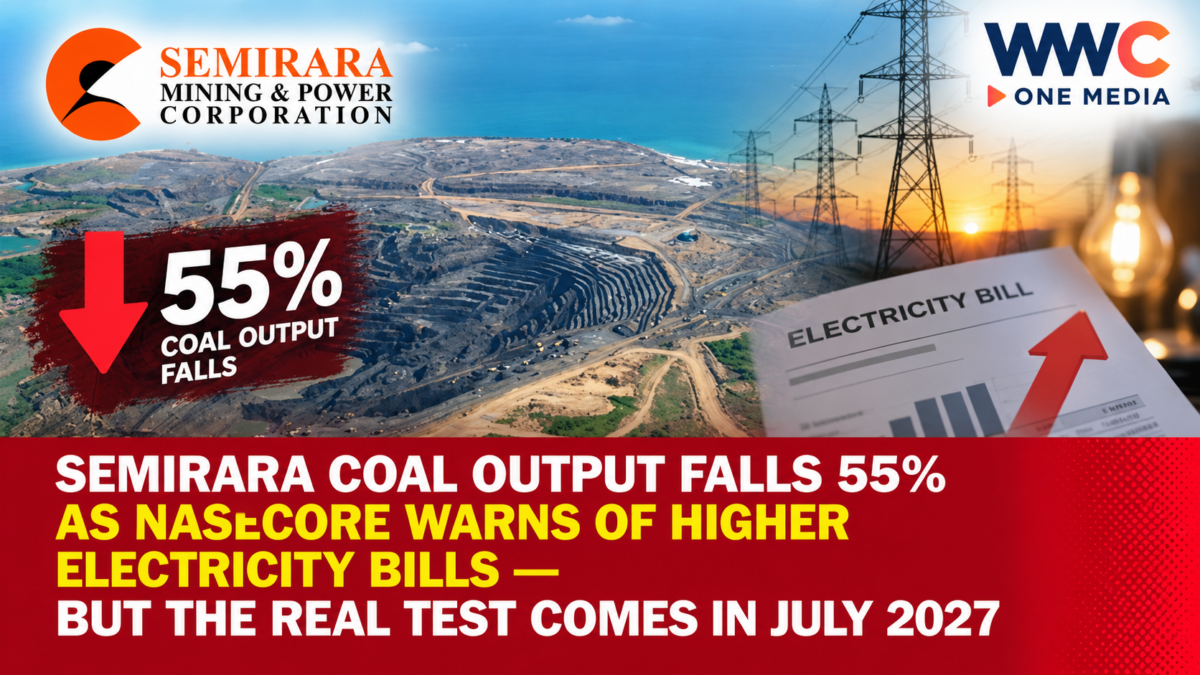
MANILA, Philippines — Filipino households and businesses could face greater electricity cost pressures if production disruptions at the country’s largest coal mine continue, according to a consumer advocacy group urging the government to prioritize reliable fuel supply and public benefits in the next Semirara mining contract.
The National Association of Electricity Consumers for Reforms (NASECORE) warned on October 19, 2026, that lower coal production, reduced capital spending and operational problems at Semirara Mining and Power Corporation (SMPC) could expose electricity consumers to higher fuel costs.
The warning comes as the Department of Energy (DOE) prepares to determine who will operate the Semirara coal resource after the current contract expires on July 14, 2027.
At stake is not only the future of a major mining business in Antique but also the continuity of domestic coal production used by Philippine power generators.
Semirara’s coal output fell by 55% in the second quarter of 2026, while flooding and seawater seepage at its Acacia mine have complicated operations.
The Consunji-led company is simultaneously challenging the government’s bidding rules, arguing that uncertainty over equipment ownership and technical qualifications could disrupt production.
But the biggest question is whether the government can resolve the contract dispute, protect local employment and maintain energy supply without passing additional costs on to Filipino electricity consumers.
Semirara Coal Production Drops 55% in One Quarter
Semirara’s operational difficulties are documented in the company’s own financial disclosures.
During the second quarter of 2026, coal production declined to 2.5 million metric tons from 5.6 million metric tons a year earlier.
That represents a 55% year-on-year drop.
Coal shipments also declined, but by a smaller 13%, from 4.6 million metric tons to 4 million metric tons.
The company attributed weaker production to stripping activities in a new section of the Narra mine and limited operations at the Acacia mine.
Stripping involves removing soil and other material covering coal deposits before commercial extraction can proceed.
Such activities can temporarily reduce production while consuming equipment capacity and operating resources.
The figures show a significant production challenge, but they do not establish that Semirara has stopped supplying coal.
The difference between production and shipments is also important because deliveries may be supported by existing inventories.
Why NASECORE Is Warning Electricity Consumers
NASECORE says Semirara accounts for approximately 97% of domestic Philippine coal production.
That makes the mine particularly significant for the country’s indigenous coal supply.
Consumer advocate Petronilo Ilagan warned that prolonged production disruptions could force power producers to rely more heavily on imported fuel.
Imported coal prices can be influenced by global demand, shipping costs, exchange rates and geopolitical developments.
If replacement fuel becomes more expensive, those additional costs may affect electricity generation charges.
However, the effect is not automatic.
Power generators may have existing inventories, long-term fuel arrangements or supply contracts that reduce immediate exposure.
The retail impact also depends on how generation costs are passed through under applicable electricity supply agreements and regulatory rules.
NASECORE’s statement is therefore a warning about a potential future cost risk, not proof that every electricity customer has already been charged more because of Semirara.
Acacia Mine Faces Serious Seawater Intrusion
One of the most pressing problems involves water entering the Acacia coal mine.
In an October 1 disclosure to the Philippine Stock Exchange, SMPC reported that seawater seepage had exceeded its pumping capacity.
The company has been working on a cut-off wall intended to limit water intrusion while coordinating with the Department of Energy.
Mining has continued in areas where extraction remains possible.
But uncontrolled water can create safety, operational and engineering challenges for an open-pit mine.
Persistent seepage may restrict access to coal deposits and increase the cost of maintaining safe operations.
NASECORE has expressed concern that the problem could jeopardize access to remaining reserves.
That concern is separate from a verified finding that all reserves have been permanently lost.
The actual extent of recoverable coal and the engineering measures required to protect it must be determined through competent technical assessments.
Capital Spending Has Been Cut Sharply
The consumer group also raised concerns about Semirara’s reduced investment plans.
SMPC revised its 2026 group capital expenditure budget from ₱5.9 billion to approximately ₱1.9 billion.
That is a reduction of about 68%.
For coal operations specifically, the planned budget declined from ₱4.8 billion to ₱800 million, or roughly 83%.
The company previously attributed the cuts partly to uncertainty over the future coal operating contract.
Management deferred certain equipment replacement and other investments while the bidding process remained unresolved.
NASECORE fears that reduced spending could increase the cost of maintaining or restoring production.
But a lower capital expenditure budget does not necessarily mean all maintenance has stopped.
It reflects the company’s revised investment plans, and its operational consequences need to be assessed against actual equipment conditions, safety requirements and mine development schedules.
The July 2027 Deadline Creates a Major Supply Challenge
SMPC’s current Semirara coal operating contract is scheduled to expire on July 14, 2027.
The government must determine how the coal resource will be managed beyond that date.
The decision matters because a mining operation requires specialized equipment, trained personnel, technical planning and continuing safety controls.
If the existing operator retains the contract, the transition issues will differ from those involved in transferring operations to a new company.
If another bidder wins, authorities will need to ensure that the incoming operator can lawfully access the equipment, facilities and workforce necessary to continue production.
NASECORE is calling for credible transition arrangements regardless of who wins.
It wants the DOE to prioritize measurable commitments to coal supply, government revenue and electricity consumers.
The group has emphasized that it is not endorsing any particular bidder.
DOE Reassesses Its Bidding Framework
The Department of Energy has already acknowledged serious questions surrounding the bidding process.
In a September 19 statement, the DOE said it had terminated an earlier coal bidding round so it could reassess the parameters for awarding the resource.
The agency identified operational uncertainties, including water seepage and disputes over mining assets, as matters requiring further evaluation.
The DOE said its revised approach should give greater weight to enforceable public benefits, appropriate government revenues and commitments to domestic coal utilization.
Its position is that publicly owned natural resources must be managed in ways that protect the national interest.
This is an important counterpoint to the incumbent company’s objections.
The government is not necessarily required to extend an operating contract because the existing operator has experience.
At the same time, a competitive process must properly address technical capability, lawful asset ownership and the risk of interrupting supply.
Semirara Challenges Equipment Transfer Requirements
SMPC has accused the government of adopting unfair bidding conditions.
In statements reported on October 13 and October 19, the company argued that it would be required to surrender mining equipment—including heavy trucks and other machinery—as a condition for joining the competition.
The company claims that this requirement disadvantages the incumbent because other bidders would not face the same asset-transfer condition.
It also argues that technical competence should play a central role in evaluating prospective mine operators.
SMPC has questioned whether the highest financial offer should be sufficient to win a complex mining contract.
These are the company’s allegations and interpretations of the bidding rules.
They should not be treated as a final judicial determination that the requirements are unlawful.
The legal treatment of equipment, including assets whose costs may have been recovered under the existing contract, remains a disputed issue.
NASECORE Says Consumer Benefits Must Come First
Although SMPC is defending its position as the incumbent operator, NASECORE has avoided endorsing it.
Instead, the group argues that the government should assess bidders based on tangible and enforceable benefits.
These may include credible production plans, appropriate government revenues, uninterrupted domestic deliveries and responsible management of mining assets.
Technical qualifications also matter because a coal mine cannot be operated successfully through financing alone.
NASECORE’s position is that the contract should deliver value to the public regardless of the winning company.
This places the dispute in a broader policy context.
The issue is not simply whether Semirara should be allowed to continue operating.
It is whether the government’s selection process can produce reliable coal output, protect public resources and safeguard electricity consumers.
Thousands of Mining Jobs Are Also at Stake
SMPC says its operations have supported more than 4,000 jobs.
The company has also disclosed employment-related measures linked to uncertainty over the mining operation.
Earlier October reporting said a redundancy program covered 996 employees amid seawater intrusion and operational pressures.
NASECORE’s separate October 19 account cited redundancy notices affecting 1,458 mine employees.
Those figures should not be treated as interchangeable or added together without examining the different reporting dates and categories.
A redundancy notice, an employee covered by a program and a completed termination are not necessarily the same thing.
For Semirara Island and nearby communities, the future of mining employment is an important concern.
The transition to any new operating arrangement will have implications for workers, contractors and local businesses.
Protecting livelihoods must be considered alongside fuel supply and government revenue.
Semirara Defends Its Economic Contributions
SMPC says it has made substantial economic contributions over decades of operating the coal resource.
In its October 19 statement, the company cited approximately ₱70.5 billion in payments to government over 29 years.
It also reported contributing around ₱600 million annually to the municipality of Caluya through programs and local economic activity.
The company argues that its existing infrastructure, trained workforce and operational experience should carry significant weight in any government decision.
These claims provide context for the incumbent’s position.
However, historical economic contributions do not by themselves establish the value of a future contract.
The government must also consider present operational conditions, the resource’s long-term management and enforceable benefits under a new agreement.
Likewise, past employment and revenue should not be used to dismiss the need for technical and environmental oversight.
Coal and LNG Price Comparisons Need Context
SMPC also cited September 2026 electricity generation price comparisons to support its argument that domestic coal provides affordable power.
According to the company, average generation prices for coal-fired plants in the Luzon-Visayas grid were around ₱4.05 per kilowatt-hour, compared with approximately ₱14 per kilowatt-hour for liquefied natural gas-fired plants.
These are company-cited generation price comparisons for a particular period.
They are not the full retail rates paid by households.
A consumer’s electricity bill can include generation, transmission, distribution, taxes and other applicable charges.
The comparison also does not establish that every coal plant is always cheaper than every gas plant under all market conditions.
Fuel contracts, plant efficiency, dispatch patterns and operating costs can change the economics.
Nonetheless, the figures help explain why Semirara considers domestic coal supply an important part of the electricity affordability debate.
Semirara’s Power Business Remains Profitable
The company’s coal mining challenges have not eliminated its earnings.
According to SMPC’s second-quarter disclosure, consolidated quarterly net income increased 17% to approximately ₱4.8 billion.
The power business accounted for around ₱4.6 billion, representing 96% of quarterly earnings.
Power sales increased 9% to a record 1,563 gigawatt-hours.
However, the coal segment contributed only ₱191 million after consolidation adjustments.
These results demonstrate a divergence between the company’s businesses.
Its electricity generation operations performed strongly during the quarter, while coal production experienced substantial pressure.
The financial distinction matters because lower mining output does not automatically mean the entire company is unprofitable.
But profitable power generation does not remove the operational challenges affecting future coal supply.
A Coal Production Decline Is Not the Same as a National Shortage
The 55% second-quarter output decline is significant.
But it should not be interpreted as proof that the Philippines has already experienced a nationwide coal shortage.
SMPC’s quarterly shipments declined by 13%, considerably less than the production decline.
The company also reported coal inventories during the period.
These figures indicate that production, sales and inventory levels must be considered together.
Other domestic and imported sources can also affect the overall fuel supply available to power plants.
A reliable national assessment would require current inventories, delivery schedules, power plant fuel requirements and expected mine production.
NASECORE’s concern is that a prolonged decline could increase import exposure.
That risk should be monitored rather than confused with a confirmed immediate nationwide supply failure.
How Semirara’s Problems Could Affect Electricity Bills
For Filipino electricity consumers, the possible transmission of higher coal costs into monthly bills is the central issue.
Coal-fired power plants may buy fuel through domestic supply agreements, import contracts or other procurement arrangements.
Changes in fuel costs can affect the cost of producing electricity.
However, the timing and magnitude of any impact depend on the contracts involved.
Some power supply agreements contain provisions governing fuel cost adjustments.
Spot market prices can also influence generation charges, depending on supply and demand conditions.
Distribution utilities pass through permitted generation charges subject to applicable regulatory rules.
That means higher imported coal prices could contribute to electricity cost pressure, but they do not automatically produce a uniform increase for every household.
The exact financial effect of Semirara’s problems has not been quantified in the October 19 NASECORE statement.
Consumers should distinguish a warning about possible future charges from an actual rate adjustment announced by their electricity provider.
Energy Security Requires More Than Choosing a Coal Operator
The dispute also raises wider questions about Philippine energy security.
Domestic coal production can reduce some reliance on imported fuel.
But coal remains a finite resource, and mining operations can face geological, environmental and equipment-related risks.
The country also needs a reliable and diversified electricity system.
Energy planning involves existing power plants, renewable generation, transmission networks, storage and fuel procurement.
For the immediate Semirara issue, the urgent concern is continuity of coal supply and safe mine operations.
For the longer term, reducing exposure to volatile energy prices will require broader investments and effective regulation.
An auction outcome alone cannot solve every electricity affordability challenge.
What the Government Must Resolve Before July 2027
The upcoming deadline gives authorities several difficult priorities.
The DOE must establish a legally sound and transparent process for awarding the next coal operating contract.
Bidders need clear rules governing technical qualifications, government revenues and operational responsibilities.
The dispute over mining equipment must be addressed so that lawful asset ownership and continuity requirements are understood.
The effect of seawater intrusion on accessible reserves also requires technical assessment.
Workers and local communities need credible information about the transition.
Most importantly for consumers, authorities must ensure that the selected arrangement supports reliable domestic coal deliveries without compromising safety or environmental obligations.
These are significant operational and policy challenges.
They cannot be resolved simply by accepting the highest financial offer or automatically favoring the incumbent.
The Bigger Test: Can the Philippines Avoid an Expensive Supply Disruption?
Semirara’s coal production decline has exposed a difficult combination of mining, legal and energy policy risks.
Second-quarter output fell 55%.
Capital spending has been sharply reduced.
Seawater intrusion has disrupted activity at the Acacia mine.
The government and SMPC remain at odds over important aspects of the next operating contract.
NASECORE fears that these problems could eventually force greater reliance on imported coal and increase electricity costs.
But there is still no verified nationwide rate increase directly attributable to the Semirara dispute.
The outcome will depend on how the mine operates in the months ahead and how the government handles the transition before July 14, 2027.
Semirara’s coal difficulties have already become a national energy policy issue. The real test is whether the government can preserve reliable fuel supply, settle the contract dispute and protect Filipino consumers before mining disruptions translate into higher electricity bills.