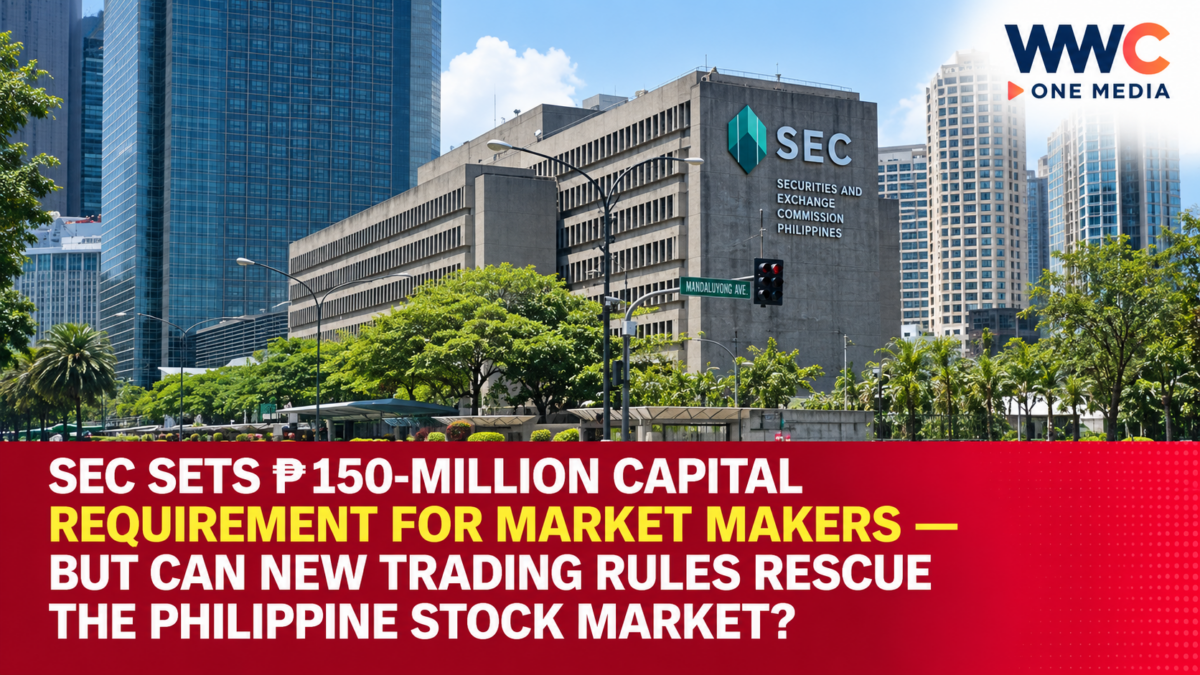
MANILA, Philippines — The Securities and Exchange Commission is introducing a major reform aimed at one of the Philippine capital market’s most persistent problems: the difficulty investors can face when trying to buy or sell securities in a market with limited trading activity.
Through Memorandum Circular No. 28, Series of 2026, the regulator has established a common framework for market-making activities involving equities and fixed-income securities traded on exchanges under SEC jurisdiction.
The rules require qualified trading firms to maintain at least ₱150 million in unimpaired paid-up capital, employ experienced specialists, and meet trading and risk-management obligations.
In exchange, approved market makers may receive incentives including reduced transaction fees, liquidity rebates and enhanced access to trading facilities.
The reform is intended to make securities more accessible to buyers and sellers, improve price discovery and strengthen confidence in Philippine capital markets.
But there is a critical question behind the regulatory announcement.
Can the SEC create a more active trading environment through better market-making rules — or will weak demand, limited participation and the high cost of providing liquidity remain bigger obstacles?
SEC Introduces New Market-Making Framework
The SEC released its Rules on Market Making on October 16, 2026, establishing a common regulatory baseline for market-making activities.
The initiative follows earlier efforts by the Philippine Stock Exchange to expand the use of market makers beyond exchange-traded funds.
Market makers are financial institutions or authorized trading firms that regularly provide prices at which they are prepared to buy and sell designated securities.
By maintaining both sides of a potential transaction, these firms can make it easier for other market participants to complete trades.
The practice is used in developed financial markets and can help improve trading conditions in securities that otherwise attract relatively few orders.
SEC Chairman Francisco Ed. Lim described the reform as an important milestone in the regulator’s efforts to stimulate trading activity.
However, the new circular does not instantly create market makers for every listed company.
Participating firms must obtain the appropriate exchange accreditation, while exchanges must establish and enforce product-specific requirements.
What Is a Market Maker and Why Does It Matter?
To understand the reform, consider an investor who owns shares in a relatively illiquid listed company.
The investor wants to sell, but there may be few willing buyers at the desired price.
Without sufficient market activity, the investor may need to lower the asking price significantly or wait until someone places a matching order.
A market maker helps by providing standing quotations to buy and sell a designated security.
For example, a market maker might quote a buying price of ₱10.00 and a selling price of ₱10.10.
The difference between those prices is called the bid-ask spread.
A narrower spread can reduce the cost of entering or exiting a position.
Market makers may also help investors find counterparties more quickly.
But they cannot eliminate all trading risk.
They are required to provide liquidity within specified conditions, not guarantee a buyer or seller at every imaginable price.
Nor are they obligated to prevent stock prices from declining.
Their function is to support orderly trading rather than manipulate prices or protect investors from losses.
Firms Need at Least ₱150 Million in Capital
One of the circular’s most important requirements is its minimum capitalization threshold.
Only trading participants of an SEC-licensed exchange that are accredited or recognized by that exchange may act as market makers.
They must maintain at least ₱150 million in unimpaired paid-up capital.
The SEC may prescribe a higher requirement depending on the activity involved, while applicable exchange requirements remain subject to regulatory approval.
The capital requirement reflects the risks associated with market making.
A market maker may need to acquire securities before it can find another buyer.
If prices fall while those securities are held, the firm may incur losses.
The capital threshold helps ensure that participating institutions possess financial resources appropriate to their responsibilities.
However, the ₱150-million requirement is not an investment amount that ordinary retail investors must contribute.
It applies to firms seeking to perform the market-making function.
Experienced Trading Specialists Are Required
Financial resources alone are not sufficient.
Each market maker must designate at least one qualified specialist responsible for performing its market-making obligations.
The specialist must have at least three years of relevant securities trading or market-making experience, or an accepted equivalent based on certifications, training and demonstrated proficiency.
The requirement recognizes the technical complexity of continuously managing quotations and securities positions.
A specialist must monitor market conditions, maintain suitable prices and manage the firm’s trading exposure.
Market-making operations can involve rapid price movements, significant transaction volumes and changing liquidity conditions.
Inadequate supervision could expose the firm to losses or create risks for market integrity.
The SEC therefore requires participating institutions to demonstrate appropriate operational capacity and risk controls.
Market Makers Must Post Firm Buy-and-Sell Prices
For designated equity securities, market makers must post and maintain two-sided quotations during a minimum portion of the trading session.
The relevant exchange will establish that required duration.
The exchange will also set maximum bid-ask spreads and minimum quotation sizes.
These requirements are intended to prevent firms from claiming to provide liquidity without making meaningful trading opportunities available.
Quotations must generally be firm and executable.
However, the circular recognizes circumstances in which temporary exceptions may be appropriate.
These include system failures, extraordinary market volatility, regulatory trading halts and other exceptional events allowed under the rules.
This distinction is important.
Market making does not mean every firm must continuously buy and sell every designated security throughout the entire trading day, regardless of market conditions.
The actual obligations depend on the security, approved exchange rules and applicable risk safeguards.
Fixed-Income Securities Have Different Requirements
The new framework also covers eligible fixed-income securities traded or enrolled on exchanges under SEC jurisdiction.
Fixed-income instruments include certain bonds and other debt securities.
Their markets can operate differently from stock exchanges.
Some corporate debt instruments have fewer transactions, longer maturities and trading arrangements based on dealer quotations rather than frequent exchange order matching.
For this reason, the SEC allows exchanges to establish fixed-income quotation standards suited to the market.
Depending on the security and approved guidelines, quotations may be firm, indicative or provided on a best-efforts basis.
The rules also consider the issue size, tenor, liquidity and other characteristics of each security.
Importantly, government securities operating under the Bureau of the Treasury’s primary-dealer framework are excluded unless the SEC and Treasury expressly extend the rules to them.
The reform should therefore not be described as automatically applying to every Philippine government bond.
Philippine Stock Exchange Had Already Proposed Wider Market-Making Rules
The latest SEC circular builds on an initiative launched earlier by the Philippine Stock Exchange.
On June 4, 2026, the PSE released proposed amendments to its existing market-making framework for public comment.
At the time, the exchange explained that its existing arrangements focused on exchange-traded funds.
The proposed framework would also accommodate Global Philippine Depository Receipts and could eventually support individual listed stocks and other exchange-traded products.
PSE President and CEO Ramon Monzon said a common framework would make it easier to establish rules for different securities.
The proposal included accreditation standards, quotation obligations and trading incentives.
It also reflected the exchange’s efforts to strengthen liquidity in the domestic market.
The October SEC circular now provides an overarching regulatory standard, while exchanges remain responsible for developing appropriate implementing guidelines.
How the New Rules Differ From the Earlier PSE Proposal
One notable difference involves capitalization.
The PSE’s June proposal identified a minimum capital requirement of ₱100 million for market-maker applicants.
The SEC’s October framework establishes a higher baseline of ₱150 million.
The two figures belong to different stages of the rulemaking process.
The earlier ₱100-million proposal should not be presented as the current universal minimum under the newly issued SEC framework.
The higher threshold may provide stronger financial safeguards.
But it may also limit the number of brokerage firms able or willing to participate.
This presents a policy trade-off.
A market-making program needs financially capable institutions, but it also needs enough participants to create meaningful competition in providing liquidity.
The eventual number of accredited firms will help indicate how that balance develops.
Exchanges May Offer Fee Reductions and Rebates
The SEC recognizes that providing liquidity can expose firms to financial risk and operating expenses.
To encourage participation, exchanges are expected to establish incentives.
These may include reduced transaction fees, liquidity rebates, simplified onboarding and access to enhanced trading facilities.
A liquidity rebate may reward a firm for placing orders that make trading opportunities available to other investors.
Lower transaction fees can reduce the cost of regularly buying and selling securities.
But incentive programs must receive SEC review and approval.
They must also avoid encouraging artificial trading, abusive order cancellations or excessive risk-taking.
The SEC’s objective is to reward genuine liquidity provision, not inflate transaction statistics through transactions that have little economic substance.
Stricter Rules Target Market Manipulation
A key concern in any market-making program is the possibility that firms could misuse their position.
Because market makers continuously submit quotations and hold securities, they may have significant influence over trading conditions for designated instruments.
The new rules prohibit practices such as wash sales, fictitious transactions, price manipulation and the misuse of material nonpublic information.
They also address conflicts of interest when a market maker has another relationship with a securities issuer.
For example, a firm acting as an underwriter or adviser may need controls to prevent inappropriate information sharing.
Exchanges must monitor trading activity and investigate potential violations.
Possible enforcement measures include suspension or revocation of accreditation, administrative penalties and referrals for civil or criminal proceedings.
These sanctions are subject to applicable procedures and due process.
The rules aim to ensure that additional trading activity reflects legitimate market transactions rather than artificial volume.
Transparency and Recordkeeping Become Mandatory
Market makers and exchanges must maintain records and disclosures supporting regulatory oversight.
Market makers must retain required orders, trades, quotations and inventory records for at least five years.
Exchanges must publish information about approved market makers, designated securities and applicable market-making obligations.
They must also maintain surveillance systems capable of monitoring trading patterns, quotations and potential abuses.
Material events affecting a market maker’s ability to operate must be reported within the required period.
These requirements could help investors understand which securities have formal liquidity-support arrangements.
But transparency will depend on how effectively exchanges publish accurate information and enforce compliance.
The presence of a registered market maker is not a guarantee that an investment is safe or suitable for every investor.
Existing Firms Receive a Six-Month Transition
The circular includes a transition period for firms already engaged in market-making activities.
Existing participants will have six months from the rules’ effectivity to comply with the new requirements.
The relevant exchanges must also submit implementing guidelines to the SEC within 30 days from effectivity.
The circular provides that it takes effect 15 days after complete publication in the Official Gazette or at least two newspapers of national circulation.
Therefore, the transition deadlines should not automatically be calculated from October 16, when the announcement was made.
The precise compliance timetable depends on the legally relevant publication and effectivity dates.
Existing exchange market-making rules may continue to apply while the new implementing guidelines await approval, provided they do not conflict with the SEC framework.
This staged approach allows market participants and exchanges time to prepare their systems and procedures.
Finance Secretary Frederick Go Welcomes the Reform
Finance Secretary Frederick D. Go has expressed support for the SEC’s market-making framework.
In a Department of Finance statement published on October 19, Go argued that deeper and more liquid capital markets can strengthen investor confidence.
A more active market may also help businesses access financing.
Companies depend on capital markets to raise funds for expansion, infrastructure, technology and other investments.
A strong secondary market can make primary fundraising more attractive because investors have greater confidence in their ability to trade securities later.
But the relationship is not automatic.
The existence of market makers does not guarantee that companies will successfully conduct public offerings.
Issuers must still demonstrate appropriate financial performance, governance and investment prospects.
Why Philippine Stocks Need More Liquidity
Liquidity is the ability to buy or sell an asset without causing a large change in its price.
In a highly liquid market, there may be many buyers and sellers competing to trade.
In a less liquid market, investors may face wide bid-ask spreads and difficulty executing larger orders.
This can discourage participation.
A buyer may hesitate to invest in a security if exiting the position later appears difficult.
For listed companies, weak liquidity can also affect investor interest and valuation.
By encouraging firms to provide two-way quotations, the SEC hopes to reduce some of these trading frictions.
However, structural market challenges go beyond the availability of quotations.
Investor confidence can also be affected by economic growth, corporate earnings, interest rates, governance and international financial conditions.
Market making addresses one part of the problem.
It is not a substitute for broader market development.
Investors Still Face Market Risk
Retail investors may benefit if market-making arrangements improve trading conditions.
Narrower bid-ask spreads can reduce certain trading costs.
More consistent quotations may also make it easier to enter or exit positions.
But the reforms do not protect investors from losses caused by falling security prices.
A market maker may provide a bid for a stock even when that bid is much lower than the price at which an investor originally purchased it.
Likewise, market-making obligations can be modified or temporarily suspended under permitted circumstances.
Investors should continue evaluating company fundamentals, financial disclosures, trading costs and their own tolerance for risk.
The SEC’s framework is designed to improve market functioning, not guarantee profits.
The Bigger Challenge: Will More Rules Bring More Investors?
The Philippine capital market is taking a step toward a more standardized and internationally familiar trading system.
The new rules establish minimum capital and experience standards for firms willing to provide liquidity.
They also introduce incentives while strengthening disclosure, risk management and enforcement requirements.
But their success depends on actual participation.
Exchanges must identify suitable securities and establish realistic obligations.
Brokerage firms must decide whether the commercial incentives justify the cost and risk of market making.
And investors must see meaningful improvements in trading conditions.
Evidence of success could include narrower quoted spreads, greater market depth, more consistent quotations and higher genuine trading volume.
These outcomes will need to be measured after the framework is implemented.
The SEC has introduced a ₱150-million capital threshold and tougher standards for market makers in Philippine stocks and eligible bonds. But the biggest test is whether the reform will attract enough capable firms to make trading genuinely easier — or whether the stock market’s deeper liquidity problems will continue despite the new rules.










