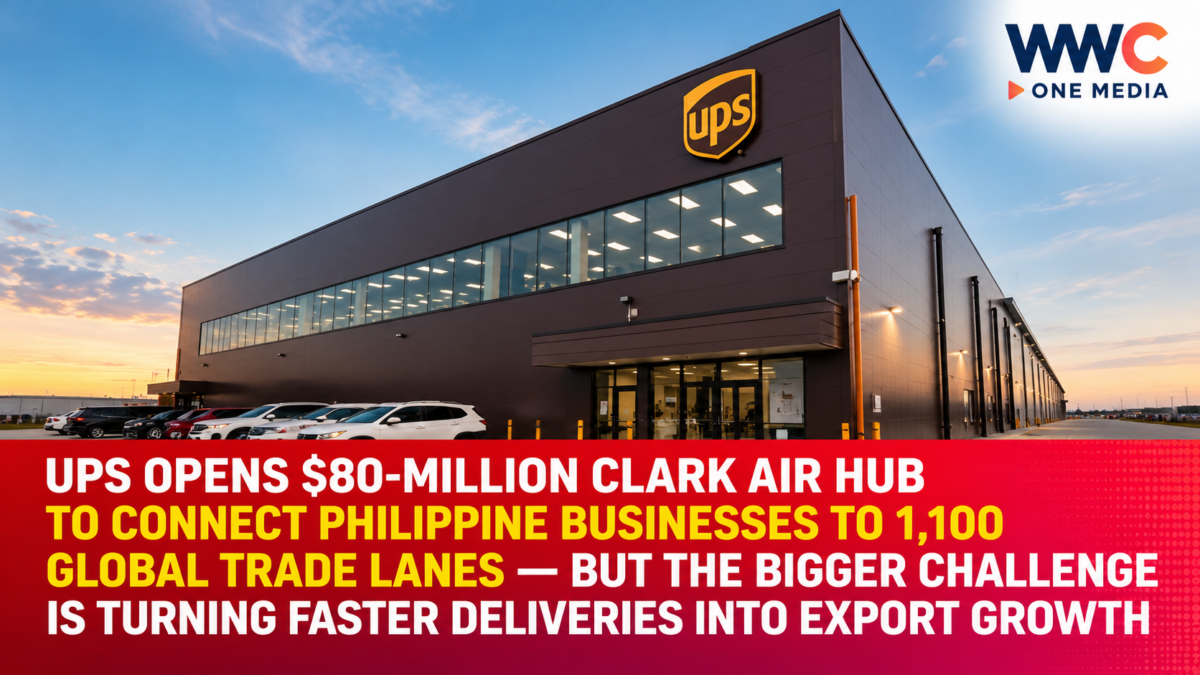
CLARK, PAMPANGA, Philippines — Global logistics company United Parcel Service (UPS) has opened its new international air hub at Clark International Airport, completing an investment of more than $80 million that dramatically expands cargo-processing capacity and strengthens the Philippines’ links to overseas markets.
Inaugurated on October 15, 2026, the 30,000-square-meter UPS Clark International Air Hub is 15 times larger than the company’s previous facility.
The expansion is expected to increase average daily package volume from approximately 5,000 to 46,000, while maximum hourly processing capacity has risen from 1,250 to 15,000 packages.
UPS said the facility improves service across more than 1,100 international trade lanes, supporting businesses shipping goods between the Philippines, other parts of Asia, India, Europe and the United States.
It has also created nearly 600 jobs, primarily benefiting workers in Pampanga and surrounding communities.
But while the investment strengthens Clark’s position in international logistics, a bigger economic question remains.
Can the Philippines turn faster global shipping connections into higher exports, stronger local industries and more opportunities for small businesses?
UPS Makes Its Biggest Philippine Investment at Clark
The new Clark hub represents UPS’ largest investment in the Philippines to date.
The company has operated a hub at Clark since 2002, supporting the movement of international shipments across its global network.
Its earlier facility served the business for more than two decades, but the company’s latest expansion significantly increases the scale and technological capabilities of its Philippine operations.
The new hub occupies approximately 30,000 square meters, equivalent to about 323,000 square feet.
The project began construction in February 2025 and was completed on schedule for its October 2026 opening, according to the Presidential Communications Office.
President Ferdinand Marcos Jr. led the inauguration, welcoming the investment as part of efforts to improve the country’s transport and logistics infrastructure.
The facility is already open, distinguishing it from other large-scale infrastructure proposals that remain in the planning or construction stages.
For UPS, the development forms part of a wider strategy to improve logistics capacity and resilience across the Asia-Pacific region.
Capacity Jumps to 15,000 Packages Per Hour
The most visible change is the massive increase in processing capacity.
The previous Clark hub handled a maximum of approximately 1,250 packages per hour.
The new facility can process up to 15,000 packages per hour.
That represents a twelvefold increase in maximum hourly capacity.
UPS also expects average daily package volumes to rise from roughly 5,000 to 46,000.
The projected daily figure is more than nine times the previous average.
However, these two measurements refer to different aspects of operations.
Maximum hourly capacity describes what the facility’s equipment can handle under suitable operating conditions.
Average daily volume is a projection of the number of shipments the site expects to process over a typical day.
The 15,000-per-hour figure should not be multiplied by 24 and presented as confirmed daily throughput.
Actual volumes will depend on cargo demand, flight schedules, sorting operations and other conditions.
New Automated Sorting System Can Handle 9,000 Small Parcels an Hour
One of the hub’s most significant improvements is an automated sorting system for small packages.
The technology can process up to 9,000 parcels weighing less than three kilograms every hour.
Clark hub general manager Albert Sapaen Jr. described the equipment as a major step forward in UPS’ automation strategy in Asia-Pacific.
The system uses intelligent conveyor technology to separate parcels and direct them toward the appropriate destinations.
Packages pass through scanners that read their labels, allowing the equipment to match each shipment with its routing information.
This helps prepare parcels for the next stage of delivery while reducing the amount of manual sorting required.
The system’s 9,000-package capacity is part of the hub’s overall 15,000-package-per-hour processing capability.
The two figures should not be added together.
The new infrastructure is designed to improve efficiency as businesses send increasing volumes of smaller international shipments.
More Than 1,100 Global Trade Lanes Receive Service Improvements
UPS said the Clark expansion improves service across more than 1,100 international trade lanes.
A trade lane refers to a shipping connection or route between markets.
It does not necessarily mean UPS has added 1,100 new direct flights or destinations from Clark.
Instead, the improvements include faster transit times, later shipment pickup deadlines and earlier deliveries through the company’s wider transportation network.
For businesses in the Philippines, these changes may create more opportunities to reach overseas customers.
A manufacturer sending product samples to an international buyer may benefit from faster deliveries.
A small exporter preparing a time-sensitive order may gain additional time before the shipping cutoff.
And companies managing inventory across multiple countries may be able to move certain goods more quickly.
However, the improvements vary by origin, destination and available service.
UPS has not promised that every Philippine shipment will arrive internationally within one day.
Deliveries Could Be Up to Two Days Faster on Selected Routes
The company identified specific regional improvements.
Shipments to and from eastern China and other major Asia-Pacific markets may experience transit times shortened by up to two days.
Services between several Southeast Asian markets and India may also improve by as much as two days.
UPS said some international destinations can be reached in as little as one business day through its expanded network.
The improvements could be especially useful to businesses that depend on urgent shipments.
However, “up to two days faster” represents the maximum advertised improvement for selected services, not a universal guarantee.
Delivery times still depend on shipping origin, destination, service selection, customs clearance and operating conditions.
Businesses should therefore check the company’s official delivery estimates for their particular shipment.
Clark Now Supports 170 Weekly UPS Flight Segments
UPS operates approximately 170 flight segments into and out of Clark each week.
These connections help link the Philippines with other parts of Asia-Pacific, India, Europe and the United States.
Clark’s geographic position is a key reason behind the investment.
The airport is located within several hours’ flying time of major Asian manufacturing and commercial centers.
That makes it strategically useful for a logistics company serving regional and long-distance supply chains.
Clark also provides an alternative operating location to the country’s heavily used Manila aviation infrastructure.
But airport connectivity alone is not enough to guarantee competitiveness.
Reliable customs processing, road access, cargo handling and coordination among agencies remain important to the overall efficiency of the logistics system.
Nearly 600 Jobs Created in Pampanga
The hub’s opening has generated nearly 600 jobs, according to UPS.
Many of the positions are being filled by residents of Pampanga and nearby communities.
The additional workforce supports cargo handling, sorting, airport operations and other functions required by the expanded facility.
President Marcos emphasized the significance of creating skilled employment outside Metro Manila during the inauguration.
The facility is an example of how major logistics investments can bring economic opportunities to regional growth centers.
Beyond direct employment, the expansion could generate demand for supporting services.
However, indirect employment effects have not been independently quantified in the reports reviewed.
The nearly 600 jobs should therefore be understood as the company’s reported employment contribution from the hub, not an estimate of every possible job supported throughout the local economy.
Healthcare Cargo Gets Specialized Temperature-Controlled Facilities
The new hub is designed for more than ordinary parcels.
UPS has installed specialized infrastructure for healthcare, high-technology and manufacturing shipments.
According to the company, the facility includes three refrigerated and freezer units capable of maintaining controlled temperatures ranging from minus 20 degrees Celsius to 25 degrees Celsius.
It also features re-icing capabilities and UPS Premier RFID technology for improved tracking and priority handling of critical shipments.
These features are particularly relevant to healthcare logistics.
Certain medicines, medical supplies and laboratory materials require specific storage and transportation conditions.
Temperature excursions can compromise the usability of sensitive products.
More advanced cargo facilities can help support these shipments when operated according to applicable handling requirements.
However, the availability of temperature-controlled equipment does not mean every pharmaceutical product can be shipped without additional packaging, regulatory clearances or specialized arrangements.
Customers still need to meet the relevant requirements for the products they transport.
Electric Ground Equipment Supports Hub Operations
UPS has also introduced electric ground servicing equipment at Clark.
The fleet includes equipment such as cargo tractors, forklifts, belt loaders and other airport support vehicles.
Electrification can reduce direct tailpipe emissions from ground operations when compared with conventional combustion-powered equipment.
The company also describes the facility as sustainability-certified.
These measures align with UPS’ broader investments in operational efficiency.
However, they should not be interpreted as making the entire hub carbon-neutral.
Aircraft operations, purchased electricity, construction and other logistics activities still have environmental impacts.
A complete emissions assessment would require additional data about electricity consumption, flight operations and the company’s broader supply chain.
The sustainability features are relevant improvements, but they do not eliminate the environmental footprint of international air freight.
Faster Logistics Could Help Philippine Exporters
For Philippine businesses, the most important potential benefit is improved access to overseas markets.
Large manufacturers may benefit from faster delivery of components and finished goods.
Healthcare companies may gain additional options for transporting time-sensitive materials.
Technology firms may be able to move products and replacement equipment more efficiently.
Smaller exporters could also benefit from later pickup cutoffs that give them more time to prepare orders.
The Philippine Star reported that UPS sees opportunities for local makers of wooden products, model aircraft and model ships operating around Clark.
These businesses may be able to use enhanced international shipping services to reach customers abroad.
But there is an important limitation.
More shipping capacity does not automatically create new export orders.
Businesses still need internationally competitive products, customers, financing, regulatory compliance and viable shipping costs.
The new UPS hub improves one important part of that equation: logistics connectivity.
Small Businesses Could Face a New Opportunity — and a New Cost Question
For micro, small and medium-sized enterprises, international delivery services can help reach overseas buyers without establishing their own foreign distribution networks.
An online seller could ship specialized products directly to customers in another country.
A business supplying samples to an overseas distributor could shorten the time required to complete negotiations.
Companies importing components could potentially reduce certain delivery delays.
But international express shipping can be expensive, especially for lower-value or heavier products.
Businesses must consider transport charges, customs duties, taxes, packaging and returns.
The new facility does not establish that all UPS shipping prices will decline.
The benefits to small enterprises will depend on whether faster service is commercially affordable for their products and target markets.
That makes pricing, customs efficiency and access to export guidance important parts of the broader trade-development discussion.
Marcos Wants Other Clark Investments Completed on Schedule
The UPS opening also prompted a wider government response.
During the October 15 inauguration, President Marcos directed the Bases Conversion and Development Authority and Department of Trade and Industry to provide opening timelines for unfinished investments in Clark.
The directive reflects a concern that announced investments should translate into completed projects, actual operations and employment.
In the case of UPS, construction began in February 2025 and the facility opened within its announced 2026 schedule.
The government highlighted this as an example of investment commitments progressing into operational infrastructure.
The directive does not necessarily establish that every other Clark project is facing a specific violation or regulatory problem.
It emphasizes the administration’s stated priority of ensuring that announced developments become functioning economic assets.
UPS Strengthens a Wider Asia-Pacific Logistics Network
The Clark investment is part of UPS’ regional strategy.
Earlier in 2026, the company opened a major logistics center in Taiwan and expanded operations at Incheon International Airport in South Korea.
UPS also began construction of a new hub at Hong Kong International Airport.
These investments reflect the company’s efforts to adapt its network as supply chains shift and customers seek reliable connections across major Asian markets.
For the Philippines, being part of that regional infrastructure can support access to overseas shipping routes.
It could also enhance Clark’s role within a network of international air cargo facilities.
But the economic effects will depend on how successfully companies use these connections and whether the Philippines continues improving its overall trade infrastructure.
Can Clark Become a Stronger International Cargo Gateway?
Clark International Airport has attracted investments from major global logistics companies, including UPS and FedEx.
Its development strengthens the argument for improving airport, road and trade infrastructure outside Metro Manila.
The expansion of international cargo facilities can help diversify the country’s logistics network and support industrial activity in Central Luzon.
However, the Philippines remains an archipelago with significant transport and distribution challenges.
Goods moving between islands may still face high domestic freight costs, port congestion, road limitations or other logistical difficulties.
The opening of a major international hub does not automatically resolve these issues.
For Philippine businesses to compete globally, improvements in air cargo operations must be complemented by efficient domestic transport systems, customs procedures and digital trade processes.
The Bigger Test: Turning Logistics Capacity Into Real Economic Growth
The UPS Clark International Air Hub represents a major investment in Philippine logistics.
Its 30,000-square-meter facility, expanded cargo-processing capabilities, automation and international connections create a stronger platform for moving goods between the country and overseas markets.
The nearly 600 jobs generated by the project provide an immediate employment benefit.
Faster transit times could also help businesses serving demanding international customers.
But a bigger question remains beyond the infrastructure itself.
Can Filipino exporters use the improved network to win more orders, reach new markets and grow their operations?
Will smaller companies be able to afford the services and meet international trade requirements?
And can the Philippines improve the wider logistics system enough to turn Clark into a more competitive regional gateway?
UPS has opened its largest Philippine investment, bringing a high-capacity international air hub to Clark. But the true measure of success will be whether faster shipping strengthens Philippine exports, supports local businesses and generates sustainable economic opportunities long after the ribbon-cutting ceremony.
WWC ONE MEDIA | Philippine Logistics, Infrastructure, Global Trade and Business News
CLARK, PAMPANGA, Philippines — Global logistics company United Parcel Service (UPS) has opened its new international air hub at Clark International Airport, completing an investment of more than $80 million that dramatically expands cargo-processing capacity and strengthens the Philippines’ links to overseas markets.
Inaugurated on October 15, 2026, the 30,000-square-meter UPS Clark International Air Hub is 15 times larger than the company’s previous facility.
The expansion is expected to increase average daily package volume from approximately 5,000 to 46,000, while maximum hourly processing capacity has risen from 1,250 to 15,000 packages.
UPS said the facility improves service across more than 1,100 international trade lanes, supporting businesses shipping goods between the Philippines, other parts of Asia, India, Europe and the United States.
It has also created nearly 600 jobs, primarily benefiting workers in Pampanga and surrounding communities.
But while the investment strengthens Clark’s position in international logistics, a bigger economic question remains.
Can the Philippines turn faster global shipping connections into higher exports, stronger local industries and more opportunities for small businesses?
UPS Makes Its Biggest Philippine Investment at Clark
The new Clark hub represents UPS’ largest investment in the Philippines to date.
The company has operated a hub at Clark since 2002, supporting the movement of international shipments across its global network.
Its earlier facility served the business for more than two decades, but the company’s latest expansion significantly increases the scale and technological capabilities of its Philippine operations.
The new hub occupies approximately 30,000 square meters, equivalent to about 323,000 square feet.
The project began construction in February 2025 and was completed on schedule for its October 2026 opening, according to the Presidential Communications Office.
President Ferdinand Marcos Jr. led the inauguration, welcoming the investment as part of efforts to improve the country’s transport and logistics infrastructure.
The facility is already open, distinguishing it from other large-scale infrastructure proposals that remain in the planning or construction stages.
For UPS, the development forms part of a wider strategy to improve logistics capacity and resilience across the Asia-Pacific region.
Capacity Jumps to 15,000 Packages Per Hour
The most visible change is the massive increase in processing capacity.
The previous Clark hub handled a maximum of approximately 1,250 packages per hour.
The new facility can process up to 15,000 packages per hour.
That represents a twelvefold increase in maximum hourly capacity.
UPS also expects average daily package volumes to rise from roughly 5,000 to 46,000.
The projected daily figure is more than nine times the previous average.
However, these two measurements refer to different aspects of operations.
Maximum hourly capacity describes what the facility’s equipment can handle under suitable operating conditions.
Average daily volume is a projection of the number of shipments the site expects to process over a typical day.
The 15,000-per-hour figure should not be multiplied by 24 and presented as confirmed daily throughput.
Actual volumes will depend on cargo demand, flight schedules, sorting operations and other conditions.
New Automated Sorting System Can Handle 9,000 Small Parcels an Hour
One of the hub’s most significant improvements is an automated sorting system for small packages.
The technology can process up to 9,000 parcels weighing less than three kilograms every hour.
Clark hub general manager Albert Sapaen Jr. described the equipment as a major step forward in UPS’ automation strategy in Asia-Pacific.
The system uses intelligent conveyor technology to separate parcels and direct them toward the appropriate destinations.
Packages pass through scanners that read their labels, allowing the equipment to match each shipment with its routing information.
This helps prepare parcels for the next stage of delivery while reducing the amount of manual sorting required.
The system’s 9,000-package capacity is part of the hub’s overall 15,000-package-per-hour processing capability.
The two figures should not be added together.
The new infrastructure is designed to improve efficiency as businesses send increasing volumes of smaller international shipments.
More Than 1,100 Global Trade Lanes Receive Service Improvements
UPS said the Clark expansion improves service across more than 1,100 international trade lanes.
A trade lane refers to a shipping connection or route between markets.
It does not necessarily mean UPS has added 1,100 new direct flights or destinations from Clark.
Instead, the improvements include faster transit times, later shipment pickup deadlines and earlier deliveries through the company’s wider transportation network.
For businesses in the Philippines, these changes may create more opportunities to reach overseas customers.
A manufacturer sending product samples to an international buyer may benefit from faster deliveries.
A small exporter preparing a time-sensitive order may gain additional time before the shipping cutoff.
And companies managing inventory across multiple countries may be able to move certain goods more quickly.
However, the improvements vary by origin, destination and available service.
UPS has not promised that every Philippine shipment will arrive internationally within one day.
Deliveries Could Be Up to Two Days Faster on Selected Routes
The company identified specific regional improvements.
Shipments to and from eastern China and other major Asia-Pacific markets may experience transit times shortened by up to two days.
Services between several Southeast Asian markets and India may also improve by as much as two days.
UPS said some international destinations can be reached in as little as one business day through its expanded network.
The improvements could be especially useful to businesses that depend on urgent shipments.
However, “up to two days faster” represents the maximum advertised improvement for selected services, not a universal guarantee.
Delivery times still depend on shipping origin, destination, service selection, customs clearance and operating conditions.
Businesses should therefore check the company’s official delivery estimates for their particular shipment.
Clark Now Supports 170 Weekly UPS Flight Segments
UPS operates approximately 170 flight segments into and out of Clark each week.
These connections help link the Philippines with other parts of Asia-Pacific, India, Europe and the United States.
Clark’s geographic position is a key reason behind the investment.
The airport is located within several hours’ flying time of major Asian manufacturing and commercial centers.
That makes it strategically useful for a logistics company serving regional and long-distance supply chains.
Clark also provides an alternative operating location to the country’s heavily used Manila aviation infrastructure.
But airport connectivity alone is not enough to guarantee competitiveness.
Reliable customs processing, road access, cargo handling and coordination among agencies remain important to the overall efficiency of the logistics system.
Nearly 600 Jobs Created in Pampanga
The hub’s opening has generated nearly 600 jobs, according to UPS.
Many of the positions are being filled by residents of Pampanga and nearby communities.
The additional workforce supports cargo handling, sorting, airport operations and other functions required by the expanded facility.
President Marcos emphasized the significance of creating skilled employment outside Metro Manila during the inauguration.
The facility is an example of how major logistics investments can bring economic opportunities to regional growth centers.
Beyond direct employment, the expansion could generate demand for supporting services.
However, indirect employment effects have not been independently quantified in the reports reviewed.
The nearly 600 jobs should therefore be understood as the company’s reported employment contribution from the hub, not an estimate of every possible job supported throughout the local economy.
Healthcare Cargo Gets Specialized Temperature-Controlled Facilities
The new hub is designed for more than ordinary parcels.
UPS has installed specialized infrastructure for healthcare, high-technology and manufacturing shipments.
According to the company, the facility includes three refrigerated and freezer units capable of maintaining controlled temperatures ranging from minus 20 degrees Celsius to 25 degrees Celsius.
It also features re-icing capabilities and UPS Premier RFID technology for improved tracking and priority handling of critical shipments.
These features are particularly relevant to healthcare logistics.
Certain medicines, medical supplies and laboratory materials require specific storage and transportation conditions.
Temperature excursions can compromise the usability of sensitive products.
More advanced cargo facilities can help support these shipments when operated according to applicable handling requirements.
However, the availability of temperature-controlled equipment does not mean every pharmaceutical product can be shipped without additional packaging, regulatory clearances or specialized arrangements.
Customers still need to meet the relevant requirements for the products they transport.
Electric Ground Equipment Supports Hub Operations
UPS has also introduced electric ground servicing equipment at Clark.
The fleet includes equipment such as cargo tractors, forklifts, belt loaders and other airport support vehicles.
Electrification can reduce direct tailpipe emissions from ground operations when compared with conventional combustion-powered equipment.
The company also describes the facility as sustainability-certified.
These measures align with UPS’ broader investments in operational efficiency.
However, they should not be interpreted as making the entire hub carbon-neutral.
Aircraft operations, purchased electricity, construction and other logistics activities still have environmental impacts.
A complete emissions assessment would require additional data about electricity consumption, flight operations and the company’s broader supply chain.
The sustainability features are relevant improvements, but they do not eliminate the environmental footprint of international air freight.
Faster Logistics Could Help Philippine Exporters
For Philippine businesses, the most important potential benefit is improved access to overseas markets.
Large manufacturers may benefit from faster delivery of components and finished goods.
Healthcare companies may gain additional options for transporting time-sensitive materials.
Technology firms may be able to move products and replacement equipment more efficiently.
Smaller exporters could also benefit from later pickup cutoffs that give them more time to prepare orders.
The Philippine Star reported that UPS sees opportunities for local makers of wooden products, model aircraft and model ships operating around Clark.
These businesses may be able to use enhanced international shipping services to reach customers abroad.
But there is an important limitation.
More shipping capacity does not automatically create new export orders.
Businesses still need internationally competitive products, customers, financing, regulatory compliance and viable shipping costs.
The new UPS hub improves one important part of that equation: logistics connectivity.
Small Businesses Could Face a New Opportunity — and a New Cost Question
For micro, small and medium-sized enterprises, international delivery services can help reach overseas buyers without establishing their own foreign distribution networks.
An online seller could ship specialized products directly to customers in another country.
A business supplying samples to an overseas distributor could shorten the time required to complete negotiations.
Companies importing components could potentially reduce certain delivery delays.
But international express shipping can be expensive, especially for lower-value or heavier products.
Businesses must consider transport charges, customs duties, taxes, packaging and returns.
The new facility does not establish that all UPS shipping prices will decline.
The benefits to small enterprises will depend on whether faster service is commercially affordable for their products and target markets.
That makes pricing, customs efficiency and access to export guidance important parts of the broader trade-development discussion.
Marcos Wants Other Clark Investments Completed on Schedule
The UPS opening also prompted a wider government response.
During the October 15 inauguration, President Marcos directed the Bases Conversion and Development Authority and Department of Trade and Industry to provide opening timelines for unfinished investments in Clark.
The directive reflects a concern that announced investments should translate into completed projects, actual operations and employment.
In the case of UPS, construction began in February 2025 and the facility opened within its announced 2026 schedule.
The government highlighted this as an example of investment commitments progressing into operational infrastructure.
The directive does not necessarily establish that every other Clark project is facing a specific violation or regulatory problem.
It emphasizes the administration’s stated priority of ensuring that announced developments become functioning economic assets.
UPS Strengthens a Wider Asia-Pacific Logistics Network
The Clark investment is part of UPS’ regional strategy.
Earlier in 2026, the company opened a major logistics center in Taiwan and expanded operations at Incheon International Airport in South Korea.
UPS also began construction of a new hub at Hong Kong International Airport.
These investments reflect the company’s efforts to adapt its network as supply chains shift and customers seek reliable connections across major Asian markets.
For the Philippines, being part of that regional infrastructure can support access to overseas shipping routes.
It could also enhance Clark’s role within a network of international air cargo facilities.
But the economic effects will depend on how successfully companies use these connections and whether the Philippines continues improving its overall trade infrastructure.
Can Clark Become a Stronger International Cargo Gateway?
Clark International Airport has attracted investments from major global logistics companies, including UPS and FedEx.
Its development strengthens the argument for improving airport, road and trade infrastructure outside Metro Manila.
The expansion of international cargo facilities can help diversify the country’s logistics network and support industrial activity in Central Luzon.
However, the Philippines remains an archipelago with significant transport and distribution challenges.
Goods moving between islands may still face high domestic freight costs, port congestion, road limitations or other logistical difficulties.
The opening of a major international hub does not automatically resolve these issues.
For Philippine businesses to compete globally, improvements in air cargo operations must be complemented by efficient domestic transport systems, customs procedures and digital trade processes.
The Bigger Test: Turning Logistics Capacity Into Real Economic Growth
The UPS Clark International Air Hub represents a major investment in Philippine logistics.
Its 30,000-square-meter facility, expanded cargo-processing capabilities, automation and international connections create a stronger platform for moving goods between the country and overseas markets.
The nearly 600 jobs generated by the project provide an immediate employment benefit.
Faster transit times could also help businesses serving demanding international customers.
But a bigger question remains beyond the infrastructure itself.
Can Filipino exporters use the improved network to win more orders, reach new markets and grow their operations?
Will smaller companies be able to afford the services and meet international trade requirements?
And can the Philippines improve the wider logistics system enough to turn Clark into a more competitive regional gateway?
UPS has opened its largest Philippine investment, bringing a high-capacity international air hub to Clark. But the true measure of success will be whether faster shipping strengthens Philippine exports, supports local businesses and generates sustainable economic opportunities long after the ribbon-cutting ceremony.