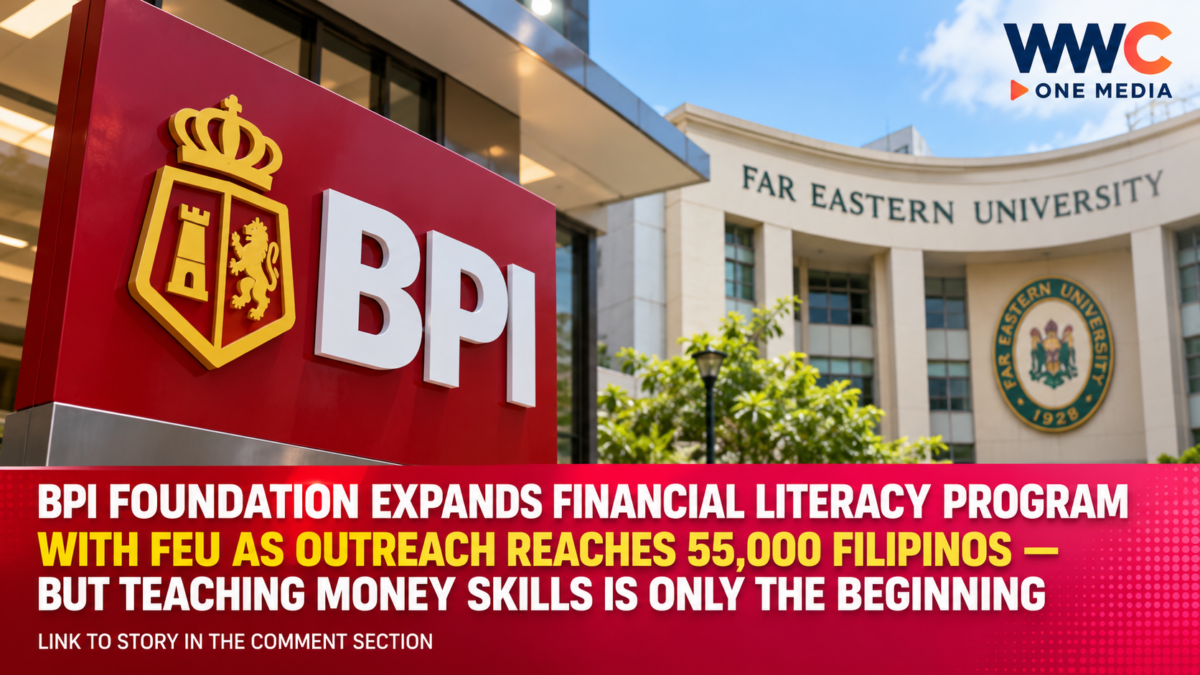
MANILA, Philippines — BPI Foundation is strengthening its partnership with Far Eastern University to teach young Filipinos how to save money, manage debt, avoid financial scams and make more informed financial decisions, as the bank-backed organization expands its education efforts nationwide.
The partnership brings together practical money-management training, leadership development and a program designed to prepare students and volunteer educators to share financial knowledge with underserved communities.
More than 200 FEU participants have already attended financial education sessions, while over 700 students are expected to receive educational booklets and other learning materials.
The expansion comes as BPI Foundation reports that its financial education initiatives reached more than 55,000 individuals by September 2026.
But behind the growing participation numbers is a question that matters to students and working families:
Can financial literacy programs help young Filipinos build better financial habits and avoid costly borrowing mistakes — or will knowledge alone prove insufficient against financial pressures and increasingly sophisticated scams?
BPI Foundation Brings Practical Financial Education to FEU
The Bank of the Philippine Islands, through its social development arm BPI Foundation, is expanding financial education through its partnership with Far Eastern University.
The collaboration was formally established on May 6, 2026.
It combines classroom learning, industry engagement, leadership discussions and community outreach.
The latest activities took place on September 30, when BPI President and Chief Executive Officer Jose Teodoro “TG” Limcaoco addressed the university community during FEU’s Unmasked Talk Series.
More than 300 students, faculty members and university leaders joined the leadership event.
Meanwhile, a separate financial literacy program reached more than 200 participants.
These figures describe different activities and should not be combined as though they were entirely separate individuals.
The initiative is designed to connect financial knowledge with the everyday decisions students will face as they enter employment, pursue entrepreneurship or begin managing independent finances.
Students Learn About Savings, Debt and Investments
A key component of the partnership is BPI Foundation’s FinEd Unboxed program.
The initiative introduces participants to six practical financial topics:
Saving money: Building financial discipline, setting aside funds and preparing for unexpected expenses.
Debt management: Understanding repayment responsibilities, borrowing costs and the risks of taking on obligations beyond one’s capacity.
Insurance: Learning how financial protection can help manage certain risks.
Investments: Understanding basic investment concepts, potential returns and the importance of evaluating risk before committing money.
Retirement planning: Recognizing why long-term savings and preparation matter even at a young age.
Fraud prevention: Learning to identify suspicious financial offers, impersonation attempts and other potentially harmful schemes.
Together, these lessons aim to help students make more informed choices.
However, completing a seminar does not guarantee financial security or make every participant a qualified financial adviser.
Investment decisions and other complex financial commitments still require careful evaluation of individual circumstances and product terms.
BPI Introduces Train-the-Trainers Program
One of the most important aspects of the FEU partnership is its Train-the-Trainers component.
Instead of limiting financial education to participants at a single event, BPI Foundation is preparing student leaders and volunteer educators to conduct future financial wellness sessions.
The strategy is intended to create a multiplier effect.
Students who learn basic financial principles can help share those lessons with classmates, families and partner communities.
This could extend the program’s reach beyond the university campus.
It also gives participants opportunities to develop leadership, communication and community-service skills.
But the effectiveness of this approach will depend on the quality of training, the accuracy of the materials and the preparation of volunteers.
Financial topics can be complicated, particularly when discussions involve investments, insurance contracts or borrowing terms.
Trained volunteers should therefore help people understand general financial concepts without presenting themselves as substitutes for licensed professionals where specialized advice is necessary.
FEU Becomes BPI Foundation’s 10th School Partner Since 2025
The foundation’s partnership with FEU is part of a wider school-based education strategy.
FEU became the organization’s third partner school in 2026 and its 10th since 2025.
The foundation is also exploring an expansion of the initiative into other schools in the FEU network.
These include FEU Alabang, FEU Diliman and FEU Pampanga.
Such expansion could help the initiative reach students outside its initial university setting.
However, the proposed expansion should not be described as already completed.
Further rollout will depend on arrangements between the participating institutions, schedules and available program resources.
For FEU, the collaboration provides an opportunity to connect academic education with the practical financial decisions students encounter outside the classroom.
For BPI Foundation, it creates another channel through which its financial education materials and training programs can reach younger Filipinos.
BPI CEO TG Limcaoco Urges Students to Become Purpose-Driven Leaders
Financial education was not the only focus of the September 30 activities.
During FEU’s Unmasked Talk Series, Limcaoco challenged students to develop ambitious goals, continue learning and recognize the importance of supporting other people.
He identified aspiration, inspiration and appreciation as important elements of leadership.
The BPI chief also discussed the bank’s corporate values, known as NICE: Nurturing, Integrity, Customer Obsession and Excellence.
His message emphasized that leadership requires more than personal achievement.
It also involves developing teams, helping others succeed and responding responsibly to changing circumstances.
For students preparing to enter the workforce, these ideas are relevant to employment, entrepreneurship and professional development.
The leadership forum was attended by more than 300 members of the university community, including students, faculty and officials.
The event complements the foundation’s practical money-management activities, although attendance at the leadership discussion should not be counted as proof that all attendees completed the financial literacy program.
More Than 55,000 Filipinos Reached Through Financial Education
BPI Foundation said its financial education initiatives had reached more than 55,000 people nationwide as of September 2026.
That figure reflects the broader reach of the organization’s education activities rather than the FEU partnership alone.
The foundation has conducted programs through schools, community organizations and other partners.
Its expansion is intended to support financial inclusion by helping people better understand how to manage money and evaluate financial products.
But the 55,000 figure is a measure of reported reach.
It does not establish that every participant improved their savings, reduced debt or avoided financial fraud after attending a session.
Those longer-term outcomes would require follow-up assessments or other evidence.
The distinction matters because effective financial education should ultimately be evaluated not only by how many people it reaches but also by whether it helps participants make better decisions.
BPI and Knowledge Channel Take Financial Lessons Beyond Universities
The FEU partnership builds on a separate nationwide financial education initiative involving BPI Foundation and Knowledge Channel Foundation Inc.
In April 2026, the organizations renewed their collaboration to produce accessible financial literacy materials for young learners and educators.
The partnership expanded the Estudyantipid educational video series, which promotes practical budgeting and responsible money management.
New materials include lessons on saving and protecting oneself from online fraud.
In September, the organizations also delivered educational television equipment and digital learning resources to schools in Basilan, Zamboanga City, Guimaras and Iloilo City.
The learning packages include portable media libraries containing more than 1,500 curriculum-aligned video lessons.
These materials cover a broad range of subjects, not exclusively financial literacy.
The initiatives demonstrate how financial education can be distributed through broadcast media, digital resources and classroom partnerships.
For areas with limited internet connectivity, offline learning materials can also help make educational content more accessible.
University Financial Literacy Efforts Expand Outside Metro Manila
BPI Foundation’s FinEd Unboxed program is also being implemented through partnerships beyond Manila.
On October 10, 2026, Carlos Hilado Memorial State University in Negros Occidental conducted an opening financial education session for National Service Training Program students at its Alijis Campus.
The activity was organized with BPI Foundation and representatives from BPI branches.
The university described the initiative as part of efforts to help students develop practical money-management skills.
The expansion demonstrates how financial education is reaching different educational institutions rather than remaining concentrated in the capital.
This wider reach may be important for young people preparing to enter the workforce or manage small businesses.
Still, the availability and scope of future sessions will depend on the schedules and commitments of individual partner schools.
Why Young Filipinos Need Financial Education
Students and first-time workers face financial decisions that can have long-term consequences.
These include managing allowances or salaries, using electronic wallets, applying for credit, buying insurance and evaluating investment opportunities.
Digital financial services have made many transactions easier and faster.
But convenience can also create risks when consumers do not fully understand the terms of the services they use.
A student may be attracted to a lending offer without recognizing the total repayment cost.
A young worker may receive an investment solicitation promising unusually high returns.
An online shopper may encounter a fraudulent payment link or impersonation message.
Financial education can help people ask the right questions before making such decisions.
However, awareness is only one form of protection.
Consumers also need accurate disclosures, secure financial platforms, reliable complaint channels and fair treatment from financial service providers.
Fraud Prevention Becomes a Critical Part of the Program
Fraud prevention is among the major topics included in FinEd Unboxed.
This is particularly relevant as financial activity increasingly moves online.
Scammers can impersonate banks, payment providers, government agencies and trusted individuals to obtain sensitive information or money.
Some schemes involve fraudulent investment offers, false emergencies or requests for one-time passwords.
Basic financial literacy can help consumers recognize warning signs.
For example, legitimate financial decisions should not depend on promises of guaranteed high returns or demands to reveal confidential banking credentials.
Consumers should verify financial products through official institutions and appropriate regulators.
But even financially knowledgeable individuals can become victims of sophisticated scams.
The responsibility for consumer protection must therefore be shared by regulators, banks, technology companies and law enforcement agencies.
Financial Inclusion Requires More Than Education
BPI Foundation’s efforts form part of a wider discussion about financial inclusion in the Philippines.
Bangko Sentral ng Pilipinas data released in May 2026 showed that 58% of Filipino adults owned a formal financial account during the first quarter of the year, based on a Social Weather Stations survey.
The results indicate progress in access to banking and electronic money services.
However, approximately 42% of adults still did not report formal account ownership under the survey measure.
Financial education can help people become more confident when considering formal financial services.
But information alone cannot resolve every barrier to inclusion.
Some people may lack the income required to save regularly.
Others may face transportation costs, documentation challenges or limited access to suitable financial products.
For genuine financial inclusion, education must be accompanied by accessible, affordable and trustworthy services.
Will Financial Literacy Translate Into Real Financial Progress?
The BPI Foundation–FEU partnership represents an expansion of practical financial education for young Filipinos.
The program combines classroom sessions, learning materials, leadership development and community-based training.
Its Train-the-Trainers model also aims to extend the benefits to people beyond those attending the initial activities.
But a successful financial literacy initiative should eventually demonstrate more than participation totals.
Useful indicators could include whether students understand loan charges more clearly, begin saving consistently, identify scams more effectively or apply practical budgeting habits.
These outcomes require measurement over time.
Neither the FEU partnership announcement nor the additional reporting reviewed establishes such long-term results for the participating students.
That does not diminish the initiative’s potential value.
It establishes the next challenge for the organizers: turning knowledge into practical financial behavior.
The Bigger Challenge: Building a Financially Confident Generation
BPI Foundation has reported reaching more than 55,000 individuals through financial education initiatives as of September 2026.
Its collaboration with FEU adds another university partnership to an expanding network of schools and community programs.
For students, the sessions provide an opportunity to understand subjects that may not always receive sustained attention in conventional classroom instruction.
For volunteer educators, the training offers a way to bring those lessons into additional communities.
The partnership also illustrates how banks and educational institutions can work together on practical consumer education.
But lasting financial well-being depends on more than knowledge.
It requires the ability to earn, save, borrow responsibly and access financial products that genuinely serve individual needs.
BPI Foundation is expanding its financial literacy programs through FEU and other educational partners. The bigger test is whether those lessons can help young Filipinos build lasting money-management habits, avoid financial traps and gain greater control over their financial futures.