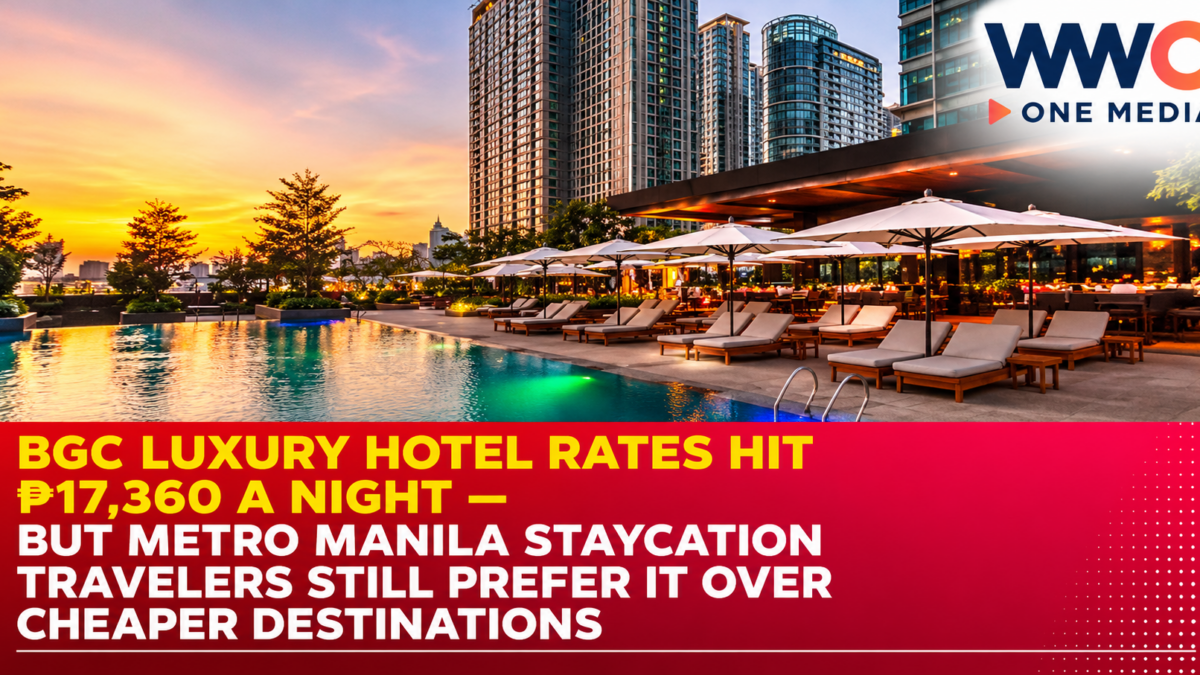
TAGUIG CITY, Philippines — Spending more than ₱17,000 for a single night at a luxury hotel may seem extravagant, but Bonifacio Global City (BGC) continues to dominate Metro Manila’s staycation preferences, even as upscale hotel rates rise and competition intensifies.
A Colliers Philippines survey identified Fort Bonifacio as the most preferred hotel staycation location among respondents, ahead of Manila Bay, Makati, Alabang, Ortigas and Quezon City.
The findings highlight the growing appeal of convenient urban escapes, where travelers can experience premium accommodations, restaurants, shopping centers and entertainment without paying for airfare or leaving Metro Manila.
But the story goes beyond the city’s luxury reputation.
While BGC hotels command some of the capital region’s highest room rates, the broader hotel market is facing softer occupancy and an incoming wave of additional rooms.
The biggest question: Can BGC maintain its premium prices and popularity as hotel operators fight harder for travelers in an increasingly competitive market?
BGC Takes the Top Spot for Metro Manila Staycations
According to Colliers’ survey findings, nearly one in three respondents selected Fort Bonifacio as their preferred location for a future hotel staycation.
The preference ranking showed:
- Fort Bonifacio/BGC — approximately one-third of respondents
- Manila Bay — 26%
- Makati CBD — 24%
- Alabang — 11%
- Ortigas — 4%
- Quezon City — 3%
The figures reflect the stated preferences of survey respondents, rather than confirmed hotel reservations or actual market shares.
Still, they provide an indication of what travelers value when choosing a local getaway.
BGC offers a concentration of international hotels, premium restaurants, shopping destinations, entertainment venues and pedestrian-friendly commercial districts.
For Metro Manila residents who want a short break without a flight or a long road trip, these amenities can make a staycation attractive despite higher accommodation costs.
BGC Five-Star Hotels Average More Than ₱17,000 a Night
BGC’s five-star hotel segment recorded an average daily rate of $284.60, equivalent to approximately ₱17,360, during the first half of 2026.
That represented an 11.3% increase from the comparable period a year earlier, based on figures reported by InsiderPH from Colliers.
The increase indicates that luxury hotels in the district maintained considerable pricing power despite wider pressures on the hospitality industry.
However, the ₱17,360 figure is a segment-wide average daily room rate, not a fixed selling price at every five-star hotel.
Individual room prices can be higher or lower depending on hotel brand, booking date, occupancy, promotions, room category and included services.
Taxes and additional charges may also affect the final amount paid.
For travelers, this means advertised discounts and weekend packages should be compared using the total booking price rather than the nightly room rate alone.
Manila Bay and Makati Offer Lower Luxury Hotel Rates
The difference in room prices across Metro Manila is substantial.
While BGC’s five-star hotels averaged about ₱17,360 per night, comparable luxury hotels in Manila Bay averaged approximately ₱11,200.
That followed a year-on-year decline of nearly 20% in Manila Bay’s five-star rates.
Makati’s five-star hotels, meanwhile, recorded an average nightly rate of about ₱12,400, reflecting an increase of approximately 6%.
The comparison shows that luxury accommodation does not carry the same price premium in every Metro Manila business district.
For travelers looking primarily for hotel facilities rather than a specific neighborhood, Manila Bay and Makati may provide alternative options.
However, price differences do not necessarily mean the hotels offer identical room types, amenities or experiences.
The better choice depends on location, accessibility, hotel facilities and the purpose of the stay.
Four-Star Hotels in BGC Are Also Expensive
BGC’s premium positioning extends beyond five-star properties.
Four-star hotels in the district averaged nearly ₱6,000 per night during the first half of 2026.
Interestingly, those rates were approximately 23.5% lower than a year earlier.
The decline suggests that different hotel categories within the same district are experiencing contrasting pricing conditions.
While five-star properties increased rates, four-star hotels became more competitively priced.
For cost-conscious travelers, this creates opportunities to experience the district without necessarily paying luxury five-star prices.
Nevertheless, ₱6,000 remains a substantial expense for a one-night stay, particularly when dining, parking, transportation and other activities are added.
The difference between four-star and five-star pricing also highlights the importance of comparing the overall guest experience rather than choosing accommodation solely by hotel classification.
Why Travelers Keep Choosing BGC
Location remains one of BGC’s major strengths.
Travelers can move between hotels, restaurants, cafés, shopping centers and entertainment destinations without needing to arrange long trips across Metro Manila.
The district also provides a convenient base for visitors attending meetings, conferences, weddings and social gatherings.
This combination of business and leisure appeal supports what hospitality analysts call the “bleisure” market, where travel experiences incorporate both professional and recreational activities.
Colliers has repeatedly identified Fort Bonifacio as a preferred location for hotel stays, noting the value of integrated districts that combine commercial amenities with quality accommodation.
A similar Colliers survey in 2025 ranked Fort Bonifacio first for staycations, with 34% of respondents choosing it ahead of Makati and Manila Bay.
The continued preference suggests that BGC’s appeal is not limited to a single survey period.
However, repeated preference rankings do not establish that all BGC hotels are fully booked or financially outperforming every other district.
Metro Manila Hotel Occupancy Slips to 63%
The popularity of BGC comes against a more challenging backdrop for the wider hotel industry.
Colliers’ first-half 2026 hotel market report showed that Metro Manila hotel occupancy declined to approximately 63%.
The consultancy attributed the softer performance partly to weaker meetings and convention activity and uncertainty related to geopolitical tensions in the Middle East.
Yet average daily room rates continued rising.
Colliers reported that Metro Manila hotel rates increased 2.4% from the preceding half-year period.
The contrast points to a market where certain hotels can maintain or raise room prices even as overall occupancy weakens.
For operators, however, higher rates do not automatically guarantee stronger financial performance.
Revenue also depends on the number of rooms sold, operating expenses and other income from restaurants, events and hospitality services.
Hotels therefore face the challenge of maintaining pricing power while attracting enough guests to keep their properties profitable.
Almost 2,500 New Hotel Rooms Expected in 2026
Competition is set to increase as more hotels enter the Metro Manila market.
Colliers expects approximately 2,490 additional hotel rooms to be completed during 2026, although construction delays have reduced the forecast from an earlier estimate of nearly 2,900 rooms.
Among the developments identified by the consultancy are Dusit Greenhills Manila, Canopy by Hilton, Seda Hotel Arca South and Mandarin Oriental Makati.
The expansion of international and local hotel brands demonstrates continuing investor interest in Philippine hospitality.
But additional rooms also create pressure on existing operators to differentiate their products and services.
Some hotels may compete through discounted packages, while others may focus on wellness facilities, dining experiences, corporate events or premium customer service.
Colliers expects hotel operators to strengthen partnerships with tourism organizations, event organizers and business customers to sustain demand.
For travelers, stronger competition could create more choices and occasional promotional opportunities.
It does not, however, guarantee that luxury room rates will fall across the market.
Domestic Tourism Remains a Critical Growth Driver
The Philippine hotel industry continues to benefit from domestic travel, even as operators seek to attract more foreign visitors.
According to Colliers, international visitor arrivals reached 3.16 million during the first half of 2026, up 5.4% year-on-year.
The consultancy said improved arrivals from China and India contributed to the increase.
Domestic tourism and business travel also supported the hospitality market.
Separate industry reporting by BusinessWorld emphasized the growing importance of domestic corporate events and meetings to hotel demand.
Meanwhile, hotel operators are exploring packages that combine accommodation, dining, wellness and event services.
The trend helps explain why a district such as BGC, with concentrated business and leisure infrastructure, remains attractive.
For residents, the district provides an escape from daily routines without the complexity of out-of-town travel.
For business visitors, it offers proximity to offices, conference facilities and commercial services.
Is a ₱17,000 BGC Staycation Worth It?
The answer depends on the traveler’s budget, priorities and expectations.
A five-star hotel may appeal to guests seeking premium service, resort-style amenities, upscale dining or a special celebration.
Others may prefer a four-star property, shorter stay or a hotel in another district with lower average room rates.
Travelers comparing staycation options should evaluate the total cost of accommodation, meals, transportation and other expenses.
It is also useful to examine cancellation conditions, breakfast inclusions, parking charges and access to facilities.
The most expensive hotel is not automatically the best choice, and the cheapest available room does not necessarily offer the strongest overall value.
For consumers, the growing range of Metro Manila hotels creates opportunities to make choices based on experience rather than brand prestige alone.
The Bigger Battle for Metro Manila’s Staycation Market
BGC’s position at the top of the staycation preference ranking reflects the appeal of an integrated urban lifestyle.
Its concentration of restaurants, retail centers, hotels and business facilities gives visitors several reasons to choose the district.
The higher average rates in its five-star segment indicate that some luxury operators continue commanding a premium.
But the wider hospitality market is changing.
More rooms are entering Metro Manila, overall occupancy has softened, and travelers have alternatives across Makati, Manila Bay, Alabang, Ortigas and Quezon City.
Hotel operators must balance competitive pricing with the quality of the experience they provide.
For BGC, the challenge will be sustaining its status as a preferred destination without relying entirely on its premium image.
BGC may command average five-star hotel rates exceeding ₱17,000 a night, but surveyed travelers still rank it as Metro Manila’s leading staycation destination. The bigger question is whether that premium appeal can survive rising competition, softer occupancy and travelers becoming more selective about where they spend their money.










