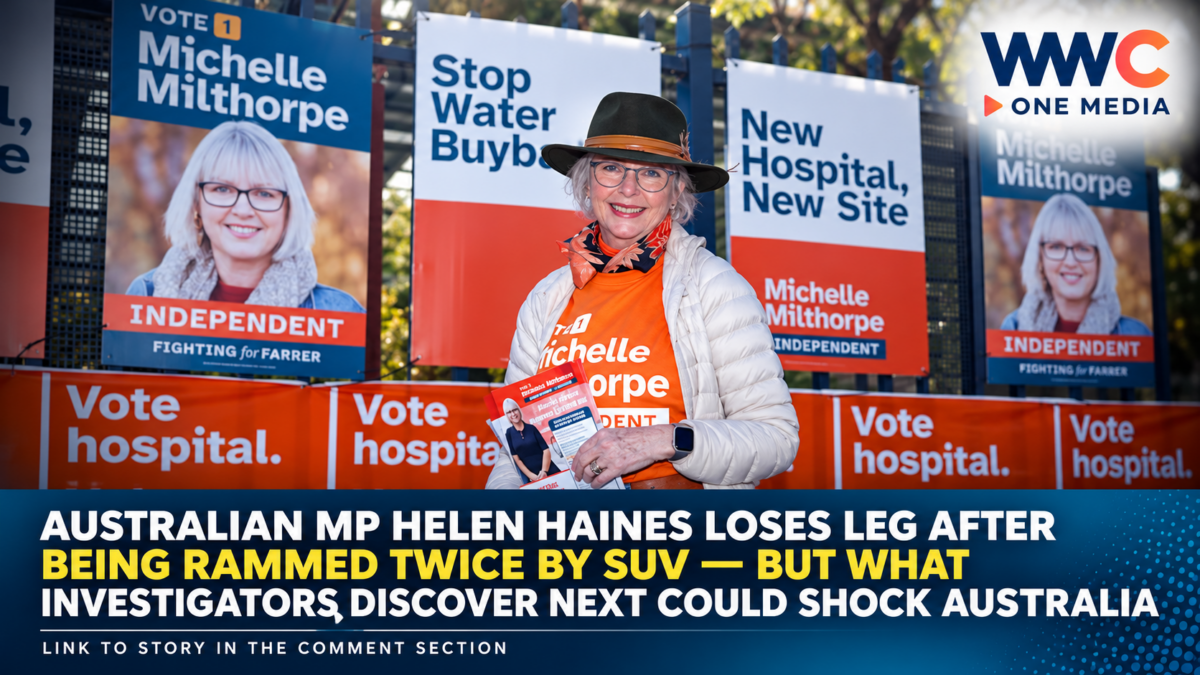
WANGARATTA, AUSTRALIA — Australia has been shaken by a violent attack on independent lawmaker Helen Haines, who lost one leg and remained in critical condition after allegedly being deliberately struck twice by a vehicle outside her electorate office in Victoria.
The October 19 attack has triggered a major investigation involving Australian counter-terrorism authorities, with Prime Minister Anthony Albanese warning that escalating political hostility threatens the country’s democratic culture.
The 65-year-old federal MP, who represents the regional electorate of Indi, underwent emergency surgery after being airlifted to Melbourne’s Alfred Hospital. Reports on October 20 said surgeons were working to save her other leg.
Driver Allegedly Turned Around and Struck Lawmaker Twice
According to Australian investigators and witness accounts reported by Reuters, The Guardian and the Associated Press, Haines was near the rear of her parked vehicle outside her Wangaratta office when a Toyota Land Cruiser allegedly turned toward her.
Home Affairs Minister Tony Burke said witnesses described the driver making a U-turn, striking Haines and then reversing into her a second time.
A nearby barber, Ricky Jefferies, rushed from his business after hearing the impact and helped restrain the driver until officers arrived.
Police arrested a 43-year-old man from Tarrawingee, a community near Wangaratta. Authorities also confirmed that a knife was recovered in connection with the incident, although there was no confirmed account that it was used to injure Haines.
Guardian Australia identified the arrested man as Brendan Nugent. His alleged involvement remains subject to investigation and the legal process.
Terrorism Investigators Called In as Questions Mount Over Motive
Australian federal authorities are examining whether the incident involved politically motivated violence.
Albanese said the collision was not being treated as an ordinary road accident and condemned the apparent deliberate targeting of the independent parliamentarian.
The investigation involves federal and state authorities, including counter-terrorism specialists, who are examining the suspect’s actions and potential motivations.
However, the involvement of counter-terrorism investigators does not establish that the attack was terrorism. Authorities have not publicly confirmed a motive or established that the suspect acted on behalf of any organization.
Australian Federal Police Commissioner Krissy Barrett said preliminary findings suggested an isolated incident, with no evidence at that stage of a wider threat.
Who Is Helen Haines, the Australian MP at the Center of the Attack?
Haines entered the Australian Parliament in 2019 after working as a nurse, midwife and academic.
She became a prominent independent voice in national politics, particularly on government accountability, integrity reform and climate policy.
Representing Indi in northeastern Victoria, she secured reelection in 2022 and 2025, building on the independent political movement associated with former MP Catherine McGowan.
Her political reputation has been defined by community engagement and a willingness to work across party lines.
Following the attack, politicians across Australia’s political spectrum expressed shock and support for Haines, highlighting the country’s tradition of relatively accessible elected representatives.
Australia Faces Growing Concerns Over Political Threats
The attack has renewed debate about whether Australian politicians can continue meeting voters and attending public events without more extensive security protection.
According to the Associated Press, official figures recorded more than 1,000 threats against politicians during Australia’s 2025–2026 financial year. Police had previously reported that threats against parliamentarians doubled over a three-year period.
Albanese also warned about the increasingly confrontational tone of Australian political discussions, including hostility spreading through social media.
But investigators have yet to establish whether that broader atmosphere contributed directly to the attack on Haines.
The incident has already had a visible impact beyond Victoria. The West Australian reported an increased armed police presence around Western Australia’s Parliament on October 20 as lawmakers debated security and the risks of political violence.
The Bigger Question: Can Australia Protect Its Politicians Without Losing Public Access?
The attack has exposed a difficult dilemma for Australia’s democratic institutions.
Public accessibility has long been an important feature of the country’s political culture. Constituency offices, community gatherings and casual encounters allow representatives to maintain direct contact with the people they serve.
Yet a deliberate assault on an elected official raises serious questions about whether existing security arrangements are sufficient.
Authorities now face two immediate priorities: establishing the suspect’s motive and determining whether additional protections are necessary for public officials.
For Haines, the immediate focus remains her medical condition and recovery. For Australia, the case may become a defining test of how a democratic society responds to serious violence against an elected representative.
The critical question is no longer only what happened in Wangaratta, but what measures Australia may need to prevent another such attack.
As the investigation continues, authorities have not confirmed the motive, and any wider political or ideological connection remains unproven.










