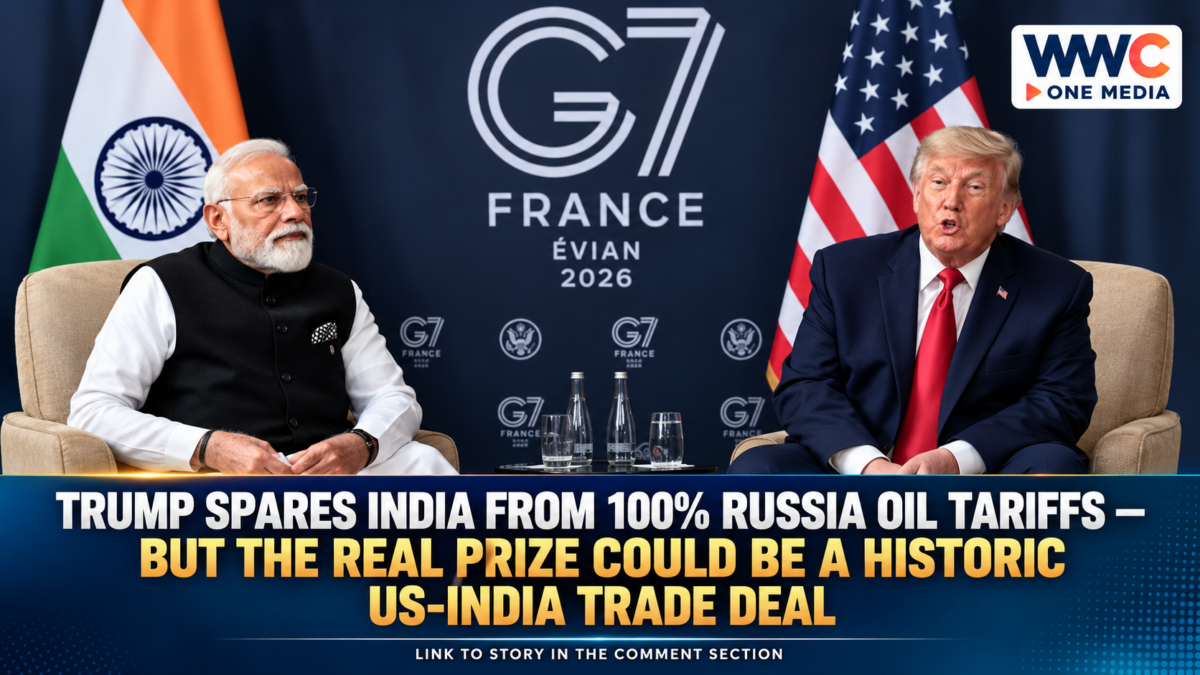
US President Donald Trump has handed India a significant economic and diplomatic reprieve by waiving key sanctions and tariffs linked to Russian energy purchases, removing an immediate threat that could have exposed Indian exports to punitive US tariffs of up to 100%.
The decision, announced through an executive order on October 16, comes as India faces mounting pressure from high global oil prices, declining Russian crude imports and uncertainty surrounding its long-awaited trade negotiations with Washington.
For Prime Minister Narendra Modi, the waiver offers more than temporary relief from possible trade penalties. It creates an opportunity to protect India’s energy supplies while advancing an agreement with the United States that has been delayed by tariff disputes and broader political tensions.
But Washington’s concession raises a bigger question: Is Trump clearing the way for a breakthrough trade deal, or merely giving India a temporary escape from another economic confrontation?
Washington Removes a Major Threat to India’s Economy
The sanctions waiver suspends the application of key measures under the Lindsey O. Graham Sanctioning Russia and Iran Act of 2026, commonly known as the Graham Act.
The legislation created the possibility of steep tariffs and other penalties targeting countries and companies involved in Russian energy trade.
India was particularly vulnerable because it remains one of the world’s largest buyers of Russian crude oil.
Trump justified his decision on US national-interest grounds, effectively giving Washington flexibility in balancing pressure on Russia against its economic and diplomatic priorities.
The relief is significant, but the threatened 100% tariff had not actually taken effect. The executive order prevents the immediate application of the relevant measures rather than reversing a tariff already collected on Indian exports.
Marco Rubio Says US-India Trade Deal Is Nearly Complete
US Secretary of State Marco Rubio has confirmed that ongoing trade negotiations with India influenced Washington’s decision.
Speaking to reporters in Uzbekistan on October 19, Rubio described negotiations as close to completion and acknowledged that the potential agreement was a consideration in granting the waiver.
His scheduled October 20 visit to India includes talks with External Affairs Minister Subrahmanyam Jaishankar covering trade, investment, energy security and defense cooperation.
The timing is significant.
Washington and New Delhi have spent months attempting to finalize a bilateral trade agreement. However, disputes surrounding Russian oil imports, trade duties and US investigations into foreign manufacturing practices have complicated the negotiations.
The waiver eliminates one immediate obstacle and gives negotiators additional room to seek a compromise.
According to Reuters, Atlantic Council senior fellow Michael Kugelman described the move as a potentially important confidence-building measure at a critical moment in bilateral relations.
Why Russian Oil Matters So Much to India
India is the world’s third-largest oil importer and consumer, making affordable crude supplies a central concern for its economy.
Earlier in 2026, Russian oil accounted for nearly half of India’s crude imports, according to Reuters. However, purchases declined in August and continued falling as Indian refiners faced growing political and commercial uncertainty.
100%
Maximum threatened tariff on targeted imports
No. 3
India’s global oil import ranking
~50%
Russian share of Indian oil imports earlier in 2026
Figures reflect the reported tariff threat and historical oil-import profile, not current tariff collections or today’s oil-import share.
CNA
+1
Reducing reliance on Russian oil has consequences.
If Indian refiners must replace discounted Russian crude with more expensive shipments, fuel import costs could rise. Higher crude prices can create additional pressure on inflation, transportation expenses, corporate operating costs and government finances.
Such pressures are especially sensitive as India approaches regional elections, when rising household expenses can become a significant political issue.
The waiver does not guarantee uninterrupted Russian oil shipments. But it reduces an immediate source of uncertainty for companies deciding where to purchase their crude.
The Indian Express
+1
Global Oil Prices Add Urgency to Trump’s Decision
The wider oil market provides another explanation for Washington’s change in approach.
International crude prices have been elevated by escalating Middle East tensions, disruptions to shipping routes and continued attacks affecting Russian energy infrastructure.
The Wall Street Journal reported that Brent crude slipped to approximately $109.55 a barrel on October 19 as traders assessed the implications of the US sanctions waiver.
However, easing restrictions on Russian energy does not automatically resolve physical supply disruptions.
Oil shipments remain exposed to geopolitical risks around the Strait of Hormuz and Bab al-Mandeb, while damage to energy facilities and higher shipping costs continue to complicate global supply chains.
For major Asian energy importers, including India, the Philippines, Japan and South Korea, prolonged high oil prices can increase import bills and pressure domestic fuel markets.
The easing of sanctions may reduce some market anxiety, but a sustained decline in oil prices would likely require broader improvements in global supply and shipping conditions.
The Biggest Obstacle: US Tariffs Are Still Unresolved
Despite growing optimism, a US-India trade agreement is not yet guaranteed.
India is seeking clarity on Washington’s tariff policies before signing the first phase of the proposed agreement.
According to the Financial Express, Indian Commerce Secretary Rajesh Agrawal has emphasized the importance of predictable tariff arrangements and preferential access for Indian exporters.
Another complication is an ongoing US Section 301 investigation into alleged excess manufacturing capacity in several economies, including India.
New Delhi wants any agreement to provide a meaningful competitive advantage for its exporters, rather than merely preserving access to the American market.
The central uncertainty is whether both countries can resolve these issues before political or economic conditions change again.
Is Trump’s Russia Waiver Permanent?
Not necessarily.
The Indian Express reported that Washington has established a 60-day review period to assess the broader effects of sanctions and related tariffs amid global energy disruptions.
This means the waiver provides immediate breathing room without necessarily eliminating the possibility of future restrictions.
The distinction matters for Indian companies making long-term purchasing decisions. Refiners, manufacturers and exporters need predictable regulations, not just short-term political assurances.
If energy prices rise further, or negotiations deteriorate, the Trump administration could face renewed pressure to reconsider its sanctions strategy.
What Happens Next?
Rubio’s meetings in India could provide a clearer indication of whether the two countries are ready to conclude their trade agreement.
For New Delhi, success would mean securing tariff certainty, preserving flexibility in energy sourcing and strengthening economic ties with the world’s largest economy.
For Washington, an agreement could deepen relations with an important Indo-Pacific partner while advancing American commercial and strategic interests.
The outcome could also influence wider Asian trade and energy markets, particularly if changes in India’s oil purchases alter demand for Russian and Middle Eastern crude.
The bottom line: Trump’s sanctions waiver has removed a major immediate threat to India’s economy and created fresh momentum for US-India trade negotiations. But a final agreement remains dependent on unresolved tariff rules, energy security concerns and the political willingness of both governments to compromise.
The next test is whether Washington and New Delhi can transform this temporary diplomatic opening into a lasting economic partnership.