RIYADH, Saudi Arabia — October 20, 2026
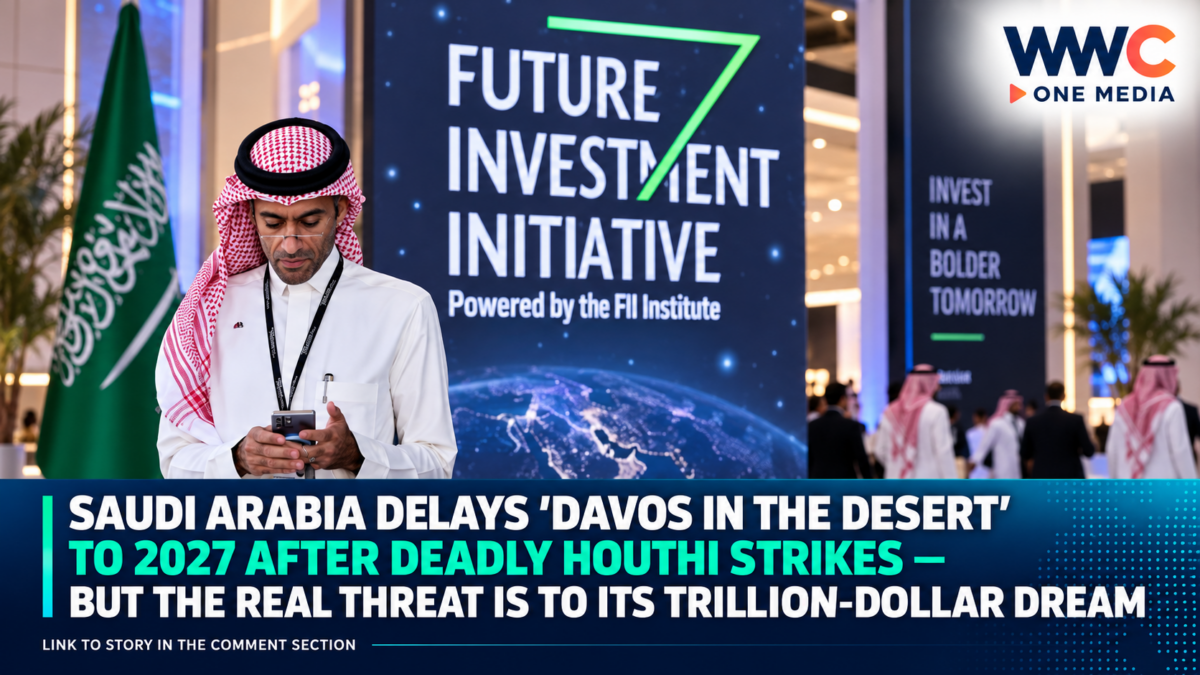
Saudi Arabia has postponed one of the Middle East’s most influential investment gatherings until 2027, as deadly attacks by Yemen’s Iran-backed Houthi rebels raise fresh concerns over regional security, international travel and the kingdom’s ambitions to become a global business powerhouse.
The Future Investment Initiative (FII), widely known as “Davos in the Desert,” was originally scheduled for October 26–29, 2026, in Riyadh. Its highly anticipated tenth edition will now take place in 2027, with organizers promising to announce revised dates soon.
The decision represents more than a scheduling disruption. It highlights the growing economic consequences of the regional conflict and raises a critical question for Saudi Arabia: Can the kingdom continue attracting international investors while missiles and drones threaten its infrastructure?
A Global Investment Showcase Forced to Retreat
For nearly a decade, the Future Investment Initiative has been an important platform for Saudi Arabia’s campaign to position itself as a leading international investment destination.
The conference regularly brings together influential financial executives, multinational corporate leaders, policymakers and investors to discuss economic transformation, technology, energy and global capital flows.
The 2026 gathering was supposed to celebrate the conference’s tenth edition under the theme “The Power of Legacy.”
Instead, mounting security concerns have forced organizers to abandon the original schedule.
FII Institute chief executive Maha Al Saud confirmed the postponement, explaining that organizers wanted the landmark anniversary gathering to meet the scale and standards expected by its international participants.
The institute also confirmed that existing registrations and partnerships would remain valid.
Although organizers framed their decision around protecting the quality of the conference, its postponement comes amid serious concerns about the safety of international visitors traveling to Riyadh.
Deadly Houthi Attacks Change the Equation
Saudi Arabia’s security environment has deteriorated following a series of missile and drone attacks attributed to Yemen’s Houthi movement.
On October 10, an attack on Riyadh’s King Khalid International Airport killed 13 people, causing major disruption to airport operations and raising concerns among international travelers.
The airport attack was described as the deadliest strike on Saudi territory in more than a decade.
Subsequent attacks and threats against strategic infrastructure have intensified fears about the conflict spreading beyond military targets into commercial aviation, energy infrastructure and major business districts.
In another significant development, Houthi forces struck the headquarters of Saudi oil giant Aramco in Dhahran, damaging part of the building without causing reported fatalities.
The attacks have demonstrated how the escalating conflict can disrupt economic activities even in a country investing heavily in security and international business expansion.
Global Financial Leaders Face Difficult Travel Decisions
The Future Investment Initiative was expected to attract some of the biggest names in international finance.
Among the prominent figures associated with this year’s planned conference were BlackRock chief executive Larry Fink and JPMorgan Chase chief executive Jamie Dimon.
Executives from other major international banks were also expected to participate.
However, increasingly serious security concerns have made corporate travel to Saudi Arabia more complicated.
Organizers had reportedly explored alternative arrangements, including virtual participation and alternative travel routes, to keep the conference on schedule.
Ultimately, postponement emerged as the preferred option.
For international companies, the decision reflects a difficult balance between pursuing opportunities in one of the world’s largest economies and protecting employees from escalating regional risks.
Saudi Arabia’s Vision 2030 Faces a Security Test
The postponement comes at a sensitive moment for Saudi Crown Prince Mohammed bin Salman’s Vision 2030 economic transformation program.
The ambitious strategy seeks to reduce Saudi Arabia’s long-standing dependence on oil revenues by expanding investment in tourism, technology, entertainment, infrastructure, financial services and other industries.
International capital is essential to supporting many of these projects.
But geopolitical instability threatens to complicate the kingdom’s efforts to convince foreign companies that Saudi Arabia offers a secure environment for long-term investment.
The country has set an ambitious objective of attracting $100 billion in annual foreign direct investment by 2030.
According to additional reporting, Saudi Arabia attracted approximately $33 billion in foreign direct investment in the previous year, illustrating the gap between recent investment inflows and its longer-term ambitions.
The postponement does not mean Vision 2030 has failed, nor does it establish that investors are withdrawing their commitments.
It does, however, expose an important challenge: Saudi Arabia’s economic transformation requires not only substantial funding but also international confidence in its stability.
A Wider Middle East Conflict Threatens Business Confidence
The conference disruption reflects a broader regional problem.
The renewed fighting involving the Houthis, Saudi Arabia and other regional actors has raised concerns about commercial aviation, energy supplies and major international events.
On October 19, a Houthi missile attack on a Yemeni government military facility in Shabwa province reportedly killed at least 53 people and injured more than 200 others, illustrating the intensity of the renewed fighting.
Meanwhile, threats against Saudi airports and oil infrastructure have added another dimension to the regional security crisis.
For international businesses, the implications extend beyond one canceled conference date.
Companies considering investment in the Gulf must evaluate operational risks, employee safety, supply chain reliability and potential disruptions to transportation networks.
The postponement therefore adds to uncertainty surrounding the region’s business outlook.
What Happens Next?
The FII Institute says the conference’s tenth edition will proceed in 2027, although an exact date has not yet been announced.
Existing registrations and partnerships will remain valid, allowing organizers to preserve relationships with investors and corporate sponsors.
Saudi Arabia is also expected to continue pursuing its economic diversification strategy despite the worsening security environment.
However, the success of its future international investment gatherings may depend on the restoration of confidence in travel safety, regional stability and the kingdom’s ability to protect critical infrastructure.
The bigger question is no longer simply when Saudi Arabia can host its next investment summit. It is whether Riyadh can convince global investors that its enormous economic ambitions remain achievable amid a deepening regional conflict.
For Crown Prince Mohammed bin Salman, the challenge extends far beyond conference halls and executive meetings.
The kingdom must demonstrate that its vision of becoming a global investment powerhouse can withstand the geopolitical pressures surrounding it.
And until those pressures ease, even Saudi Arabia’s biggest business ambitions could face an increasingly uncertain path forward.