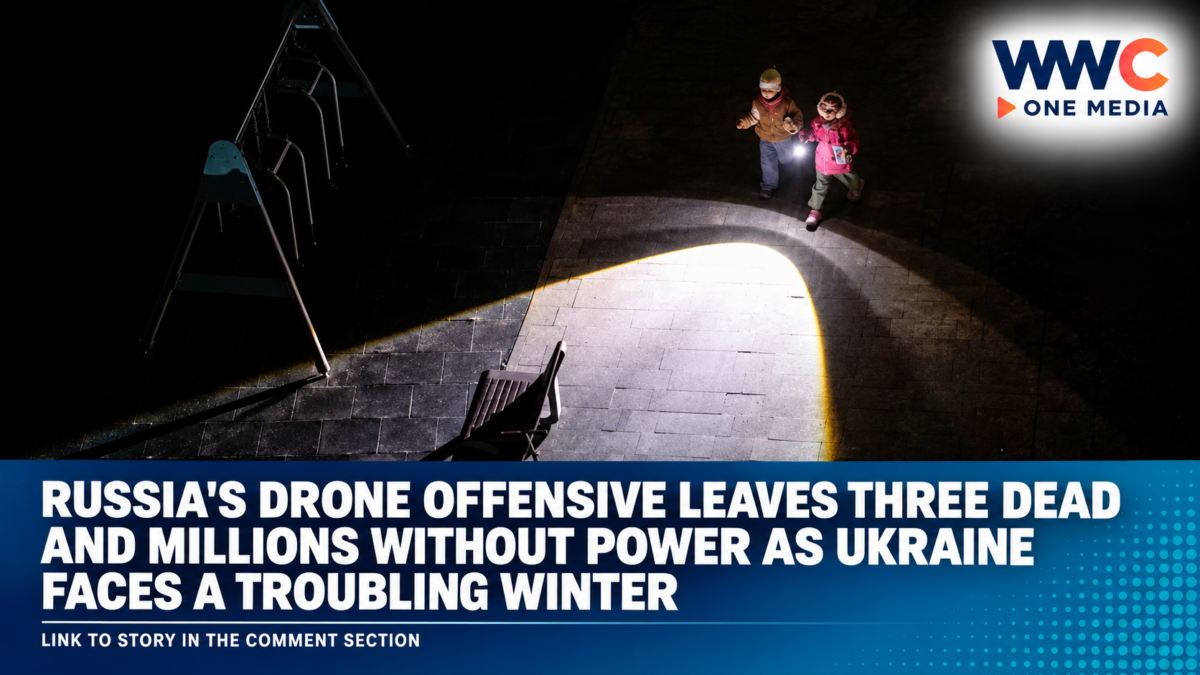
Russian drone attacks killed at least three people across Ukraine on October 16, 2026, while strikes on critical energy infrastructure temporarily disrupted electricity supplies to more than one million people, intensifying concerns over the country’s ability to withstand another difficult winter.
The overnight attacks struck several regions, damaging residential areas, commercial establishments, transportation facilities and energy infrastructure. Ukrainian authorities also reported casualties in the eastern city of Kharkiv and the northwestern Volyn region, which borders Poland.
In Kharkiv, a 71-year-old woman and a 58-year-old man were killed when Russian drones struck three districts of the city. Another 12 people were wounded, according to regional Governor Oleh Syniehubov.
In Volyn, a separate drone strike hit a food-processing facility, killing one person and injuring eight others, regional Governor Roman Romaniuk said.
The attacks also caused widespread electricity disruptions. Ukraine’s Energy Ministry reported that more than one million consumers had experienced power outages following the strikes. Repair crews managed to restore electricity to more than one million affected consumers, although the full extent of the remaining disruptions was initially unclear.
Volyn was among the hardest-hit areas. Approximately 370,000 people temporarily lost electricity, with around 100,000 reconnected by later Friday morning.
The situation remained particularly concerning in Lutsk, the regional capital, where Mayor Andriy Razumovskyi warned that electricity interruptions could continue for at least 24 hours.
Russian drone attacks also continued throughout the day, striking a customs terminal in the town of Kovel and setting approximately 10 trucks on fire. The town is strategically located along an important transportation route connecting Kyiv with Poland, making the damage particularly significant for logistics and cross-border trade.
Commercial establishments were also affected. At least two shopping centres were hit, including one in Sumy and another in the neighbouring Rivne region.
In Rivne, regional Governor Oleksandr Koval reported that seven people were wounded after drones struck a major shopping centre and other locations. Authorities also reported widespread electricity disruptions in parts of the city and surrounding communities following attacks on energy facilities.
Ukraine Faces Growing Pressure on Its Energy Infrastructure
The latest attacks highlight Moscow’s continued efforts to damage Ukraine’s electricity network as temperatures begin to fall and preparations for winter become increasingly urgent.
The situation has become particularly alarming in Kyiv, where Russian strikes have repeatedly targeted power plants, electrical substations and other critical infrastructure.
According to reporting by The Kyiv Independent, Russian attacks on October 15 caused power outages in portions of Kyiv and the surrounding region. Damage to energy facilities also affected water pressure in parts of the capital, forcing authorities to switch electricity supplies to water-pumping stations.
The developments demonstrate how attacks on electricity infrastructure can produce consequences extending beyond power shortages, potentially disrupting water services, heating systems, transportation and other essential public services.
The Guardian also reported on October 16 that Russia’s intensified campaign against Ukraine’s energy facilities could leave major cities facing prolonged blackouts during the winter. The publication examined documents reportedly obtained by Ukrainian intelligence outlining vulnerabilities in the country’s electricity, heating and water systems.
The report raised concerns that repeated strikes against power-generation facilities and substations could make living conditions increasingly difficult for civilians, particularly in densely populated urban areas.
Attacks Continue Despite Efforts to Halt Strikes on Energy Facilities
The latest bombardment also raises questions about efforts to reduce attacks on energy infrastructure.
US President Donald Trump had previously called for a halt to attacks targeting energy facilities in both countries. However, Ukrainian officials continued reporting Russian strikes against critical infrastructure.
The Associated Press reported on October 16 that Russian attacks across nine Ukrainian regions had disrupted electricity supplies to hundreds of thousands of households and injured at least 15 people.
The report also highlighted growing concerns about Ukraine’s air defence capabilities, particularly its shortage of US-made Patriot missile interceptors needed to counter Russia’s ballistic missile attacks.
Ukrainian President Volodymyr Zelenskyy has repeatedly warned that protecting the country’s energy infrastructure will become increasingly difficult as Russia intensifies its aerial campaign.
The broader humanitarian consequences are also becoming more serious. According to the United Nations human rights office in Ukraine, at least 328 civilians were killed and another 2,105 injured in September 2026. The combined number of civilian deaths and injuries was 85 per cent higher than during the same month last year.
The rising casualties underscore the growing risks faced by civilians as attacks increasingly affect residential neighbourhoods, commercial facilities and essential infrastructure.
A Difficult Winter Looms for Millions of Ukrainians
With Russia continuing to target electricity facilities, Ukraine faces another potentially challenging winter, when reliable access to electricity, heating and clean water becomes essential for millions of residents.
Although emergency repair teams have managed to restore electricity to many affected communities, repeated attacks could overwhelm repair operations and create further disruptions.
The latest strikes also demonstrate that the consequences of the Russia-Ukraine war extend far beyond the battlefield. Damaged shopping centres, burning transportation facilities, power outages and civilian casualties are placing additional pressure on communities already struggling after years of conflict.
As Moscow continues its aerial campaign and Kyiv works to strengthen its defences, the ability of Ukraine’s energy network to withstand further attacks could become one of the most important challenges facing the country in the coming months.
For millions of Ukrainians, the immediate concern is no longer simply whether electricity will be restored after an attack, but whether their homes and essential services can remain operational as winter approaches.