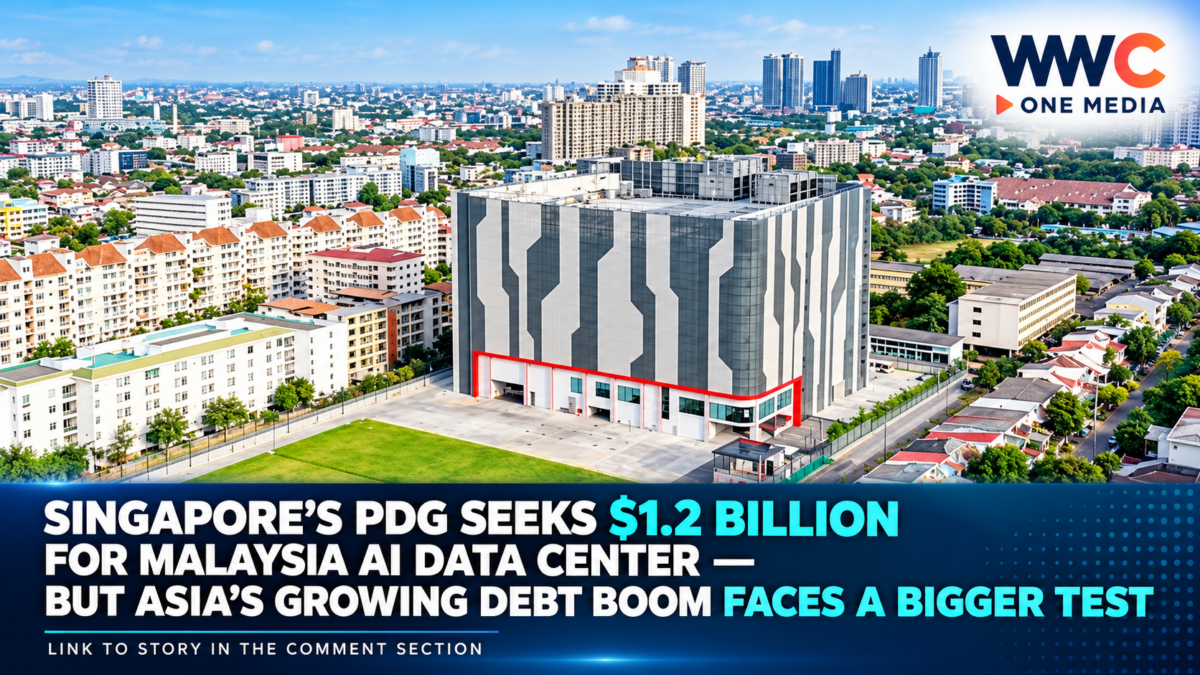
SINGAPORE / JOHOR, MALAYSIA — October 14, 2026 — Singapore-based Princeton Digital Group (PDG) is seeking a massive US$1.2-billion (RM4.9-billion) syndicated loan to finance its expanding data center operations in Malaysia, highlighting the enormous borrowing requirements behind Southeast Asia’s artificial intelligence revolution.
The proposed financing will support a 198.8-megawatt data center campus in Johor, the Malaysian state rapidly becoming one of Asia’s most strategically important locations for AI computing and hyperscale cloud infrastructure.
But the project comes at a crucial moment for the global technology industry.
While artificial intelligence continues to generate billions of dollars in infrastructure investment, concerns are growing over rising debt, financing costs, power consumption and whether future AI demand can justify the extraordinary amount of capital being committed.
For PDG, securing the proposed financing would represent another major step in its expansion across Asia.
For Malaysia, it would further strengthen Johor’s position as a leading destination for international technology investment.
And for investors, it raises an increasingly important question: How much more borrowing can the AI infrastructure industry sustain before financial returns come under greater pressure?
Five Major Banks Line Up for $1.2-Billion Financing
According to Bloomberg, citing a person familiar with the transaction, five major financial institutions are arranging the proposed three-year syndicated loan.
They include HSBC’s Singapore branch, Maybank Investment Bank, OCBC Bank (Malaysia), Standard Chartered Bank (Singapore) and United Overseas Bank (UOB).
The proposed borrower is Princeton Digital Group Labuan Alpha Ltd., a subsidiary of PDG.
The funds are intended for two purposes: financing the Johor data center campus and refinancing existing debt.
The involvement of major regional and international banks highlights the scale of financing required to develop modern data center facilities.
However, the participation of banks as mandated lead arrangers and bookrunners does not mean the loan has already been fully syndicated or disbursed.
Standard Chartered declined to comment on the reported transaction, while PDG and the other banks had not immediately responded to Bloomberg’s requests for comment.
Details including the final loan amount, pricing and completion date had not been publicly confirmed as of October 14.
Why Johor Is Becoming a Major AI Investment Hotspot
Johor has emerged as one of Southeast Asia’s most attractive destinations for large-scale data center development.
Located immediately north of Singapore, the Malaysian state combines proximity to a major international financial and technology hub with access to land suitable for industrial infrastructure.
Singapore’s limited land supply and stringent sustainability requirements have encouraged operators to pursue regional expansion strategies involving Malaysia and Indonesia.
Johor has benefited from this trend as demand accelerates for cloud services, AI computing, digital storage and network infrastructure.
For companies operating across the Singapore-Malaysia corridor, the arrangement offers an opportunity to serve regional customers while developing large-scale facilities outside Singapore’s constrained land market.
PDG is one of the companies pursuing this strategy.
Its Johor investments form part of a wider network designed to support hyperscale customers across multiple Asian markets.
But the rapid expansion also means competition is intensifying for land, electrical infrastructure, skilled workers and long-term customer contracts.
PDG Already Has a Multibillion-Dollar Asian Expansion Plan
The proposed US$1.2-billion financing is part of a much larger capital-raising effort.
In March 2026, Princeton Digital Group announced plans to raise up to US$5 billion in debt financing to support the development of contracted data center capacity across Asia.
At the time, the company disclosed that it operated across seven markets and had a portfolio exceeding 1.8 gigawatts.
PDG also confirmed the completion of an additional US$350-million financing agreement, which expanded an existing US$400-million holding-company loan to US$750 million.
That facility was converted into a sustainability-linked loan, connecting elements of its financing structure to specified operational and environmental performance targets.
These transactions demonstrate PDG’s strategy of using institutional debt markets to fund the capital-intensive development of hyperscale infrastructure.
However, its announced US$5-billion financing target should not be confused with money already fully raised.
It represents the company’s planned borrowing program, of which individual completed transactions and proposed deals form different components.
Johor Already Attracted a $280-Million Green Loan
PDG’s latest financing effort follows an earlier major transaction in Malaysia.
In May 2024, the company secured a US$280-million green loan for the first phase of its 150MW JH1 data center campus at Sedenak Tech Park in Johor.
The initial 52MW development formed part of a planned US$1.5-billion investment in an AI-ready facility.
Maybank, Standard Chartered and UOB Malaysia participated in that earlier green financing transaction.
The project illustrated the growing appeal of Johor as an alternative location for large-scale infrastructure serving cloud and AI customers.
The newly reported 198.8MW project is larger in stated capacity than the previously announced 150MW JH1 campus, although the available October reporting does not establish whether it represents a separate development, an expansion or a revised project configuration.
What is clear is that Johor has become central to PDG’s regional growth plans.
A $3-Trillion Global AI Investment Wave Is Fueling the Borrowing Rush
The financing reflects a much bigger global trend.
Data center operators are increasingly turning to syndicated loans, institutional investors and debt markets to finance the infrastructure required by artificial intelligence.
According to Moody’s Ratings estimates cited in Bloomberg’s reporting, at least US$3 trillion could flow into data center-related investment over the next five years.
Much of this spending is expected to involve borrowing.
The reason is straightforward: modern AI facilities are extremely expensive to construct and operate.
They require high-performance computing equipment, specialized electrical systems, advanced cooling technology, backup power, high-speed communications and secure buildings.
Developers must often commit substantial funding long before a facility begins generating its expected full revenue.
That creates a significant financial challenge.
If customer demand grows as anticipated, major infrastructure investments could produce stable long-term income.
If demand disappoints, construction costs rise or financing becomes more expensive, highly leveraged operators could face pressure on profitability and debt servicing.
The expanding scale of AI-related borrowing is therefore attracting increasing attention from credit markets.
Investor Caution Begins to Challenge Asia’s Data Center Boom
There are already indications that investors are becoming more selective about AI infrastructure transactions.
On October 13, The Wall Street Journal reported that Blackstone-backed AirTrunk had postponed plans for a major Singapore real estate investment trust listing amid market volatility and uncertainty about interest rates.
Reuters Breakingviews also examined the investment outlook for Singapore-based DayOne Data Centers, highlighting the importance of construction efficiency, customer commitments and concentration risks.
Meanwhile, Bloomberg reported that Bain Capital-owned Bridge Data Centres was considering an expansion of its existing financing to approximately US$6.6 billion.
These developments show two competing forces shaping the sector.
On one side, demand for computing infrastructure is encouraging companies to accelerate construction and capital raising.
On the other, equity investors and lenders are scrutinizing valuations, financing structures and the ability of operators to convert demand forecasts into sustainable earnings.
This does not establish that PDG faces financial distress.
Rather, it illustrates why the terms and eventual completion of its proposed loan will matter.
The Power Supply Challenge Behind Malaysia’s AI Ambitions
Financing is only one part of the equation.
Malaysia’s growing data center industry also requires significant investment in electricity generation, transmission and supporting infrastructure.
Large AI facilities can demand substantial and continuous power supplies to operate servers, cooling systems and essential backup equipment.
For a country competing to become a regional AI hub, reliable electricity access is therefore a critical commercial advantage.
However, rapid development can place pressure on grid planning, network connections and long-term energy supply arrangements.
Malaysia must balance the economic benefits of data center investment against the cost of expanding infrastructure and meeting its energy and sustainability objectives.
Water availability and cooling efficiency are also important considerations, particularly for large industrial developments.
While these are industry-wide challenges, there is no confirmed evidence in the October 14 reporting that PDG’s proposed Johor project is suffering an electricity shortage or environmental compliance failure.
The key question is whether Malaysia can scale its supporting infrastructure quickly enough to accommodate continuing industry growth.
What This Means for Singapore, Malaysia and ASEAN
The proposed transaction highlights how Singapore and Malaysia are becoming increasingly interconnected in the digital economy.
Singapore contributes access to international capital, technology companies, financial institutions and regional headquarters.
Malaysia provides opportunities for large-scale physical infrastructure development, particularly in Johor.
This cross-border model has become an important part of Southeast Asia’s strategy to attract investment from global cloud providers and AI companies.
Successful data center developments can create opportunities for construction contractors, utilities, engineering companies, telecommunications firms and technology service providers.
They may also support longer-term digital infrastructure development across the wider region.
However, the benefits depend on factors beyond the amount of money invested.
Projects must be commercially viable, connected to reliable infrastructure and capable of delivering long-term economic value.
What Happens Next for Princeton Digital Group?
Attention now turns to whether PDG can successfully complete the proposed US$1.2-billion financing.
Investors will be watching for confirmation of the final loan size, repayment terms, interest costs and construction milestones.
The company’s ability to secure dependable energy arrangements and fulfill customer commitments will also be central to the project’s long-term success.
More broadly, the transaction reflects a fundamental shift in the AI industry.
The race is no longer simply about developing smarter artificial intelligence models or manufacturing more powerful computer chips.
It is increasingly about who can finance, construct and operate the enormous physical infrastructure required to sustain the technology.
For Malaysia, this creates an opportunity to strengthen its position as a major digital economy hub.
For banks, it presents the prospect of financing one of the fastest-growing infrastructure industries in the world.
But for the sector as a whole, the financial stakes continue to rise.
As Princeton Digital Group seeks another US$1.2 billion for its Malaysian expansion, the bigger question is whether Asia’s AI infrastructure boom can generate enough long-term returns to justify the enormous debts being accumulated today.