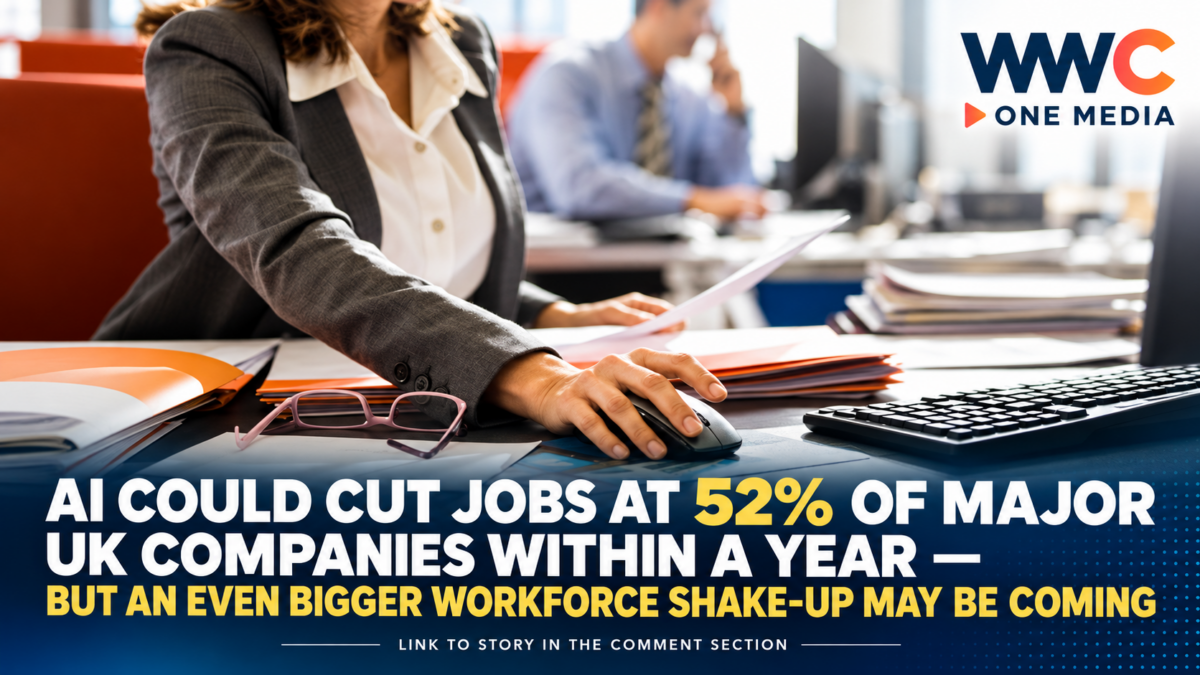
LONDON, UNITED KINGDOM — October 14, 2026 — Artificial intelligence is rapidly moving from a productivity tool to a potential workforce-reduction strategy at some of Britain’s largest businesses, with a new survey revealing that more than half of corporate finance chiefs expect AI to reduce employee numbers within the next 12 months.
The findings from Deloitte’s latest quarterly Chief Financial Officer Survey suggest that Britain’s corporate sector is entering a new phase of technological restructuring.
According to the survey, 52% of CFOs expect artificial intelligence to reduce headcount at their organizations over the coming year.
Even more striking, 67% say their businesses have completed only about one-quarter of the AI-driven changes they ultimately anticipate.
The findings suggest that AI’s impact on corporate employment may be far from over.
The survey, conducted between September 17 and October 1, covered 66 CFOs at major UK companies, including executives from 12 FTSE 100 businesses and 25 FTSE 250 companies.
The results were reported by Bloomberg on October 13 and independently contextualized by Reuters on October 14.
They arrive as companies confront higher borrowing costs, persistent inflation and pressure to protect profitability.
Meanwhile, British policymakers face an uncomfortable economic dilemma: artificial intelligence could help companies produce more goods and services with fewer employees, but the benefits of greater efficiency may not automatically translate into stronger hiring or higher household incomes.
AI is promising companies greater productivity and lower expenses. But for millions of workers, the bigger question is whether technology will create enough new opportunities to replace the jobs it makes unnecessary.
More Than Half of UK CFOs Expect AI to Reduce Staff
Deloitte’s headline finding marks an important change in how business leaders view artificial intelligence.
Corporate executives have spent years discussing AI’s potential to improve efficiency.
Now, a majority of the surveyed finance chiefs expect the technology to reduce employee numbers within the next year.
The 52% figure reflects expectations, not completed layoffs.
A company can reduce headcount through redundancies, voluntary departures, attrition or leaving vacancies unfilled.
The survey does not establish how many workers will be made redundant or what proportion of employees each business expects to cut.
It also does not represent all UK employers.
The respondents primarily lead finance functions at major listed companies, large privately owned businesses and UK subsidiaries of international corporations.
Nevertheless, their responses are significant because CFOs play central roles in budgeting, staffing plans and capital allocation.
When finance executives anticipate lower headcount, those expectations can influence decisions about recruitment, investment and organizational design.
AI Transformation May Still Be in Its Early Stages
Another striking finding is that 67% of respondents believe their organizations have completed only around 25% of the AI-related changes they expect in the longer term.
This suggests that many businesses are still building their AI capabilities.
Some may be experimenting with automation.
Others may be integrating AI into customer service, finance, technology operations or internal administrative processes.
The difference between early experimentation and large-scale deployment matters.
A company may initially use AI to help employees perform tasks more quickly.
Later, it may redesign entire workflows around automated systems.
That could change the number and types of employees needed.
However, the survey does not show that the remaining 75% of anticipated change will translate proportionately into job reductions.
Some investments could support expansion, improve service quality or create new types of roles.
The ultimate employment effect remains uncertain.
UK Companies Are Increasingly Focused on Cutting Costs
AI adoption is accelerating as British companies deal with rising financial pressures.
Reuters’ separate coverage of the same Deloitte survey found that 68% of CFOs considered cost reduction a strong priority for the following 12 months.
That was up from 53% in the previous quarterly survey.
The increase points to a more defensive corporate mindset.
Businesses are concerned about inflation, interest rates, political uncertainty and geopolitical instability.
Artificial intelligence can appear attractive in this environment because it may reduce the time required to perform certain tasks.
Companies might use it to process documents, assist customer-service teams, generate reports or improve software development.
But potential savings depend on how successfully the technology is integrated.
Subscription fees, computing expenses, cybersecurity controls and training can all reduce the financial benefits.
AI investment does not automatically result in lower overall costs.
Deloitte Survey: Key Findings
| Survey measure | Result |
|---|---|
| CFOs expecting AI-related headcount reductions | 52% |
| CFOs reporting only around one-quarter of anticipated AI transformation completed | 67% |
| CFOs treating cost reduction as a strong priority | 68% |
| Previous quarter’s cost-reduction priority | 53% |
| CFOs expecting AI to increase margins over the next year | About one-third |
| Expected inflation in 12 months | 3.4% |
| Expected Bank of England policy rate in 12 months | 4.0% |
| Respondents | 66 CFOs |
| Survey period | September 17–October 1, 2026 |
Sources: Deloitte CFO Survey, Bloomberg and Reuters. The figures describe executive expectations and sentiment, not guaranteed economic outcomes.
AI Savings May Arrive Before Profit Growth
The survey reveals another potential problem for companies investing heavily in AI.
Only around one-third of CFOs expect the technology to improve profit margins within the next 12 months.
That contrasts with the much larger share expecting AI to reduce headcount.
The difference suggests businesses may be confident about cutting certain labor requirements but less certain about achieving substantial financial returns.
There are several possible reasons.
AI systems can be expensive to implement.
Employees may need training.
Businesses may require additional investment in data infrastructure, security and compliance.
AI-generated work may also need human review.
These costs can delay financial benefits.
In other cases, companies may use efficiency gains to improve products or reduce prices rather than increase margins.
The result is that workforce reduction and profitability improvement should not be treated as the same outcome.
Young Workers Face a Particularly Difficult Job Market
The findings add to concerns about employment opportunities for young people.
Bloomberg reports that Britain’s youth unemployment is at its highest level in more than a decade.
At the same time, businesses are increasingly able to automate tasks that traditionally formed part of entry-level office roles.
These may include drafting routine documents, preparing basic financial analysis, summarizing information and responding to straightforward customer inquiries.
That creates a potential problem for workers who are beginning their careers.
Junior employees often acquire experience by performing foundational tasks before progressing to more complex responsibilities.
If AI reduces demand for those tasks, employers may need new ways to train future managers and specialists.
However, the survey does not provide occupation-by-occupation evidence showing exactly which entry-level jobs will disappear.
The greatest risks will depend on specific job duties, technology adoption and employers’ staffing decisions.
Jobless Growth Becomes a Political Challenge
Britain’s economy faces the possibility of becoming more productive without expanding employment at the same pace.
Economists sometimes refer to this as jobless growth.
Businesses can produce more output while hiring fewer additional workers.
That can benefit productivity and competitiveness.
But if employment opportunities become scarcer, some households may not share equally in the economic gains.
For Prime Minister Andy Burnham’s Labour government, the issue presents a major challenge.
The government wants to encourage innovation, investment and economic growth.
But it must also respond to public anxiety about job security.
A successful AI strategy will require more than encouraging companies to adopt software.
It must consider worker training, labor-market adjustment and access to new opportunities.
UK AI Minister Promises Workers Will Not Be Abandoned
Britain’s AI Minister Kanishka Narayan addressed concerns about the technology’s employment impact on October 12.
He acknowledged public anxiety about what artificial intelligence could mean for existing jobs and future career opportunities.
Narayan pledged that working people should not be left carrying the costs of technological change.
The statement reflects increasing political pressure for governments to consider the distribution of AI’s economic benefits.
The challenge is translating that commitment into practical measures.
Possible approaches include expanding digital training, supporting workers who change occupations and helping smaller businesses adopt technology effectively.
But the Deloitte survey does not establish that specific new employment protections have already been implemented.
Government commitments and completed policies must be distinguished.
Companies Are Buying AI Tools Without Enough Training
A separate report from London-based training company Multiverse identifies another concern.
Some businesses are investing in artificial-intelligence tools without adequately preparing their employees to use them.
The company, founded by Euan Blair, argues that organizations can waste money when technology adoption is disconnected from workforce skills.
The problem is not simply whether employees have access to AI.
It is whether they understand how to apply the tools effectively and safely to real business processes.
A company may purchase advanced software but achieve limited benefits if staff lack training.
In other cases, employees may use AI without adequate guidance on data protection, accuracy or quality control.
The findings suggest that businesses could improve returns by investing in people alongside technology.
Multiverse is itself a workforce-training provider, so its commercial interest in training should also be considered when assessing its recommendations.
Will AI Replace Workers or Change Their Jobs?
Artificial intelligence can affect employment in several different ways.
Some tasks may be fully automated.
Others may become faster to complete with AI assistance.
Certain occupations may evolve as employees take on more complex responsibilities.
New roles may emerge in AI oversight, integration, cybersecurity and other areas.
The outcome depends on how companies deploy the technology.
A customer-service organization might use AI to handle routine inquiries while retaining employees for complicated cases.
A finance department might automate initial report preparation while keeping human oversight for judgment and compliance.
A software company might use coding assistants to increase developer productivity.
These examples illustrate possible changes, not confirmed layoffs at particular UK firms.
The survey shows that many finance chiefs expect fewer employees.
It does not establish that AI can independently replace the full range of skills and judgment required in every affected occupation.
Higher Borrowing Costs Add Pressure
AI is not the only factor affecting staffing decisions.
Deloitte’s latest CFO survey found that business leaders expect UK inflation to reach 3.4% in a year’s time.
That was higher than the 3.0% expected in the previous quarter’s survey.
Respondents also anticipated that the Bank of England’s policy rate would reach 4.0% within 12 months, compared with the current rate of 3.75%.
Higher borrowing costs can discourage investment and hiring.
They can also make companies more cautious about expansion.
Businesses facing higher costs may look for ways to improve efficiency.
AI is one option.
But firms may also reduce hiring for reasons unrelated to technology.
The distinction matters when assessing the causes of weaker employment.
It would be misleading to attribute all UK staff reductions or hiring freezes to AI.
UK Graduate Hiring Faces a Broader Squeeze
Deloitte’s July 2026 survey had already highlighted problems for graduates.
At that time, finance chiefs identified cost control as a major factor discouraging graduate recruitment.
The report found that businesses were optimistic about AI-driven productivity while remaining cautious about hiring.
This suggests the October findings are part of a longer-running pattern.
Companies want to invest in technology but are reluctant to expand payrolls rapidly.
The danger is that young workers may encounter fewer opportunities to gain initial professional experience.
However, reduced graduate recruitment is not necessarily equivalent to mass layoffs.
Employers may simply fill fewer vacancies or postpone expansion.
For workers, the practical effect can still be serious: fewer entry-level openings and stronger competition for available positions.
Could AI Widen Inequality Between Workers?
AI-driven productivity gains may benefit some employees more than others.
Workers who can use AI to improve their performance may become more valuable.
Employees whose roles consist largely of repetitive tasks could face greater pressure.
Experienced professionals may also be better positioned to combine AI tools with specialized knowledge and judgment.
But the relationship is not fixed.
Effective training can help workers acquire new skills.
Job redesign can also create opportunities.
The distribution of benefits will depend on employers’ decisions, access to education and public policy.
If companies focus only on reducing labor costs, productivity gains may be distributed differently than if businesses also invest in employee development.
That is one of the central economic questions raised by the Deloitte findings.
What the Findings Mean for Outsourcing
The UK survey has implications beyond Britain’s domestic workforce.
British companies purchase technology and business services from providers across the world.
Artificial intelligence could change how much work is outsourced and which services clients require.
For example, routine data processing and administrative work may face greater automation pressure.
At the same time, organizations may demand more expertise in AI deployment, cybersecurity, data governance and complex business processes.
The effect on outsourcing companies will depend on their service mix and ability to adapt.
A business specializing in tasks that become inexpensive to automate may face pricing pressure.
A provider offering advanced technical expertise may discover new opportunities.
The Deloitte figures do not quantify future reductions in outsourced contracts.
They indicate a direction of concern rather than a forecast for a specific international industry.
What This Means for the Philippines’ BPO Industry
The Philippines has a substantial business-process outsourcing and IT-business-process management industry.
Many companies serving international clients depend on labor-intensive customer support, back-office operations and administrative services.
The UK’s growing interest in AI-driven headcount reduction is therefore relevant.
Some clients may seek to automate routine work rather than expand traditional outsourcing contracts.
Others may want Philippine providers to integrate AI into their operations.
That could create demand for employees with stronger analytical, technical and customer-management skills.
However, the Deloitte survey does not predict a specific number of Philippine BPO job losses.
It covers expectations among large UK corporate finance chiefs, not a forecast of employment at Philippine outsourcing companies.
For local businesses, the important question is how to combine AI adoption with workforce development.
Competing on price alone may become harder as routine tasks become more automated.
Specialized services, effective oversight and employee training could become increasingly important.
What Business Leaders Should Watch
The next year will help determine whether the CFOs’ expectations are reflected in actual staffing decisions.
Investors and policymakers should examine reported employment changes alongside corporate AI investment.
It will also be important to distinguish reductions caused by automation from cuts linked to weak demand or high financing costs.
Other indicators include graduate vacancies, investment in employee training and changes in productivity.
Corporate profit margins will provide another measure of whether AI spending delivers financial returns.
A company that cuts employees but fails to improve performance may not be benefiting from automation as much as anticipated.
The quality and reliability of AI output will also matter.
Businesses still need effective controls for errors, confidential information and regulatory obligations.
The Bigger Question: Will AI Create a More Productive Economy With Fewer Jobs?
The Deloitte survey highlights a turning point in the relationship between artificial intelligence and employment.
Corporate finance chiefs are no longer discussing AI only as a future possibility.
Many now expect the technology to influence staffing decisions within the next 12 months.
But the findings also reveal uncertainty.
Most surveyed companies believe their AI transformation is far from complete.
Only around one-third expect higher profit margins over the coming year.
And Britain’s economy is already facing pressure from inflation, financing costs and a difficult employment environment.
The challenge for companies is to determine whether workforce reductions will produce sustainable productivity improvements.
For workers, the challenge is adapting to changing job requirements.
For policymakers, the challenge is ensuring that economic growth does not leave large groups of people without viable employment opportunities.
More than half of Britain’s surveyed corporate finance chiefs expect artificial intelligence to reduce staffing within a year, even though most companies have barely begun their planned transformation. But the bigger test is still ahead: Will AI deliver the productivity boom businesses are promising—or could widespread automation create a generation of workers struggling to find their place in the new economy?