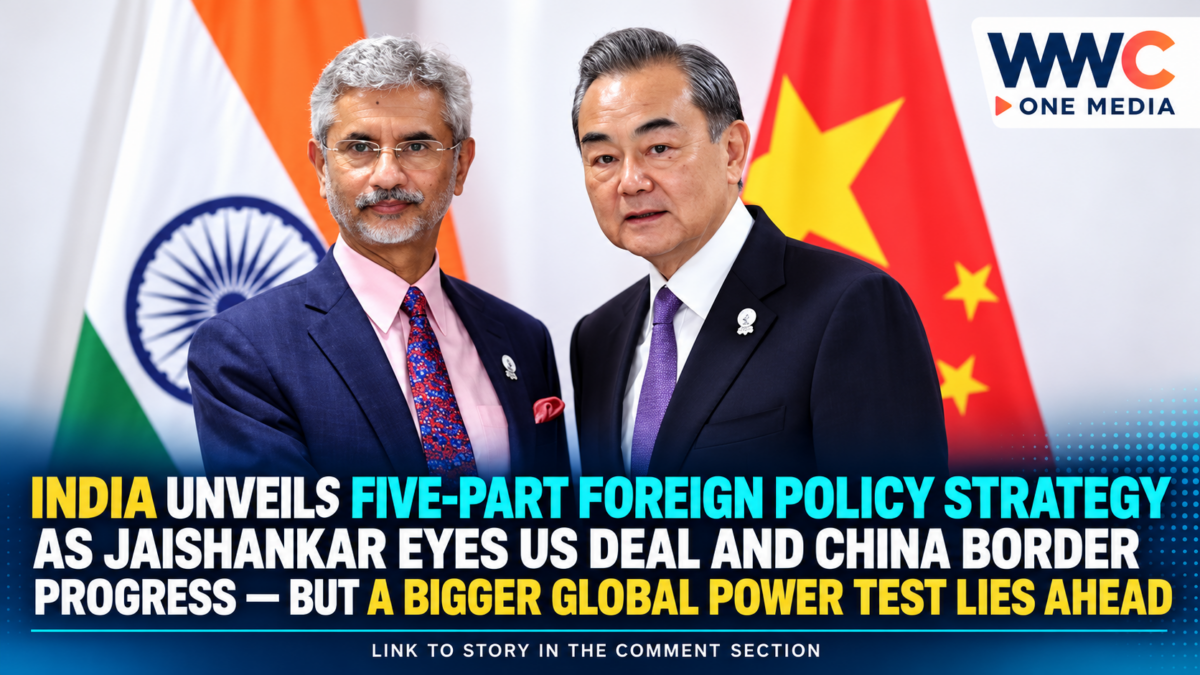
NEW DELHI, INDIA — October 14, 2026 — India is positioning itself as an independent power in an increasingly divided world, with External Affairs Minister Subrahmanyam Jaishankar outlining an ambitious diplomatic strategy that seeks stronger economic ties with the United States and Europe while keeping important relationships with China and Russia intact.
Speaking at the Bloomberg New Economy Forum in New Delhi on October 13, Jaishankar offered one of his clearest assessments of how India intends to navigate growing tensions among the world’s major powers.
His priorities include advancing negotiations for a trade agreement with Washington, exploring a partial settlement of India’s longstanding territorial dispute with China, strengthening commercial relations with Europe and maintaining India’s traditional partnership with Russia.
Jaishankar also emphasized the importance of Japan and warned that artificial intelligence could become one of the most consequential challenges facing international governance.
The interview with Bloomberg Editor-in-Chief John Micklethwait came as India faced a complicated geopolitical environment.
Relations with Washington have been strained by trade disagreements and India’s economic ties with Russia.
New Delhi and Beijing are attempting to rebuild confidence following years of military tensions along their disputed Himalayan border.
Meanwhile, Europe is seeking to diversify its trading relationships, creating opportunities for closer cooperation with India.
The foreign minister’s message was clear: India wants to expand its global influence without committing itself exclusively to any single geopolitical bloc.
India is seeking closer partnerships with competing world powers while protecting its strategic independence. But the real challenge is whether New Delhi can turn its diplomatic balancing act into trade agreements, stronger security and economic gains without being pulled into increasingly dangerous international rivalries.
Jaishankar’s Foreign Policy Formula: Engage, Manage, Cultivate and Reassure
During the discussion, Jaishankar’s approach was summarized around four major diplomatic objectives: engaging America, managing China, cultivating Europe and reassuring Russia.
He also acknowledged Japan as another essential partner.
The framework reflects India’s longstanding commitment to strategic autonomy.
Unlike formal military alliances, strategic partnerships give countries flexibility to cooperate in areas of common interest without agreeing to support every policy decision made by the other side.
India maintains significant relationships with multiple countries whose interests sometimes conflict.
It cooperates with the United States on technology and security.
It conducts extensive trade with China.
It purchases energy and military equipment from Russia.
It is negotiating deeper economic integration with Europe.
And it works closely with Japan on investment, infrastructure and regional security.
Managing these relationships simultaneously is becoming increasingly difficult as geopolitical competition intensifies.
India Says the United States Has Changed Its Global Approach
One of Jaishankar’s most important observations concerned Washington’s changing foreign policy.
He argued that the United States has altered the way it engages with other nations, requiring governments to reconsider their relationships with the world’s largest economy.
His comments reflected New Delhi’s efforts to adapt to a more transactional US foreign policy.
Under President Donald Trump, tariffs, trade negotiations and security commitments have become major sources of international uncertainty.
India has experienced disagreements with Washington over trade barriers and energy imports, particularly purchases connected to Russia.
Jaishankar nevertheless emphasized that India and the United States retain a strong strategic partnership.
He also distinguished that partnership from a formal military alliance.
That distinction matters because India does not want closer US ties to eliminate its freedom to pursue independent policies toward other major powers.
Jaishankar Signals Optimism About US Trade Negotiations
Despite bilateral tensions, India’s foreign minister expressed optimism about ongoing trade negotiations with the United States.
He said negotiators were making progress toward resolving outstanding disagreements.
The talks involve Indian commerce officials and the Office of the United States Trade Representative.
Both governments have economic incentives to reach an agreement.
The United States is an important destination for Indian goods and services.
India, meanwhile, represents a large consumer market and an increasingly important location for manufacturing and technology investment.
An agreement could improve market access, reduce selected trade barriers and strengthen commercial confidence.
But Jaishankar did not announce a finalized treaty.
He declined to reveal detailed negotiating terms.
The distinction is important for investors: positive diplomatic statements indicate progress, but they do not establish that tariffs have been removed or that a signed deal is imminent.
The final outcome will depend on the unresolved negotiating issues and political decisions in both countries.
China and India Explore a Partial Border Settlement
One of the most significant revelations concerned India’s relationship with China.
Jaishankar confirmed that the two governments are examining whether some sections of their disputed boundary could be settled before attempting a comprehensive agreement.
The approach is sometimes called an early-harvest arrangement.
Rather than waiting for a settlement of every territorial disagreement, the countries could seek progress on areas where compromise is more achievable.
Such a strategy could help reduce uncertainty.
However, Jaishankar made clear that the discussions are still exploratory.
No agreement defining new territorial boundaries was announced.
The India-China border dispute has persisted for decades and involves competing territorial claims across the Himalayan region.
Military tensions escalated dramatically in 2020, when deadly clashes occurred in the Galwan Valley.
Relations began improving after an October 2024 border-patrol arrangement helped ease some immediate military tensions.
But the larger territorial dispute remains unresolved.
Border Stability Is Essential to Normal Relations
Jaishankar emphasized that peace along the disputed border remains essential for improving relations with Beijing.
India is not necessarily demanding that every boundary disagreement be resolved before other forms of cooperation can advance.
Instead, New Delhi considers stability along the frontier a minimum condition for normalization.
That creates a possible pathway toward better diplomatic and economic engagement.
Trade and business relations could improve while negotiators continue working on the boundary question.
However, military confidence and commercial cooperation remain separate challenges.
A partial settlement could reduce tensions without eliminating the possibility of future disagreements.
The ability of both governments to maintain border stability will therefore remain a major test.
India Accuses China of Unequal Market Access
Although relations have improved in certain areas, Jaishankar also criticized China’s economic policies.
He argued that Indian businesses do not enjoy sufficiently equal opportunities in the Chinese market.
India has longstanding concerns about its trade imbalance with China.
Indian companies have also raised market-access issues involving sectors in which they believe they are competitive.
Jaishankar emphasized that India must address these commercial problems independently of the territorial negotiations.
That means a possible border agreement would not automatically require New Delhi to ease investment restrictions or other policies affecting Chinese businesses.
It would also be inaccurate to suggest that Beijing has already agreed to India’s complaints about commercial access.
The two governments continue to have significant differences over trade and economic policy.
Russia Remains a Critical Long-Term Partner
Jaishankar also defended India’s relationship with Russia.
The partnership has developed over several decades and includes defense equipment, energy and diplomatic cooperation.
The war in Ukraine has complicated that relationship.
Western countries have imposed sanctions on Russia and criticized governments that continue significant commercial engagement with Moscow.
India, however, has consistently argued that its energy and foreign-policy decisions must reflect its national interests.
Jaishankar said India wants Russia to retain meaningful international relationships beyond China.
That position reflects concern that Moscow’s growing dependence on Beijing could further alter the balance of power in Asia.
Maintaining ties with India gives Russia another major partner.
For New Delhi, the relationship also preserves access to longstanding defense and energy arrangements.
However, India has not announced that it is joining a new Russia-led military alliance.
India’s Position on Ukraine and Russia’s Global Options
The foreign minister acknowledged that Russia has become more closely connected to Asia since the invasion of Ukraine.
With much of its relationship with Europe damaged, Moscow has increasingly turned toward Asian markets.
China has been a particularly important partner.
India sees strategic value in preventing Russia from becoming excessively dependent on a single country.
The logic is not simply commercial.
India and China are themselves strategic competitors, despite efforts to improve their bilateral relationship.
New Delhi therefore has an interest in preserving a more diversified regional balance.
At the same time, India must manage its relationships with European governments and Washington, which have their own positions on Russia.
That illustrates the difficulty of maintaining strategic autonomy during a major international conflict.
Europe Becomes a Bigger Priority for India
Europe represents another important part of India’s diplomatic strategy.
Jaishankar expressed confidence that the India-European Union free-trade agreement could enter into force within months, potentially by the end of 2026 or early 2027.
The agreement is expected to support greater commercial cooperation between the two economies.
Potential benefits include improved market access, investment opportunities and stronger supply-chain relationships.
However, implementation depends on the necessary legal and political procedures.
A negotiated agreement does not automatically enter into force immediately.
The final timetable remains subject to the relevant approval processes.
For Indian businesses, access to European markets could support sectors including manufacturing, pharmaceuticals, technology and professional services.
European companies could also gain opportunities in India’s expanding market.
But the size of any economic benefit will depend on actual trade flows, investment and the terms of implementation.
Why Europe’s Strategic Autonomy Appeals to India
Jaishankar welcomed Europe’s increasing emphasis on strategic autonomy.
The concept refers to governments seeking greater independence in economic, security and technological decisions.
It does not necessarily mean rejecting alliances or ending cooperation with the United States.
For India, the approach resembles its own preference for preserving flexibility among competing powers.
A Europe that pursues more independent economic partnerships could create opportunities for closer India-EU cooperation.
Both sides have reasons to diversify supply chains and reduce excessive reliance on individual markets.
However, strategic autonomy can also create disagreements when governments choose different positions on sanctions, trade or international security.
The concept provides a basis for cooperation, not a guarantee of identical foreign policies.
Japan Remains an Essential Asian Partner
Jaishankar also acknowledged Japan as an important part of India’s international relationships.
Japan is a major investor in Indian infrastructure, manufacturing and industrial development.
The two countries cooperate in regional security and participate in the Quadrilateral Security Dialogue, or Quad, alongside the United States and Australia.
That arrangement focuses on cooperation across Indo-Pacific priorities.
It is not a NATO-style collective-defense treaty.
For New Delhi, Japan provides technology, investment and an important strategic relationship in Asia.
Closer cooperation can also help diversify production networks.
Japan’s inclusion in Jaishankar’s diplomatic framework reinforces India’s intention to build several strong partnerships rather than rely on one major power.
Artificial Intelligence Emerges as a Foreign Policy Priority
The foreign minister also addressed the growing influence of artificial intelligence.
Jaishankar described AI as a technology likely to affect an exceptionally wide range of human activities.
He warned that its reach could extend across economic life, public institutions and political systems.
Unlike some earlier technologies controlled by a relatively small number of governments or specialized organizations, AI is being developed and deployed by a wide range of companies and institutions.
That raises difficult governance questions.
Who should determine how powerful AI systems are used?
How should governments respond to misinformation, political manipulation and other harms?
And how can the benefits of AI be distributed more fairly?
Jaishankar called for international regulation and safeguards.
However, he did not unveil a binding international AI treaty.
His remarks were a call for stronger governance rather than an announcement of completed regulations.
Why AI Governance Matters to India’s Global Ambitions
India has a rapidly growing digital economy and a major technology workforce.
AI could influence software development, financial services, healthcare, education and manufacturing.
The country also has an interest in ensuring that international rules do not exclude emerging economies from access to advanced technologies.
For New Delhi, AI governance is therefore both an economic and diplomatic issue.
Rules governing technology exports, data, computing infrastructure and safety may affect global competition.
India wants greater participation in decisions that shape these systems.
Its position reflects a wider demand among developing economies for a stronger voice in international technology governance.
However, reaching consensus will be difficult.
The United States, China, Europe and other governments have different regulatory priorities.
India’s Strategic Autonomy Faces Its Biggest Test
Jaishankar’s remarks illustrate a central principle of Indian foreign policy.
India wants the benefits of cooperation without becoming fully dependent on any one geopolitical bloc.
That approach can provide flexibility.
It allows the country to pursue defense arrangements, energy contracts, investment and trade agreements with different partners.
But it can also create friction.
Washington may want closer coordination on Russia or China.
European governments may press India on trade standards or geopolitical issues.
China may seek greater access to the Indian market.
Russia may look for reassurance that longstanding ties remain secure.
New Delhi must manage those competing expectations while protecting domestic economic interests.
The strategy requires continuous negotiation rather than permanent agreement with every major power.
What the Strategy Means for ASEAN and the Philippines
India’s diplomatic priorities matter to Southeast Asia because the region is central to Indo-Pacific trade and security.
ASEAN countries maintain extensive economic relationships with China, the United States, Japan and Europe.
Many also seek to preserve strategic flexibility rather than align exclusively with one bloc.
India’s approach therefore has similarities with the balancing strategies used by several Southeast Asian governments.
For the Philippines, developments in India-US relations and India-China negotiations could influence the wider regional diplomatic environment.
India and the Philippines have also expanded cooperation in defense and other areas.
However, Jaishankar’s October 13 remarks did not announce a new Philippines-India agreement.
Any direct effect on Philippine trade, defense procurement or investment would require separate confirmation.
The broader significance is India’s determination to play a larger role in regional affairs while retaining independent foreign-policy choices.
What Happens Next?
Several developments will determine whether India’s diplomatic strategy produces tangible results.
India-US trade negotiations: The two governments must resolve remaining disagreements before announcing a completed agreement.
India-China boundary talks: Officials will explore whether a partial settlement is feasible while maintaining stability along disputed areas.
India-EU free trade agreement: Both sides will work through the steps required for the agreement to take effect.
India-Russia relations: New Delhi will continue balancing traditional economic and security cooperation with international geopolitical pressures.
Japan and Indo-Pacific cooperation: India will seek to strengthen strategic and commercial relationships.
AI governance: Governments will debate how to establish safeguards without unnecessarily restricting innovation.
Each development could affect India’s economic and diplomatic position.
But none is guaranteed to proceed exactly as New Delhi hopes.
The Bigger Question: Can India Balance the World’s Rival Powers?
India is entering a period in which foreign policy is becoming closely connected to trade, technology and economic growth.
The country’s leaders see an opportunity to strengthen its international influence while major powers compete for markets, investment and strategic partnerships.
Jaishankar’s approach reflects that ambition.
He wants productive relations with Washington without formal dependence.
He wants a calmer border with China while addressing commercial imbalances.
He wants closer trade with Europe and enduring cooperation with Russia.
He also wants deeper ties with Japan and greater influence over artificial-intelligence governance.
The strategy offers India opportunities, but it requires difficult compromises.
A trade deal with the United States may demand concessions.
A China border settlement may face political and military obstacles.
Maintaining Russia ties may continue to complicate relations with Western governments.
And international AI rules may be difficult to negotiate among competing powers.
India’s foreign minister has outlined a broad strategy to engage America, manage China, cultivate Europe, reassure Russia and strengthen Asian partnerships. But the bigger test is whether New Delhi can turn diplomatic flexibility into lasting economic and strategic gains—or whether intensifying global rivalries will force India to make choices it has long tried to avoid.