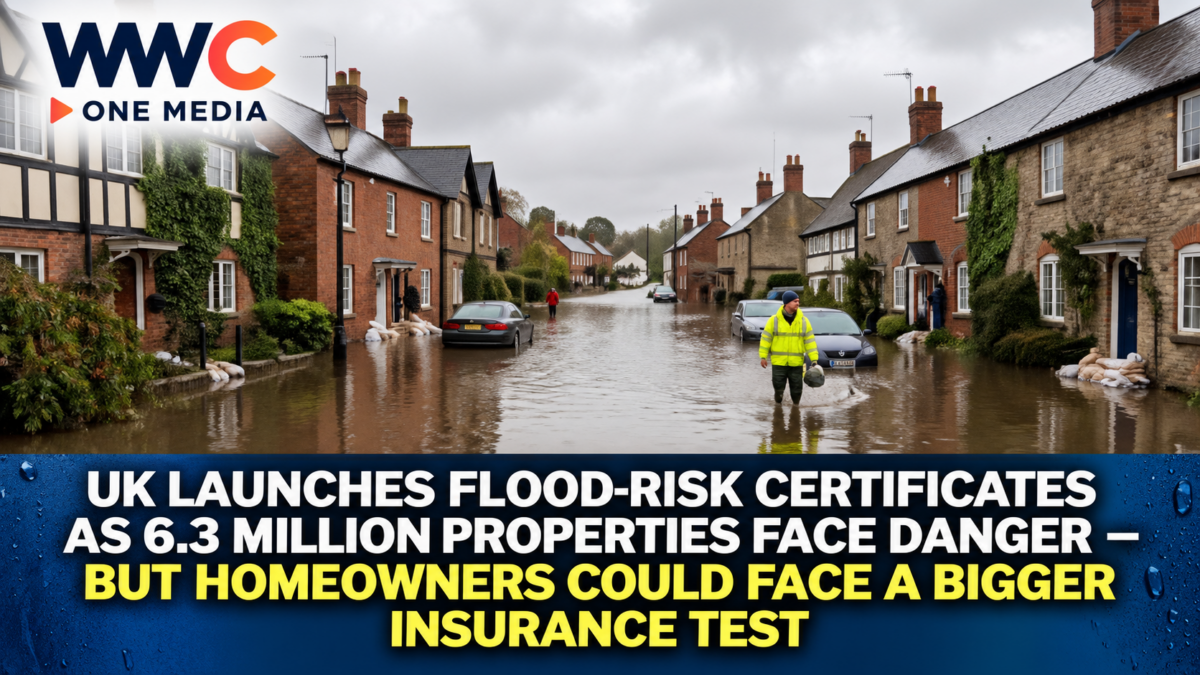
LONDON, United Kingdom — October 14, 2026 — Millions of property owners in England could soon receive a clearer picture of how vulnerable their homes are to flooding under a new government-backed certificate scheme designed to make climate-related risks more visible to households, insurers and mortgage lenders.
The UK government and Flood Re announced on October 13 that they will begin piloting Flood Performance Certificates, or FPCs, before the end of 2026.
The certificates are intended to provide standardized assessments of a property’s flood exposure, existing defenses and ability to withstand water damage.
The system will also recommend improvements such as flood barriers, water-resistant flooring and specially designed ventilation bricks.
The initiative comes as Britain’s flood threat continues to grow.
According to the Environment Agency, approximately 6.3 million properties in England—including homes and businesses—are located in areas exposed to flooding from rivers, the sea or surface water.
That figure could climb to around 8 million properties by the middle of the century as climate change increases risks in vulnerable areas.
But the certificates are about more than environmental awareness.
The government wants them to help homeowners demonstrate resilience improvements to insurance companies and mortgage lenders, potentially influencing how flood risk is assessed and priced.
The scheme could therefore become an important part of Britain’s housing and insurance market.
The new certificates promise to help families better protect their properties. But a bigger question is emerging: Will clearer flood-risk ratings make insurance more affordable—or could they expose vulnerabilities that affect property values, borrowing and future home sales?
What Are Flood Performance Certificates?
Flood Performance Certificates are proposed standardized assessments of how exposed a property is to flooding and how effectively it can withstand water damage.
They are being developed by Flood Re with support from the Department for Environment, Food and Rural Affairs, the Environment Agency and industry partners.
The certificates are designed to provide information that homeowners can understand and use.
A proposed Flood Performance Rating will assess several components.
Flood exposure: The likelihood of flooding from sources such as rivers and surface water.
Building characteristics: Features that influence how water might enter or damage a property.
Flood resistance: Existing measures that help prevent or limit water entering the building.
Flood resilience: Improvements that reduce damage and make recovery easier if flooding occurs.
Recommended improvements: Practical measures that could make the property less vulnerable.
Unlike an ordinary flood-risk map, the certificates are intended to reflect what individual homeowners have done to protect their buildings.
This distinction is important.
Two houses on the same street may face similar exposure to flooding but have different levels of physical protection.
The new assessments could help demonstrate those differences.
How Will the Certificates Work?
The government wants the system to become a trusted source of standardized information, comparable in purpose to Britain’s Energy Performance Certificates.
Energy Performance Certificates assess the energy efficiency of buildings.
Flood Performance Certificates would instead focus on flood exposure and physical resilience.
The proposed system may draw on existing information from the government’s Check Your Flood Risk service.
This includes data about flooding from rivers and surface water.
Assessments could also consider building-specific information and installed protective measures.
Flood Re aims to develop an approach that could eventually support app-based self-assessments.
However, the final methodology is still being tested.
The government has not announced a single finalized nationwide scoring scale or confirmed that every property will immediately receive a numerical rating.
Those details will depend on the results of the pilots.
Pilots Begin in 2026, With Wider Testing in 2027
The first phase will focus on selected areas of England exposed to flood risk.
Testing is expected to begin before the end of 2026.
Additional trials will take place during 2027 and beyond.
The government and Flood Re will work with homeowners, insurance providers, lenders and other partners.
The pilots will examine whether the information is understandable, reliable and useful.
They will also test how resilience improvements can be recorded and communicated.
Industry participants want a system that can be applied consistently across different property types.
But implementation will be gradual.
The announcement does not establish that every homeowner in England must obtain a certificate in 2026.
Nor does it introduce an immediate legal requirement to produce an FPC when selling or renting a property.
Why 6.3 Million Properties Are at Risk
The scale of England’s flood exposure explains the urgency behind the initiative.
The Environment Agency’s national assessment identifies approximately 6.3 million properties in areas at risk from one or more sources of flooding.
These include residential and commercial buildings.
Of that total, approximately 4.6 million properties are exposed to surface-water flooding.
Around 2.4 million are in areas at risk from rivers or the sea.
Some properties face more than one type of flooding, so these categories overlap and should not be added together.
Surface-water flooding occurs when heavy rainfall overwhelms drainage systems or accumulates faster than it can drain away.
It can affect properties far from major rivers and coastlines.
That makes it particularly difficult for some homeowners to recognize their exposure.
A house may never have experienced a serious flood and still be located in a risk area.
The proposed certificates aim to make these risks more visible.
England’s Flood Risk Could Affect 8 Million Properties by 2050
Climate change is expected to increase the number of properties exposed to flooding.
The Environment Agency projects that approximately 8 million homes and businesses could be located in flood-risk areas by mid-century.
That represents about one in four properties in England.
The projection reflects future climate conditions, including changes in rainfall, river flows and sea levels.
However, it is not a prediction that 8 million buildings will definitely flood.
Flood-risk classifications describe exposure to possible flooding over time.
Actual events depend on weather conditions, drainage, geography and protection measures.
The Environment Agency also cautions that some differences between earlier and newer risk assessments reflect improvements in data and modelling rather than a sudden increase in physical risk.
The important conclusion is that flood exposure is already widespread and is expected to remain a major challenge.
Flood Barriers and Resilient Kitchens Could Improve Ratings
A central objective of the certificate scheme is encouraging practical improvements.
Flood defenses cannot eliminate every risk, but they can reduce damage and make recovery easier.
Examples include:
- Flood barriers: Removable or permanent products designed to reduce water entering doorways and other openings.
- Self-closing air bricks: Ventilation systems designed to close automatically when floodwater rises.
- Flood-resilient kitchens: Materials and fittings that withstand water exposure and can be cleaned or repaired more easily.
- Water-resistant flooring: Surfaces designed to reduce long-term damage after flooding.
- Raised electrical fittings: Positioning vulnerable electrical systems above likely flood levels where appropriate.
- Property-specific drainage improvements: Measures that help manage or redirect water, subject to suitable design.
Not every measure will be appropriate for every building.
A qualified assessment is important because certain interventions can create problems if they are installed incorrectly.
For example, preventing water from entering a building during a deep flood can create structural pressure that requires professional consideration.
The certificates are intended to guide homeowners toward appropriate action rather than encourage the same solution for every property.
Could Homeowners Receive Cheaper Insurance?
This is one of the most important questions surrounding the scheme.
Flood Re and the government want insurance companies to recognize genuine improvements in flood resilience.
A homeowner who invests in protective measures may be able to demonstrate that their property would suffer less damage during a flood.
That information could support a more favorable assessment by an insurer.
Over time, it might improve the availability or affordability of suitable coverage.
However, no automatic premium discount has been announced for obtaining a certificate.
Insurers will continue to assess risk according to their underwriting practices.
The amount and nature of any financial benefit would depend on the property, installed protections and insurer.
The pilot program aims to determine how this information can be incorporated effectively.
The distinction between possible future savings and guaranteed immediate discounts is essential.
Flood Re’s Role in the Insurance Market
Flood Re is a joint initiative between the UK government and insurance industry.
It was created to help make flood insurance more accessible and affordable for eligible households exposed to significant flood risk.
The scheme operates through insurers rather than selling policies directly to households.
Insurance companies can transfer certain eligible flood risks to Flood Re under specified terms.
That helps support the availability of household insurance in areas where flood risk might otherwise make coverage difficult or expensive.
The scheme is designed to be temporary, with a transition toward a more risk-reflective market by 2039.
Flood Performance Certificates are intended to support that transition by encouraging households to reduce physical vulnerability.
The goal is for property owners to become better prepared rather than depend indefinitely on subsidized insurance arrangements.
Selected Flood Re Charges Will Fall to £25
Separate reforms announced in July 2026 will reduce a particular Flood Re charge.
From April 2027, the scheme’s contents-cover premium charged to insurers for eligible Council Tax Band A and B properties will fall from £52 to £25.
The reduction is intended to support lower-income households and renters.
The government expects participating insurers to pass the benefit on to customers.
However, this does not mean homeowners will be able to buy a complete insurance policy for £25.
The figure is a specific Flood Re scheme charge for eligible contents cover.
Retail home-insurance premiums include other costs, risks and commercial pricing decisions.
The reform and certificate initiative are linked by a common objective: maintaining affordable insurance while improving household resilience.
But they are distinct policies.
Could Flood Ratings Affect Property Prices?
Clearer information about flood exposure may influence the housing market.
Buyers already consider location, condition, financing costs and environmental risks when purchasing property.
A standardized certificate could make flood vulnerability easier to compare between homes.
A property with effective defenses might become more attractive to some buyers.
A property requiring substantial protection work could face more questions about future costs.
However, no evidence from the new pilot establishes that certificates will cause specific changes in house prices.
Their effects will depend on how buyers, sellers, lenders and insurers use the information.
Improved transparency may help transactions by reducing uncertainty.
But it could also reveal risks that were previously poorly understood.
The government must balance those possibilities.
Mortgage Lenders Are Paying Attention
Mortgage lenders have an important interest in flood resilience.
Property serves as security for mortgage loans.
Severe flooding can damage buildings, affect resale prospects and create unexpected financial pressure for homeowners.
Nationwide, one of Britain’s major mortgage lenders, welcomed the proposed certificates.
Its property-risk leadership said standardized information could help homeowners, lenders and insurers make better-informed decisions.
The certificates may eventually help lenders distinguish between properties that share similar exposure but have different protection measures.
However, the announcement does not establish that banks must change their mortgage rates or reject borrowers with poor flood ratings.
Any such practices would depend on future policies, regulation and lender decisions.
Insurer Aviva Warns About a Long-Term Coverage Challenge
Aviva, a major British insurer, has also supported the initiative.
The company’s UK and Ireland general insurance chief executive, Jason Storah, emphasized the importance of improving flood resilience as more homes become exposed to severe weather.
He noted that newer homes do not benefit from the Flood Re scheme in the same way as eligible older properties.
That makes physical resilience especially important for some homeowners.
The broader insurance challenge is that flooding can produce expensive and repeated claims.
If premiums become unaffordable or coverage becomes difficult to obtain, households may face considerable financial risk.
Flood Re and the government hope better information will encourage investment before damage occurs.
However, insurers will need to demonstrate that their pricing practices fairly recognize improvements.
Consumer Groups Warn Against Unintended Consequences
The introduction of standardized flood information also raises fairness questions.
Some homeowners can afford substantial protective renovations.
Others may struggle to pay for relatively modest improvements.
Households in areas of high flood exposure may also have limited control over the risks they face.
For example, river flooding can be influenced by conditions far beyond an individual property boundary.
A parliamentary committee examining flood resilience previously recommended introducing certificates voluntarily.
It also urged consideration of free or subsidized assessments for lower-income households.
The committee warned against creating a system that leaves some properties difficult to sell or insure because of risks outside homeowners’ control.
These concerns remain relevant as the new pilots begin.
A successful certificate system will need to provide useful information without unfairly penalizing vulnerable households.
Flood Action Week Highlights Preparedness
The announcement coincides with the Environment Agency’s Flood Action Week, running from October 12 to 18.
The campaign encourages households to check local flood exposure and prepare emergency plans.
Residents are also urged to register for official flood warnings where available.
The Environment Agency maintains emergency equipment, including 260 mobile pumps and approximately 25 kilometers of temporary barriers.
Its teams operate around the clock during flood emergencies.
However, public flood defenses cannot prevent all property damage.
Flood Performance Certificates are intended to complement broader flood-management investments by improving protection at the household level.
What Homeowners Can Do Now
Because the certificates are still being piloted, homeowners do not need to wait for the scheme before taking practical action.
A sensible first step is to check the property’s exposure using the government’s existing flood-risk information service.
Homeowners can then review their insurance coverage and consider whether additional protections are appropriate.
Properties that have previously flooded may benefit from a professional flood-resilience assessment.
Residents can also prepare an emergency plan, identify important documents and understand how to respond to official warnings.
The new certificates are expected to make these decisions easier over time.
But they should not replace existing emergency preparedness.
The Bigger Implications for the Global Property Industry
Britain’s initiative could attract attention from other countries confronting climate-related property risks.
Flooding affects housing markets, insurance systems and infrastructure worldwide.
As climate data improves, insurers and lenders are gaining more detailed information about environmental risks.
That may influence how buildings are constructed, renovated, financed and insured.
A standardized flood-resilience certificate offers one possible approach to making that information easier to use.
However, the British system has not yet been proven through nationwide implementation.
Its effectiveness will depend on pilot results, industry cooperation and consumer acceptance.
Other countries would also need to adapt the model to their own geography, regulatory structures and insurance markets.
Why the Philippines Should Pay Attention
The Philippines faces recurring flooding associated with tropical cyclones, heavy rainfall, river overflows and urban drainage limitations.
For homeowners, developers and financial institutions, property-level flood resilience is already an important issue.
A system that documents exposure and protective measures could potentially help households understand their risks.
It may also offer useful ideas for insurers and property developers interested in promoting resilient buildings.
However, the British announcement applies to the English pilot scheme.
The Philippines has not been included in the program, and no equivalent national certificate requirement is established by this news.
Any application to the Philippine market would require separate domestic policy development, technical standards and institutional support.
The broader lesson is that flood preparedness increasingly involves financial resilience as well as physical safety.
What Happens Next?
The first pilots are expected to begin before the end of 2026.
Further testing will take place during 2027 and beyond.
Flood Re and government partners will evaluate whether certificates can be produced consistently across different properties.
Insurers and lenders will examine how the information could influence decisions.
Consumer groups will be interested in affordability, accessibility and fairness.
The government may then consider broader adoption.
However, no definitive date has been announced for a mandatory nationwide rollout.
The outcome will depend on evidence gathered from the pilot program.
The Bigger Question: Will Flood Certificates Protect Homeowners or Transform Property Finance?
The UK’s new Flood Performance Certificates represent a shift in how climate-related risks may be communicated to property owners.
Instead of relying solely on broad flood maps or historical claims, the government wants homeowners to understand the vulnerability of their individual buildings.
The approach could encourage investment in protective measures and help reduce damage when flooding occurs.
It may eventually allow insurers and lenders to assess property resilience more consistently.
But making risk visible also creates difficult questions.
Can low-income homeowners afford improvements?
Will insurers recognize those investments fairly?
Could poor ratings make some properties harder to sell or finance?
And will the new system deliver practical benefits without adding unnecessary costs?
Those questions remain unanswered while the pilots are being developed.
England’s new flood-risk certificates could give millions of homeowners a clearer way to protect their properties as climate threats intensify. But the real test lies ahead: Will the certificates unlock cheaper insurance and safer homes—or could greater transparency about flood exposure reshape property values, mortgages and the financial future of vulnerable households?