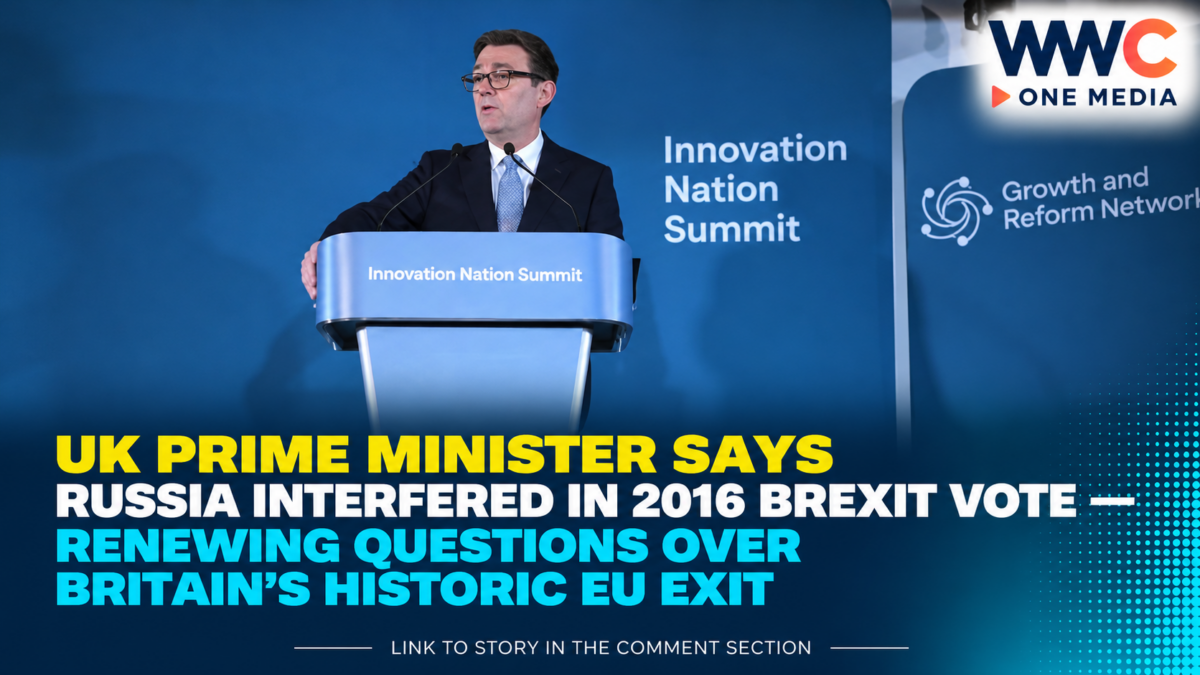
British Prime Minister Andy Burnham has said Russia interfered in the United Kingdom’s 2016 Brexit referendum, marking the first time a British prime minister has publicly acknowledged such interference in the vote that led to the country’s departure from the European Union (EU).
Burnham made the remarks in excerpts from an interview with political podcast The Rest Is Politics, released on Sunday (Oct 11). He said he sought clarification about Russia’s involvement after entering Downing Street in July.
“I asked the question coming to Downing Street: was there interference in the 2016 referendum from Russia? I’ve had the clear answer that yes, there was,” he said.
However, Burnham did not identify who provided the assessment, disclose the evidence behind it or explain whether any alleged interference affected the referendum’s outcome.
His comments have renewed scrutiny of Russia’s alleged efforts to influence Western democracies and the British government’s handling of concerns surrounding the Brexit campaign.
Why the 2016 Brexit referendum still matters
On June 23, 2016, British voters chose whether the UK should remain in or leave the EU. The Leave campaign won with 51.9 per cent of votes, compared with 48.1 per cent for Remain.
The result reshaped British politics, triggering years of negotiations and political disputes before the UK formally left the bloc in January 2020.
Questions about foreign interference emerged during and after the campaign, particularly as concerns grew over Russian state-backed media, online disinformation and the use of social media to influence political debate.
Burnham said Britain needed to be more open about foreign attempts to disrupt democratic processes, arguing that acknowledging such threats could help voters in other European countries understand the risks they face.
What did Britain’s intelligence committee find?
A 2020 report by Parliament’s Intelligence and Security Committee criticised the British government for failing to commission a full assessment of possible Russian interference in the Brexit referendum.
The committee said the government had not adequately investigated the issue, despite concerns about Russian activities and the potential role of state-backed media and online accounts.
However, the report’s findings should not be confused with definitive proof that Russian interference changed the referendum result. The committee highlighted the lack of a comprehensive government assessment, leaving important questions about the extent and impact of any interference unresolved.
Burnham’s latest statement adds a new political acknowledgment, but he has not publicly presented the evidence behind the assessment he says he received.
Russia rejects accusations of election interference
Moscow has repeatedly denied interfering in elections and referendums in Western countries, dismissing allegations of Russian meddling.
The latest remarks could add pressure for greater transparency about the intelligence available to the British government and how it evaluates foreign influence operations.
Such questions have become increasingly significant as governments across Europe confront concerns about online manipulation, covert funding and disinformation campaigns targeting political institutions.
Germany and France face similar concerns
Burnham said the issue was relevant beyond Britain, pointing to concerns about Russian influence in Germany and France.
During a recent meeting in Berlin, he discussed the far-right Alternative for Germany (AfD) party with German Chancellor Friedrich Merz.
Burnham said Merz had raised concerns about the party’s links to Russia, including possible funding. He also alleged that misinformation and disinformation originating from Russia were circulating in German politics.
Those claims remain politically sensitive, and allegations about specific links or funding require evidence and careful assessment.
Burnham also referred to alleged Russian efforts to interfere in Britain’s 2019 general election, which he criticised in a speech to the United Nations General Assembly in September.
Could the Brexit debate reopen?
The prime minister’s comments come amid renewed discussion about Britain’s long-term relationship with the EU.
In September, Burnham said the UK should examine possible future arrangements with the bloc, including the option of rejoining it.
His latest remarks do not change the legal or political outcome of the 2016 referendum. Instead, they bring fresh attention to questions about the integrity of the campaign and whether foreign actors attempted to influence voters.
For now, the central issue remains what evidence underpins Burnham’s assessment. Until more details are made public, the extent of Russia’s alleged involvement — and whether it had any measurable effect on the referendum — remains unresolved.