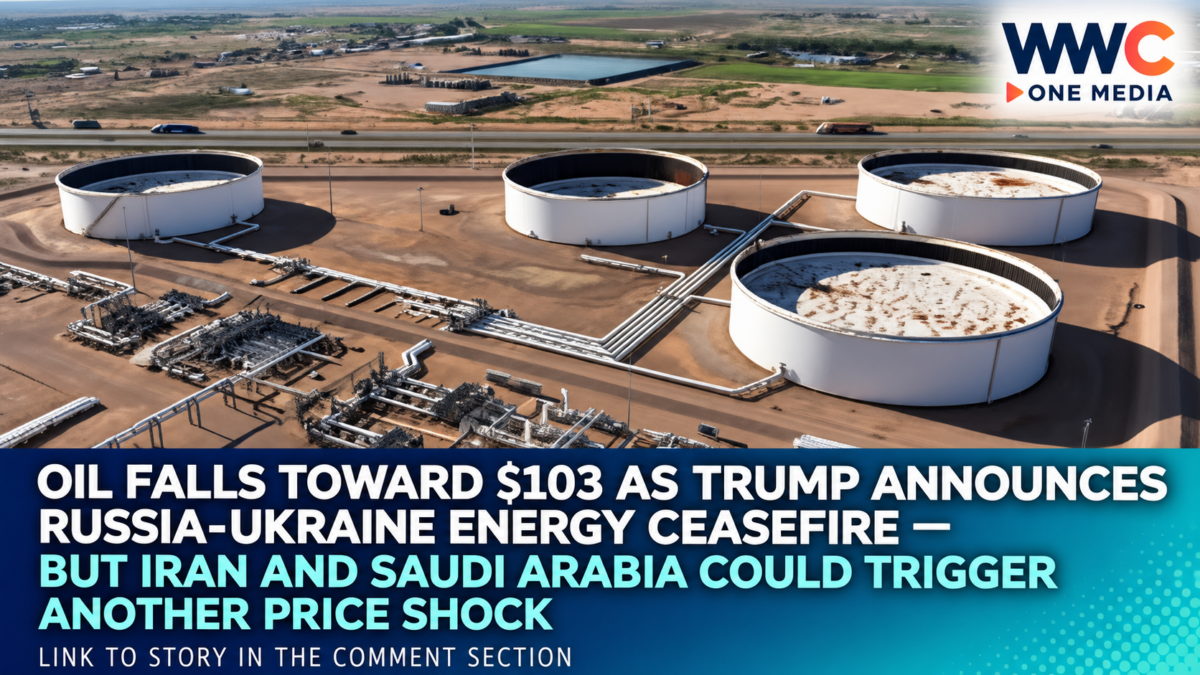
SINGAPORE, October 12, 2026 — Global oil prices retreated on Monday after US President Donald Trump announced a proposed energy ceasefire between Russia and Ukraine and an agreement that could release additional Russian diesel supplies into international markets.
But the decline offered little reassurance that the world’s energy crisis was nearing an end.
Escalating tensions involving Iran, renewed attacks on Saudi Arabia and threats to commercial shipping in the Strait of Hormuz continued to raise fears of another major supply disruption.
Brent crude futures declined approximately 1.47% to $103.18 per barrel during Monday’s trading, while US West Texas Intermediate (WTI) crude fell around 1.68% to $90.31 per barrel, according to Reuters.
The reversal followed earlier gains that briefly pushed Brent above $105 as traders responded to intensified attacks in the Middle East.
The dramatic price swings highlighted the conflicting pressures confronting global energy markets: expectations of additional supplies from Russia on one side, and growing risks to oil transportation and infrastructure in the Middle East on the other.
For businesses and consumers already struggling with expensive fuel, the critical question is whether diplomatic developments can produce lasting price relief before another geopolitical crisis sends crude higher.
Trump Announces Energy Ceasefire Between Russia and Ukraine
Oil prices fell after President Trump announced that Russia and Ukraine had agreed to stop attacks on each other’s energy infrastructure.
The announcement raised expectations that fewer attacks on refineries, pipelines and other energy facilities could help stabilize international fuel supplies.
Trump also said Russia would release additional diesel supplies into global markets under an arrangement with Washington.
However, the proposed ceasefire remained uncertain as of October 12.
Ukrainian President Volodymyr Zelenskyy indicated that he was awaiting further details, while Russia had not publicly confirmed the agreement in the reporting available at that point.
This distinction is important because a presidential announcement does not necessarily mean both parties have accepted and implemented a binding ceasefire.
Analysts were therefore cautious about assuming that attacks on energy infrastructure would immediately stop.
If the arrangement is implemented and sustained, it could reduce some of the supply risks associated with the Russia-Ukraine war.
But continued attacks or disagreements over its terms could quickly reverse the optimism.
Russian Diesel Supplies Could Help Ease Global Shortages
Another major development was the prospect of additional Russian diesel entering international markets.
Diesel is particularly important because it powers trucks, shipping equipment, agricultural machinery and industrial operations.
Shortages can raise freight and production costs, eventually affecting prices paid by businesses and consumers.
Trump announced plans involving significant Russian diesel shipments, which investors interpreted as a possible source of relief for strained fuel markets.
Reuters reported that an initial volume exceeding 300,000 metric tonnes was being discussed, with additional shipments potentially following.
The broader scale and timetable of the proposed arrangement remained subject to confirmation and implementation.
The impact on international fuel prices will depend on actual shipments, export restrictions, refinery conditions and whether buyers can legally and commercially receive the product.
The Financial Times also reported that the proposed energy arrangement was politically sensitive because of the continuing conflict in Ukraine and existing restrictions on Russian energy trade.
While greater diesel availability could improve supply conditions, the effect on crude oil prices may be less direct because diesel is a refined petroleum product rather than crude.
Saudi Arabia Faces Escalating Houthi Attacks
Even as traders considered the prospect of Russian supply relief, the Middle East remained a major source of uncertainty.
Yemen’s Iran-backed Houthi movement intensified its attacks on Saudi Arabia over the weekend, including strikes targeting Riyadh’s international airport.
The attacks reportedly caused significant casualties and heightened concerns that regional conflict could further threaten important transportation and energy infrastructure.
President Trump said the United States was considering joining Saudi operations against the Houthis, raising the possibility of an additional military escalation.
Any broader confrontation could increase the risk of attacks on oil facilities, ports and shipping routes.
Saudi Arabia is one of the world’s most important crude exporters, so serious disruptions to its infrastructure could affect international oil availability and pricing.
However, the airport attacks alone do not establish that Saudi crude production or exports were interrupted.
The market’s reaction reflects concern about potential escalation rather than confirmed losses of Saudi production from those specific incidents.
Strait of Hormuz Attacks Keep Global Oil Supply at Risk
The Strait of Hormuz remains one of the most important sources of uncertainty in the oil market.
The narrow waterway connects the Persian Gulf with the Gulf of Oman and international shipping routes.
Before the conflict, oil and petroleum-product shipments passing through the strait represented roughly one-fifth of global consumption.
Its strategic importance makes even temporary disruptions a serious concern for oil-importing economies.
Over the weekend, attacks involving commercial tankers in the region renewed fears about shipping security.
Reuters reported that two tankers had been attacked, adding to growing concerns over the safety of vessels operating around the Gulf and nearby waters.
Such incidents can increase shipping insurance costs, force changes in vessel routes and discourage commercial operators from entering higher-risk areas.
Even when crude remains available from producing countries, difficulties transporting it to customers can push global prices higher.
The Financial Times separately reported that vessel traffic through the Strait of Hormuz had experienced significant disruption in recent weeks, with shipping flows falling sharply on some days.
These disruptions help explain why oil prices can remain elevated despite expectations of additional supply from other regions.
Oil Surged Above $104 Before Monday’s Reversal
The latest retreat followed a period of intense volatility.
On October 8, Brent crude settled at approximately $104.28 per barrel after gaining around 4%, according to Reuters.
US crude also advanced sharply as markets responded to threats against shipping and energy infrastructure.
At the same time, Hurricane Isaias threatened offshore production in the US Gulf of Mexico, creating another supply concern.
Energy companies suspended production at some facilities while monitoring the storm.
The combination of geopolitical and weather-related disruptions helped push crude prices higher.
By October 12, however, expectations of a possible Russia-Ukraine energy ceasefire and additional diesel shipments shifted market sentiment.
The sharp reversal demonstrated how quickly oil traders can move between fears of shortages and expectations of improved supply.
But prices remaining above $100 for Brent showed that significant uncertainty was still embedded in the market.
Goldman Sachs Sees Potential Oil Price Relief
Despite ongoing geopolitical tensions, some analysts believe additional supplies could reduce crude prices later this year.
Reuters reported that Goldman Sachs revised its December Brent crude price forecast to approximately $90 per barrel.
The projection suggests the bank sees potential for prices to ease if international supply conditions improve.
However, the forecast remains exposed to significant risks.
A renewed escalation involving Iran, additional attacks on Saudi energy infrastructure or further disruptions to shipping could keep crude above projected levels.
Conversely, a sustained decline in regional tensions and improved availability of crude and refined products could support lower prices.
Forecasts are not guarantees, and actual market conditions may differ considerably from investment banks’ projections.
Why Asian Economies Remain Vulnerable
Asia is particularly exposed to volatility in international oil markets because several major economies depend heavily on imported crude and refined petroleum products.
Countries such as Japan, South Korea, India and the Philippines are vulnerable to higher international energy prices.
For the Philippines, sustained increases in crude prices can raise the cost of gasoline, diesel, aviation fuel and other petroleum products.
Higher transport costs can also affect food distribution, logistics and industrial operations.
However, movements in international crude prices do not translate immediately or proportionately into domestic pump prices.
Local pricing depends on refined-product markets, exchange rates, taxes, inventories and individual fuel companies’ pricing schedules.
Oil-market uncertainty is therefore important not only to financial investors but also to consumers and businesses across Southeast Asia.
The Inflation Threat Has Not Disappeared
Global energy prices remain an important factor in the inflation outlook.
Higher oil and diesel costs can affect transportation, agricultural production, aviation, shipping and manufacturing.
These increases may eventually be passed on to consumers through more expensive goods and services.
Investors are also watching the next US inflation report, scheduled for October 14.
Stronger-than-expected inflation could complicate the Federal Reserve’s interest rate decisions, particularly if elevated energy prices continue feeding into the broader economy.
The situation creates a difficult policy environment.
Higher interest rates can help restrain inflation but may also increase borrowing costs for households, companies and governments.
A lasting decline in oil prices could relieve some inflationary pressure, although energy prices are only one component of overall inflation.
The Bigger Question: Can Diplomacy Outrun Another Middle East Escalation?
The October 12 selloff shows how sensitive oil markets have become to political announcements and developments on the battlefield.
A possible Russia-Ukraine energy ceasefire and additional Russian diesel supplies are raising hopes for improved fuel availability.
But the continuing Iran conflict, attacks involving Saudi Arabia and risks to shipping through the Strait of Hormuz remain major threats.
The global market is facing two competing scenarios.
If diplomatic agreements hold, Russian fuel exports increase and shipping conditions improve, crude prices could gradually decline.
If negotiations collapse or attacks on oil infrastructure intensify, the market could experience another rapid price surge.
The central challenge is that increased supply from one region may not be enough to offset a major disruption in another.
For oil-importing economies, this uncertainty could mean continued pressure on transport costs, inflation and economic growth.
For financial markets, it means that every major announcement involving Washington, Moscow, Tehran or Riyadh could trigger another sharp price movement.
Oil may have fallen toward $103 as traders welcomed the prospect of Russian supply relief, but the bigger test is whether diplomacy can deliver enough stability to overcome the risks building across the Middle East.
Until the security of global energy infrastructure and major shipping routes improves, the threat of another oil-price shock will remain.