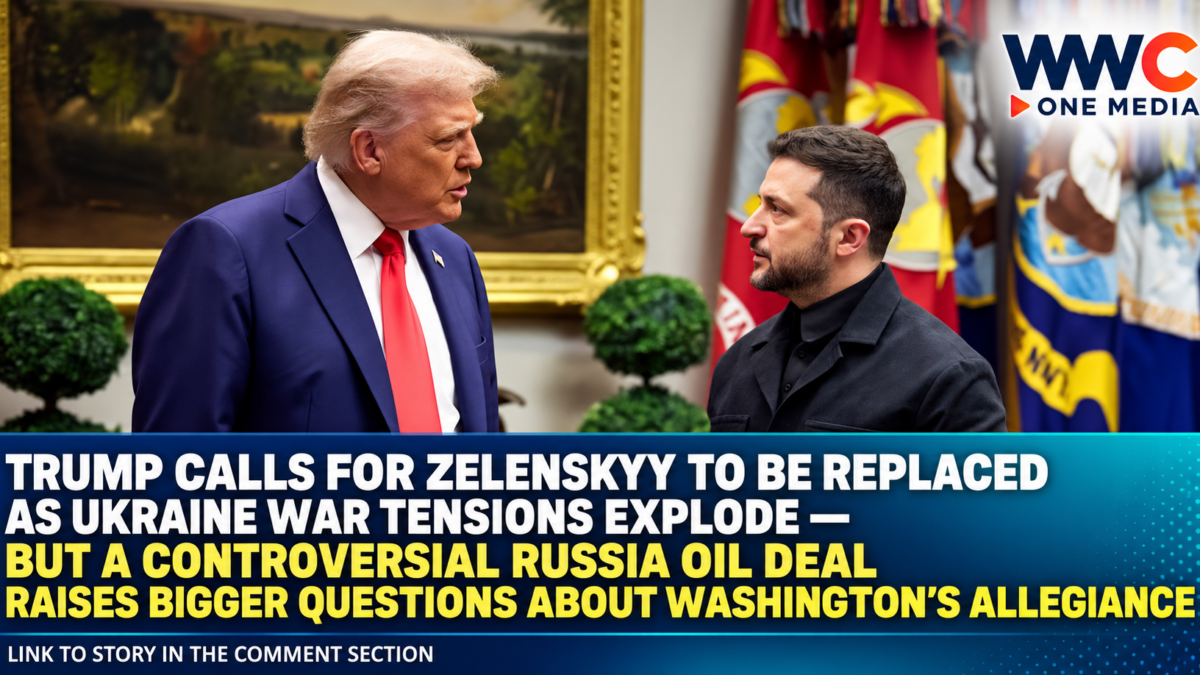
WASHINGTON, UNITED STATES — U.S. President Donald Trump has intensified his confrontation with Ukrainian President Volodymyr Zelenskyy, openly suggesting that Ukraine needs a new leader as a controversial American agreement to ease restrictions on Russian diesel exports threatens to deepen divisions between Washington, Kyiv and its European allies.
Speaking to reporters outside the White House on Saturday, October 10, Trump criticized Zelenskyy’s handling of the war with Russia, accused him of failing to negotiate a peace agreement and demanded that Ukrainian forces stop attacking Russian oil refineries.
“I think it’s time for Ukraine to get a new president,” Trump declared, arguing that Kyiv needs a leader capable of reaching an agreement with Moscow.
The remarks represent a striking escalation in Trump’s increasingly strained relationship with Zelenskyy, coming just one day after Washington announced an arrangement with Russia to release millions of tons of diesel into international markets.
The dispute is no longer simply about peace negotiations. It now encompasses global energy prices, Western sanctions, Russia’s war financing and the future of U.S. support for Ukraine.
Trump Blames Zelenskyy for Failure to End Russia-Ukraine War
Trump accused the Ukrainian president of missing repeated opportunities to negotiate a settlement with Russia, suggesting that a leadership change could help end the conflict.
According to Bloomberg, Reuters and the Associated Press, Trump also criticized Ukraine’s continued strikes against Russian petroleum infrastructure.
The American president argued that attacks on refineries were worsening international fuel shortages and pushing up energy prices.
He told reporters that Ukraine could strike other Russian targets but should avoid oil refineries, describing their destruction as a problem for global energy supplies.
Trump further claimed that Russia’s February 2022 invasion would never have happened had he been president at the time.
However, that assertion is a counterfactual political claim, not an established fact.
Russia launched its full-scale invasion of Ukraine on February 24, 2022, and Moscow remains responsible for initiating that invasion.
Trump also cited enormous territorial and human losses in arguing that Ukraine needs new leadership. His specific casualty and territorial figures should be treated as political claims rather than independently verified totals.
The latest confrontation highlights the increasingly difficult relationship between Washington and Kyiv as the United States attempts to broker an end to a war now in its fifth year.
Controversial U.S.–Russia Diesel Agreement Sparks Outrage
At the center of the diplomatic confrontation is a new energy arrangement between Washington and Moscow.
On October 9, Trump announced that Russia would supply large quantities of diesel fuel to the United States and international markets, following discussions with Russian President Vladimir Putin.
According to the Associated Press and CBS News, the announced deliveries include:
- More than 300,000 tons of diesel initially.
- An additional 500,000 tons in November.
- Another 1 million tons thereafter.
- A further potential delivery of 3 million tons, dependent on Russian refinery conditions.
The U.S. Treasury Department also announced a temporary sanctions waiver allowing certain Russian diesel supplies to enter international markets.
The decision marks a significant shift from Washington’s previous strategy of restricting Russian energy revenues to limit Moscow’s ability to finance its military operations.
For Trump, the agreement is intended to increase international fuel supplies and ease diesel prices as the United States confronts energy-market pressures.
The political stakes are also substantial ahead of the November 3 U.S. midterm elections.
But for Ukraine and its supporters, relaxing restrictions on Russian energy exports raises a far more troubling possibility: additional revenue flowing to Moscow while Russian forces continue attacking Ukrainian cities.
Zelenskyy Warns Russia Could Use Oil Revenues to Finance More Attacks
Zelenskyy sharply criticized Washington’s decision to ease restrictions on Russian diesel exports, warning that the arrangement could strengthen the Kremlin’s capacity to continue the war.
The Ukrainian president argued that additional revenue from Russian energy sales could ultimately translate into more military equipment, weapons and attacks against Ukrainian communities.
His criticism came as Russian forces launched another deadly wave of strikes against Ukraine.
According to the Associated Press, Russian attacks in the Zaporizhzhia region on October 10 killed at least 20 people, including three children.
Residential buildings were struck, leaving communities devastated as emergency crews searched through the wreckage.
Additional strikes targeted Kyiv, where several people were reported wounded.
Zelenskyy argued that Moscow interprets reduced economic pressure as a sign that it can continue military operations without facing sufficient consequences.
His position reflects Ukraine’s longstanding demand that Western nations maintain sanctions on Russian energy exports until meaningful progress is achieved toward ending the invasion.
The disagreement has created a politically explosive situation: Washington is seeking additional Russian fuel supplies while Kyiv is demanding tighter financial pressure on Moscow.
European Allies Face a New Diplomatic Dilemma
The dispute is also raising concerns in Europe, where governments have supported Ukraine through military assistance, economic sanctions and diplomatic pressure on Russia.
European officials have repeatedly argued that Russian energy revenues help sustain Moscow’s military campaign.
The European Union’s foreign policy chief, Kaja Kallas, warned against easing pressure on Russia as attacks on Ukrainian cities continue, according to AFP reporting.
The latest U.S. decision threatens to complicate coordination among Western allies at a critical moment for ongoing diplomatic negotiations.
If Washington relaxes restrictions while European governments maintain tougher sanctions, the allies could find themselves pursuing increasingly different strategies toward Moscow.
That divergence could weaken the unified international pressure that Western governments have sought to maintain since Russia’s full-scale invasion.
However, the extent of any damage to transatlantic relations will depend on how the sanctions waiver is implemented and whether the diesel arrangement leads to further policy changes.
Peace Negotiations Face Another Major Setback
Trump’s remarks come as American, Ukrainian and European officials continue efforts to develop a framework for ending the war.
According to Reuters and Al Jazeera, talks involving Ukraine’s Western partners have been taking place as the conflict enters another difficult period.
Meanwhile, Putin has expressed skepticism about immediately restarting peace negotiations, citing Ukrainian drone attacks against Russian territory.
Ukraine maintains that it must retain the ability to strike Russian military and energy infrastructure used to support the war.
Moscow, meanwhile, continues demanding concessions that Kyiv has resisted.
The disagreement reflects a fundamental obstacle to negotiations: the two sides remain divided over territorial control, security guarantees and the conditions necessary for a durable peace.
Trump’s public criticism of Zelenskyy adds another layer of uncertainty.
Although the U.S. president has called for new Ukrainian leadership, Washington does not have the authority to decide who governs Ukraine.
Ukraine’s presidential elections have also been complicated by martial law imposed following Russia’s full-scale invasion. Under Ukraine’s existing wartime legal framework, national elections cannot proceed while martial law remains in force.
Any eventual leadership transition would therefore need to follow Ukraine’s constitutional and legal processes.
Why the Russia Diesel Deal Matters to Asia and Global Markets
The confrontation also carries implications beyond Europe.
Diesel is essential to freight transportation, agriculture, shipping, manufacturing and industrial activity across the global economy.
A sustained increase in diesel prices can raise the cost of transporting food, operating factories and moving goods through international supply chains.
For energy-importing countries such as the Philippines, developments affecting international fuel supplies could eventually influence domestic pump prices and transportation costs.
Other Asian economies, including Japan, South Korea and Singapore, are also sensitive to disruptions in global energy markets.
Additional Russian diesel supplies could provide some relief to international markets if they become commercially available.
However, the actual effect on prices will depend on delivery volumes, shipping arrangements, sanctions compliance, refinery capacity and broader geopolitical developments.
The agreement does not guarantee an immediate reduction in pump prices.
It also presents a complicated geopolitical trade-off: expanding energy supplies may ease economic pressure on consumers, but increasing purchases of Russian fuel could undermine efforts to restrict Moscow’s wartime revenue.
Trump’s Political Gamble Could Reshape U.S. Relations With Ukraine
Trump’s renewed criticism of Zelenskyy arrives during a politically sensitive period in the United States.
High fuel prices have become an important economic issue ahead of the November midterm elections, increasing pressure on the administration to demonstrate that it can bring energy costs under control.
The diesel arrangement could allow the White House to argue that it is taking concrete action to address rising prices.
Yet the decision also risks criticism from lawmakers who believe relaxing energy sanctions rewards Russia despite its continuing invasion of Ukraine.
According to reporting by The Guardian, the move has drawn criticism from both Democratic lawmakers and some Republicans, highlighting divisions over the administration’s approach to Moscow.
For Kyiv, the larger concern is whether Washington’s energy priorities could increasingly take precedence over Ukraine’s security interests.
For Moscow, any weakening of Western sanctions could provide both financial relief and diplomatic leverage.
And for European governments, the latest confrontation raises fresh questions about whether the United States and its allies can maintain a coordinated strategy toward ending the war.
The Bigger Picture: Is Washington Changing Its Strategy Toward Russia?
Trump’s suggestion that Ukraine needs a new president is more than another diplomatic confrontation.
It comes at a moment when Washington is reconsidering how energy security, sanctions and peace negotiations fit into its broader relationship with Moscow.
The U.S. administration argues that releasing additional Russian diesel could help address international fuel shortages and lower prices for consumers.
Ukraine counters that increased Russian energy revenue could prolong the very war Washington says it wants to end.
Both arguments expose the difficult choices facing governments as they attempt to balance economic priorities against long-term security concerns.
What remains unclear is whether Trump’s increasingly aggressive criticism of Zelenskyy is primarily intended to pressure Kyiv into negotiations or signals a more substantial shift in American policy toward Russia.
The consequences could extend far beyond the personal relationship between two presidents.
For Ukraine, the stakes involve its sovereignty, territorial integrity and continued access to Western support.
For Europe, they involve the credibility of sanctions and the future of regional security.
For global markets, they involve the uncertain relationship between international energy supplies and geopolitical risk.
Trump says he wants to end the Russia-Ukraine war. But as Washington eases restrictions on Russian diesel while demanding a change in Ukrainian leadership, an even bigger question is emerging: can the United States still persuade Kyiv and its European allies that its peace strategy protects Ukraine’s future?