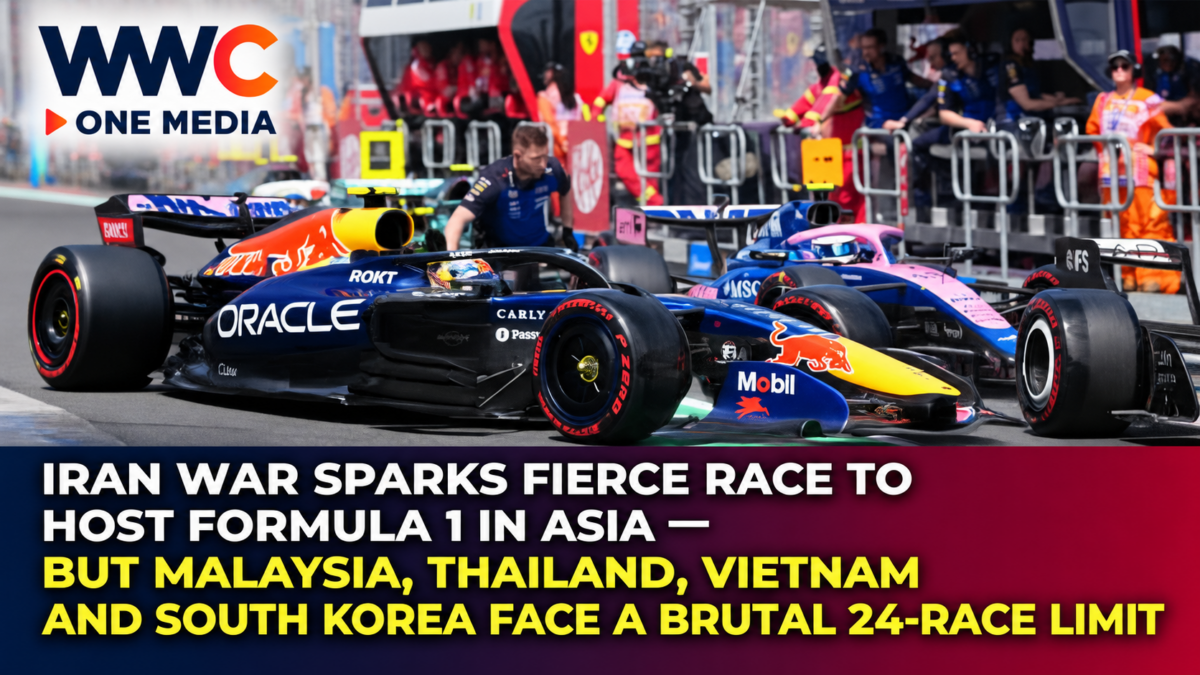
SINGAPORE — October 10, 2026 — Formula 1’s growing ambitions in Asia have received an unexpected boost from the conflict involving Iran, as Malaysia, Thailand, Vietnam and South Korea emerge as potential contenders for future Grand Prix events.
The geopolitical crisis has exposed the vulnerability of a global racing calendar heavily dependent on international travel, complex logistics and long-term agreements with host countries.
But it has also created an opportunity for Asian destinations eager to secure one of motorsport’s most valuable international sporting events.
According to the Financial Times, Formula 1 is considering growing interest from several Asian countries as it evaluates the next phase of its global expansion.
Malaysia’s unexpected return to the championship last weekend demonstrated the region’s ability to stage a major race at relatively short notice.
The Sepang International Circuit hosted the Bahrain Grand Prix from October 2 to 4 after the event could not proceed at its original Middle Eastern venue.
Strong demand for tickets, international attention and the circuit’s established infrastructure have strengthened the case for Asia as an increasingly important part of Formula 1’s future.
However, one major obstacle remains.
Formula 1 does not intend to increase its calendar beyond 24 races, meaning a new Asian Grand Prix could come at the expense of an existing event elsewhere.
That restriction is turning the competition for hosting rights into a potentially high-stakes contest involving national governments, tourism authorities, private investors and some of the world’s most recognizable racing circuits.
Malaysia’s Surprise Return Changes the Formula 1 Conversation
Malaysia’s Sepang International Circuit returned to the Formula 1 calendar for the first time since 2017.
But the event was not a conventional reinstatement of the Malaysian Grand Prix.
Instead, Malaysia hosted the officially designated Formula 1 Gulf Air Bahrain Grand Prix in Malaysia, preserving the Bahrain race through a special arrangement involving Formula 1, the FIA and the governments of Bahrain and Malaysia.
The agreement was formally announced on July 26, 2026.
It allowed organizers to stage the race on October 2–4 between the Azerbaijan and Singapore Grands Prix.
The arrangement provided a practical response to regional security concerns that made Bahrain’s original hosting plans difficult.
It also demonstrated that an established circuit outside the Middle East could help protect the championship’s schedule during a period of international uncertainty.
The Financial Times reported that tickets for the Sepang event sold out within three weeks, reinforcing the impression of strong regional fan demand.
For Malaysia, the successful return offers a compelling argument for why the country should be considered for future races.
However, the October event was a replacement arrangement rather than confirmation of a permanent Malaysian Grand Prix contract.
Max Verstappen Wins Rain-Hit Sepang Race
The race itself provided a dramatic reminder of why Sepang remains popular among motorsport enthusiasts.
Red Bull driver Max Verstappen won the Bahrain Grand Prix staged in Malaysia on October 4, overcoming difficult wet-weather conditions.
The race featured heavy rain, unpredictable track conditions and technical complications linked to Formula 1’s current power-unit systems.
Reuters subsequently reported that the FIA had implemented a temporary software adjustment after a problem exposed during the wet race weekend.
The issue affected some cars’ power delivery during low-speed running.
The FIA planned to retain a contingency version of the software for the Singapore Grand Prix if wet conditions required it.
The technical problems were separate from the geopolitical reasons for moving the event.
Together, however, the circumstances demonstrated both the opportunities and operational challenges involved in staging races at short notice.
For Sepang, the event offered renewed international exposure and showed that its infrastructure remains capable of supporting elite motorsport.
Thailand Sees Formula 1 as a Major Tourism Opportunity
Thailand is among the countries identified by the Financial Times as interested in bringing Formula 1 to its shores.
A Thai Grand Prix would have significant commercial potential because the country already attracts international visitors and hosts major entertainment and sporting events.
Bangkok has been associated with ambitions to stage a Formula 1 street race.
The appeal is clear.
A major urban event could provide international television exposure, attract high-spending visitors and support hotels, airlines, restaurants and other tourism-related businesses.
Thailand could also benefit from a large regional fan base, with spectators potentially traveling from neighboring Southeast Asian countries.
However, hosting a Formula 1 race requires more than identifying an attractive city or building a circuit.
Organizers must demonstrate that they can satisfy strict safety, infrastructure, operational and financial requirements.
Street races present additional challenges involving road closures, transport disruption, event construction and impacts on local communities.
As of October 10, Thailand had not been confirmed as a new permanent Formula 1 race host.
Its interest represents a potential opportunity, not an awarded calendar position.
Vietnam’s Abandoned Grand Prix Could Get Another Chance
Vietnam’s inclusion in the discussion is particularly notable because the country previously came close to hosting Formula 1.
Hanoi was scheduled to stage a Grand Prix in 2020.
A street circuit was developed for the event, but the inaugural race was canceled amid the COVID-19 pandemic.
The race subsequently disappeared from the calendar, leaving costly infrastructure that has not hosted the Formula 1 event originally envisioned.
The experience illustrates the financial risks associated with hosting agreements.
Governments and promoters can commit substantial resources before a race produces any tourism or commercial benefits.
Now, renewed interest in Asian venues could revive questions about Vietnam’s potential role.
The country’s growing economy and international tourism market may make it attractive to motorsport organizers.
However, a new Vietnam Grand Prix has not been confirmed.
Any future bid would require a viable commercial plan and updated assessments of infrastructure, financing and regulatory approval.
The existence of a previously developed circuit does not automatically make a new race financially or technically feasible.
South Korea Wants Another Opportunity on the F1 Calendar
South Korea is another country attracting attention as Formula 1 evaluates Asian expansion.
The nation previously hosted Formula 1 races at the Korean International Circuit in Yeongam from 2010 to 2013.
Although the event brought international attention, it struggled with commercial and logistical challenges.
The Korean Grand Prix eventually disappeared from the championship calendar.
A renewed bid would therefore need to address some of the weaknesses that affected the earlier event.
South Korea has a major automotive industry and globally recognized technology and entertainment brands, offering potential commercial advantages.
Its domestic market could also provide opportunities for sponsorship, tourism and broader international promotion.
However, the existence of large automakers or strong economic fundamentals does not guarantee that a Grand Prix will be commercially successful.
Organizers must establish a workable event location, sustainable funding and sufficient spectator demand.
As with Thailand and Vietnam, the country’s prospects remain under consideration rather than confirmed.
The Iran War Has Exposed Formula 1’s Geopolitical Risks
The competition for new venues has intensified because the Middle East conflict has complicated Formula 1’s schedule.
Modern Formula 1 races require the movement of teams, drivers, equipment, personnel and broadcast infrastructure across multiple continents.
Disruptions to air travel, shipping routes or regional security can therefore affect far more than the race weekend itself.
The relocation of the Bahrain Grand Prix to Malaysia highlighted the importance of contingency planning.
Other races in the region have also faced uncertainty.
Reuters reported in September that decisions affecting the end of the 2026 season in Qatar and Abu Dhabi could be influenced by the conflict.
The situation raises an important question for the championship.
How much of its commercial calendar should depend on regions vulnerable to geopolitical or logistical disruption?
Formula 1 must maintain relationships with existing host countries while considering how alternative venues could strengthen operational flexibility.
Asian circuits with established infrastructure may become particularly valuable in that environment.
However, Asia is not free from geopolitical, weather-related or logistical risks of its own.
Formula 1 Chief Says the 24-Race Limit Will Remain
Despite growing international interest, Formula 1 chief executive Stefano Domenicali has repeatedly indicated that the championship does not plan to expand indefinitely.
The sport has targeted a maximum of 24 races per season.
That position creates a difficult commercial reality for aspiring hosts.
If all existing calendar places are occupied, a new event must compete for a position currently held by another race.
Possible changes could involve expiring contracts, rotating arrangements or decisions not to renew individual events.
The calendar therefore represents a limited commercial resource.
Hosting rights are valuable precisely because the championship cannot accommodate every interested destination.
Formula 1 must consider financial commitments, promoter relationships, logistics, audience demand and the sporting quality of individual circuits.
For countries seeking admission, convincing the championship that they offer long-term value is essential.
A successful demonstration race or a strong tourism market may help, but neither guarantees a permanent position.
Asia Could Overtake Europe in Formula 1 Race Numbers
Formula 1’s geographic balance is also changing.
Europe remains the historic center of the championship, with many of its most recognizable circuits and leading teams based on the continent.
But the series has steadily expanded its presence in Asia, the Americas and the Middle East.
Financial Times reporting indicates that Asia could host more races than Europe in 2027, helped by the planned return of the Turkish Grand Prix.
The Istanbul circuit is located on the Asian side of Turkey.
The shift would be symbolically significant for a sport whose earliest identity was closely associated with European motorsport.
However, geographic classifications can vary depending on how transcontinental countries and Middle Eastern venues are counted.
The broader trend is more important than the precise regional tally.
Formula 1’s commercial strategy increasingly emphasizes international audiences and markets capable of supporting major sporting events.
For Asian countries, that creates opportunities to participate in one of the world’s most valuable annual sports properties.
Traditional European Circuits Face New Pressure
The rise of Asian contenders could intensify competition for long-established European events.
Formula 1’s heritage includes famous venues such as Silverstone, Monza, Spa-Francorchamps and Monaco.
But tradition alone may not guarantee a permanent calendar slot.
Commercial agreements, venue modernization, safety standards and fan engagement remain important considerations.
Some European races have already faced calendar changes or rotational arrangements.
The Financial Times has reported that the championship’s international expansion is creating fresh pressure on historic venues even as Europe remains central to Formula 1 engineering.
That creates a tension between the sport’s heritage and its global commercial ambitions.
Fans may value traditional circuits for their racing history.
Promoters, meanwhile, must evaluate financial commitments and growing demand from potential hosts elsewhere.
As Asian bids become more competitive, every renewal negotiation could become more consequential.
Hosting a Grand Prix Can Bring Benefits — But Also Major Costs
Governments and tourism authorities often view Formula 1 as a tool for international promotion.
A successful race can attract overseas visitors, television exposure and spending across hospitality, transport and entertainment.
Singapore has demonstrated how a Grand Prix can become the centerpiece of a wider business and tourism program.
Its October 2026 race weekend coincides with several major international conferences and investment events.
Reuters reported that Maybank expected Formula 1-related tourism receipts in Singapore to exceed S$160 million during the period.
However, projected visitor spending is not the same as net economic benefit.
Hosting a race can involve substantial public or private spending on infrastructure, security, road closures and event operations.
Cities must assess whether tourism revenue and longer-term promotional benefits justify those costs.
Malaysia’s successful return provides evidence of spectator demand.
But a lasting hosting agreement would require a sustainable financial model beyond one exceptional event.
For Thailand, Vietnam and South Korea, this economic calculation could be just as important as securing Formula 1’s approval.
What the Growing Asian Race Means for Southeast Asia
The potential addition of new Asian Grands Prix could reshape regional motorsport tourism.
Southeast Asia already includes major motorsport destinations in Singapore and Malaysia.
Additional events could attract travelers from Indonesia, the Philippines and neighboring markets.
Airlines, hotels, travel agencies and entertainment businesses could potentially benefit from increased visitor flows.
There may also be opportunities for local motorsport development and commercial sponsorship.
However, multiple races in the same region could compete for fans, travel budgets and corporate partners.
Organizers must therefore consider whether demand is strong enough to support additional events without weakening existing ones.
The commercial success of one race does not prove that every interested destination can achieve similar results.
Could the Philippines Benefit From Formula 1’s Asian Expansion?
For Filipino Formula 1 fans, the growing interest in Asian races could make attending a Grand Prix more accessible.
Additional events in neighboring countries could create more travel choices and reduce the need to fly to distant destinations.
Tourism businesses in the Philippines could also explore regional travel packages built around major motorsport events.
But the country is not among the four Asian contenders identified in the Financial Times report.
There is no confirmed announcement that the Philippines has been selected to host a Formula 1 Grand Prix.
Hosting would require suitable infrastructure, extensive financing, technical approvals and long-term coordination among public and private stakeholders.
For now, the immediate opportunity for Filipino fans lies in greater access to races across Asia rather than an announced domestic event.
The Bigger Picture: Formula 1 Is Becoming a Global Competition Between Host Cities
The race to secure a Formula 1 calendar position reflects the championship’s transformation into a major international entertainment business.
Countries and cities see Grand Prix events as opportunities to attract visitors, promote international recognition and strengthen relationships with global corporations.
Formula 1, meanwhile, can choose among destinations offering different combinations of commercial revenue, infrastructure, audience demand and strategic value.
The Iran conflict has added another factor to that calculation: resilience.
A venue capable of hosting races reliably when international conditions change may have advantages beyond its commercial appeal.
Malaysia’s unexpected 2026 return demonstrated the usefulness of retaining relationships with established circuits.
But it also revealed how crowded the competition for permanent calendar positions has become.
The next challenge for the sport is determining how to expand its Asian presence while preserving historic venues and maintaining a manageable schedule.
THE BOTTOM LINE
The war involving Iran has intensified competition among Malaysia, Thailand, Vietnam and South Korea to host future Formula 1 races.
Malaysia’s Sepang International Circuit has strengthened its credentials after successfully staging the Bahrain Grand Prix on October 2–4, marking its first Formula 1 event since 2017.
The return demonstrated strong regional demand and showed how alternative venues can help Formula 1 navigate geopolitical disruptions.
But chief executive Stefano Domenicali has reiterated that the championship intends to retain its 24-race limit.
That means the addition of another Asian race could require an existing event to make way.
The biggest question is no longer whether Asia has the fans, infrastructure and commercial ambition to host more Formula 1 races — but which country can convince the championship it deserves one of its limited calendar positions.
Malaysia has proved that Sepang can return under extraordinary circumstances. Now Thailand, Vietnam and South Korea are competing for their own place on the grid — and one of Formula 1’s existing hosts may ultimately pay the price.