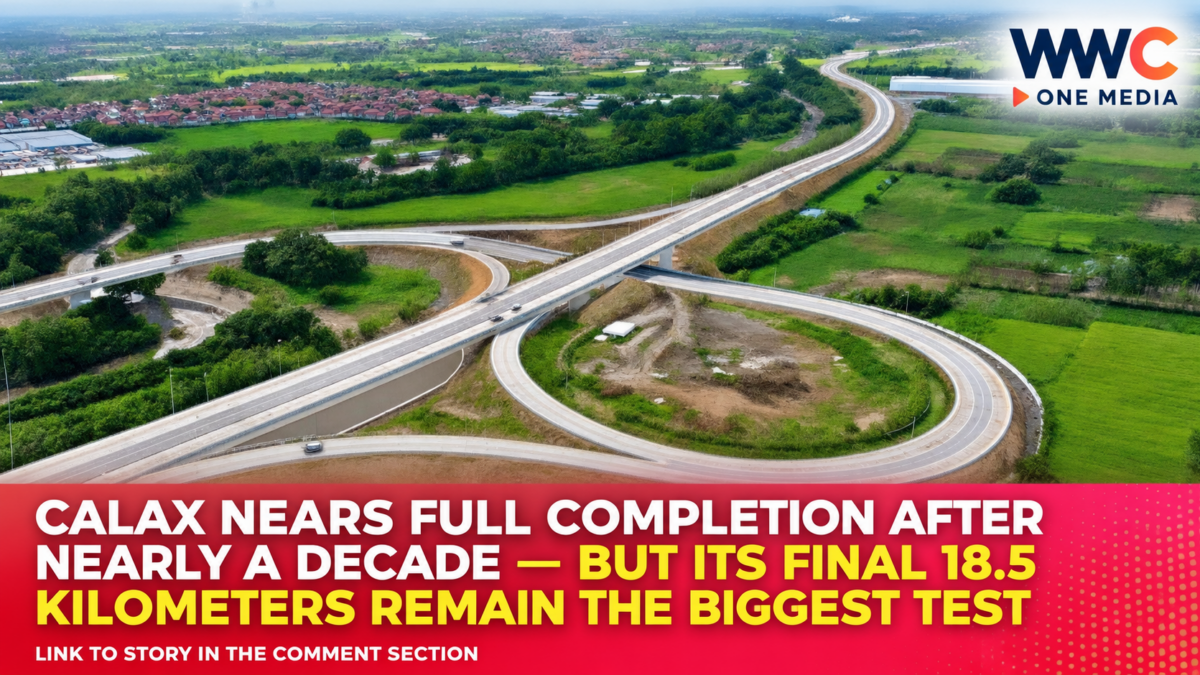
MANILA, Philippines — Nearly a decade after construction began in June 2017, the long-awaited Cavite-Laguna Expressway (CALAX) is moving closer to full completion, raising hopes for faster travel, smoother cargo movement and stronger economic connections across Southern Luzon’s rapidly expanding industrial corridor.
Metro Pacific Tollways Corporation (MPTC), through subsidiary MPCALA Holdings Inc., is pressing ahead with construction of the remaining 18.5 kilometers of the approximately 45-kilometer toll road.
The final sections will extend the expressway from Governor’s Drive in General Trias, Cavite, through Open Canal and toward Kawit, where it is planned to connect with the Manila-Cavite Expressway (CAVITEX).
Once completed and interconnected, CALAX will establish a continuous expressway corridor linking the South Luzon Expressway (SLEX) side of Laguna with CAVITEX, providing motorists and businesses with an alternative to heavily congested local roads.
But while the project is described as approaching full completion, one critical question remains: When will the final 18.5 kilometers actually open to motorists after nearly a decade of construction?
CALAX’s Remaining 18.5 Kilometers Enter Construction Push
According to MPCALA Holdings’ October 9, 2026 announcement, construction activity is continuing on CALAX Subsections 1 and 2, which make up the unfinished portion of the expressway.
Current works include mainline road pavement, bridge superstructures, drainage systems, interchange ramps and other supporting infrastructure.
These components are essential to completing the connection through Open Canal and Kawit.
The expressway currently operates from Mamplasan in Biñan, Laguna, to Governor’s Drive in General Trias, Cavite, spanning approximately 26.5 kilometers.
Although the operator has characterized CALAX as approaching full completion, it has not disclosed an overall physical completion percentage for the unfinished sections or a definite opening date.
This distinction is important for motorists awaiting the full Cavite-Laguna connection.
An announcement that construction is advancing does not mean the remaining road sections are already available for public use.
CALAX Will Connect SLEX and CAVITEX Across Southern Luzon
CALAX is designed as a four-lane expressway, with two lanes in each direction, connecting major residential, commercial and industrial areas in Cavite and Laguna.
Its planned interchanges include Laguna Technopark, Laguna Boulevard, Santa Rosa–Tagaytay, Silang East, Silang Aguinaldo, Governor’s Drive, Open Canal and Kawit.
The completed route will connect with CAVITEX through the CAVITEX-CALAX Link, creating an alternative expressway connection across the southern portion of Metro Manila’s expanding economic region.
This would improve access between Laguna’s manufacturing centers, Cavite’s residential and industrial developments, and major commercial destinations closer to Metro Manila.
For commuters, the advantage could be a more direct route that bypasses sections of heavily congested local roads.
For businesses, the connection could support more predictable journeys for deliveries, employees and commercial vehicles.
However, actual travel-time savings will depend on traffic demand, toll charges, interchange conditions and the performance of connecting road networks.
President Marcos Opens CALAX Governor’s Drive Section
A significant milestone came on May 4, 2026, when President Ferdinand Marcos Jr. led the opening of CALAX Subsection 3, connecting Silang Aguinaldo to Governor’s Drive in General Trias.
The newly opened segment extended the operational expressway farther into Cavite.
According to the Presidential Communications Office and Metro Pacific Tollways, the new section was designed to provide a faster alternative to congested provincial roads.
The government cited an expected reduction in travel time between Biñan, Laguna, and General Trias, Cavite, from approximately one hour to 26 minutes under favorable operating conditions.
It also projected that travel between Aguinaldo Highway and Governor’s Drive could decline from about 30 minutes to six minutes.
These are estimated travel-time benefits, not guaranteed journey times during every traffic condition.
The new road section initially operated without toll charges.
The Toll Regulatory Board subsequently authorized toll collection beginning August 9, 2026.
For Class 1 vehicles, the approved toll for the Silang Aguinaldo-to-Governor’s Drive subsection was ₱35.
The opening was an important step toward completing CALAX, but the Open Canal and Kawit sections remain unfinished.
Cavite and Laguna Factories Could Be Major Beneficiaries
Beyond its impact on commuters, CALAX is positioned as an important transport link for the Cavite-Laguna industrial corridor.
Both provinces host manufacturing plants, industrial estates, warehouses, commercial developments and expanding residential communities.
Factories and logistics operators depend on efficient road connections to move raw materials, finished goods and employees.
Congestion on existing roads can make delivery schedules less predictable and increase transportation expenses.
When completed, CALAX could offer a more direct route between industrial locations and major markets.
MPCALA Holdings said improved expressway connectivity is expected to strengthen access to manufacturing facilities, distribution hubs, business centers and logistics networks.
The potential economic benefits extend to businesses supplying factories, commercial establishments and construction projects.
However, those gains will depend on whether transport operators consider the completed toll road faster and more economical than existing alternatives.
Metro Pacific Seeks to Complete Its Southern Tollway Network
CALAX is a key component of Metro Pacific Tollways Corporation’s expanding expressway network.
The company operates major Philippine toll roads including the North Luzon Expressway, Subic-Clark-Tarlac Expressway, NLEX Connector and Manila-Cavite Expressway.
It also has interests in other transport infrastructure projects, including the Cebu-Cordova Link Expressway.
Completing CALAX would strengthen Metro Pacific’s network in Southern Luzon by linking the CAVITEX corridor with the SLEX side of Laguna.
The connection is expected to improve mobility between major economic centers while providing motorists with additional route choices.
The expressway is being developed as a public-private partnership with the Department of Public Works and Highways serving as the government grantor and MPCALA Holdings acting as the private concessionaire.
The arrangement places construction, operation and related responsibilities within the terms of the project’s concession agreement.
CALAX’s Controversial Bidding History
The nearly decade-long construction effort follows an earlier procurement process that became one of the most closely watched infrastructure bidding disputes during the administration of former President Benigno Aquino III.
In 2014, the Ayala-Aboitiz-led Team Orion initially emerged as the winning bidder after San Miguel Corporation was disqualified over issues involving its bid security.
San Miguel subsequently disclosed that its financial proposal was higher than the declared winning offer.
The controversy prompted the government to reconsider the bidding outcome and conduct a new auction.
Ayala and Aboitiz declined to participate in the rebidding.
Metro Pacific eventually secured the concession in 2015 after submitting a higher financial offer than San Miguel.
The project later broke ground in June 2017.
The unusual procurement history illustrates the complex path that some major Philippine infrastructure developments must navigate before construction can proceed.
Why Completing the Final Sections Matters
The remaining CALAX subsections are crucial because they will complete the road’s planned connection to the CAVITEX corridor.
While motorists can already use the operational sections between Biñan and General Trias, the full route’s intended network benefits cannot be realized until the remaining construction and connecting infrastructure are completed and opened.
The last 18.5 kilometers will require the completion of road pavements, bridges, drainage infrastructure and interchanges.
These facilities must also undergo the necessary inspections, safety assessments and regulatory processes before public operation.
Until those requirements are satisfied, motorists cannot assume that CALAX’s full route will be available.
As of October 10, 2026, MPCALA Holdings has not provided a specific completion date in its latest announcement.
The absence of a firm timetable leaves commuters, freight operators and businesses awaiting greater clarity.
Nearly a Decade Later, Infrastructure Delivery Remains the Real Challenge
CALAX highlights both the ambition and complexity of major transport development in the Philippines.
Large expressway projects can improve regional mobility, reduce dependence on congested roads and strengthen connections between economic centers.
But their benefits are often realized gradually as individual road sections become operational.
For commuters and businesses, delayed completion means the full value of an interconnected transport network remains out of reach.
Even after the remaining CALAX sections open, authorities and the operator will need to monitor traffic performance, toll affordability, road safety and the capacity of connecting highways.
A completed expressway does not automatically eliminate congestion, particularly if bottlenecks persist near exits or connecting roads.
The project will therefore be judged not simply on the length of road constructed, but on whether it delivers meaningful improvements in transportation efficiency.
The Bigger Picture: Southern Luzon’s Growing Demand for Faster Mobility
Cavite and Laguna remain important locations for manufacturing, property development, logistics and regional commerce.
As residential communities and business districts expand, demand for dependable road infrastructure is likely to remain strong.
CALAX is intended to help address that demand by creating a more direct route across the two provinces and improving access toward Metro Manila.
For Metro Pacific Tollways, completing the expressway would be another major milestone in its broader infrastructure portfolio.
For the government, the project represents an opportunity to demonstrate the value of public-private partnerships in delivering transport facilities.
For motorists, however, the priority is more straightforward: a reliable, safe and fully operational road connecting the destinations they need to reach.
THE BOTTOM LINE
After nearly a decade of construction, the Cavite-Laguna Expressway is moving toward the completion of its planned 45-kilometer corridor.
Approximately 26.5 kilometers are already operational, while the final 18.5 kilometers remain under construction.
Once finished and connected to CAVITEX, the expressway is expected to offer motorists and businesses a more direct link across one of the Philippines’ most economically active regions.
But with no definite opening date announced for the remaining sections, the biggest milestone is still ahead.
The real test for CALAX will not be how close the project appears to completion — but when motorists can finally travel the entire route and experience the promised benefits of faster, more connected Southern Luzon transportation.