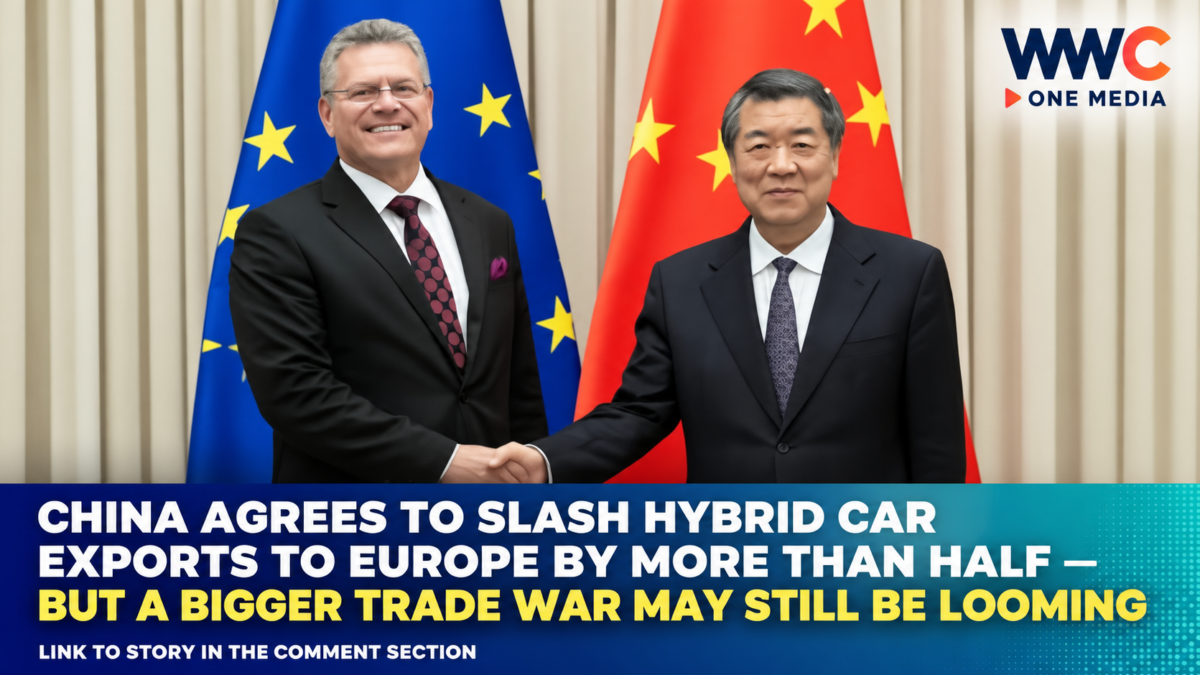
BEIJING, China — China and the European Union have reached a landmark preliminary trade understanding that could reduce Chinese hybrid vehicle exports to Europe by more than half relative to projected levels over the next four years, marking a major diplomatic breakthrough in efforts to prevent an escalating trade war between two of the world’s largest economic powers.
The agreement, announced on October 9, 2026, followed intensive negotiations in Beijing between European Commissioner for Trade and Economic Security Maroš Šefčovič and Chinese Commerce Minister Wang Wentao.
The discussions focused on one of Europe’s most urgent economic concerns: the rapid expansion of Chinese automotive exports and the growing competitive pressure facing European manufacturers.
Under the understanding, China would moderate shipments of hybrid and plug-in hybrid vehicles to the European Union, potentially reducing exports by several million vehicles compared with projected levels over four years.
But while Brussels is presenting the agreement as a breakthrough, an even bigger question remains: Will limiting Chinese car exports protect Europe’s struggling automotive industry, or merely delay a wider trade confrontation over industrial subsidies, market access and critical minerals?
China and Europe Reach Breakthrough After Intense Trade Talks
The agreement emerged after two days of high-level negotiations in Beijing, following several months of discussions over trade imbalances and Chinese exports.
European Trade Commissioner Maroš Šefčovič said both sides had reached a shared understanding to moderate China’s exports of hybrid and plug-in hybrid vehicles to the European market.
According to Reuters and the Financial Times, the arrangement could reduce Chinese hybrid shipments by more than half compared with projected export levels over four years.
However, the precise baseline, implementation schedule and enforcement mechanisms have not been fully disclosed.
That distinction matters because the agreement should not automatically be interpreted as a guaranteed 50% reduction from current annual export volumes.
Actual exports could still increase under certain scenarios if the restrictions are calculated against higher projected future shipments.
The agreement also remains subject to further approval and implementation procedures within the European Union.
Why Europe Wants to Slow China’s Expanding Car Exports
European automakers face mounting competition from Chinese manufacturers that have expanded internationally with competitively priced electric and hybrid vehicles.
Chinese automakers have invested heavily in battery technology, manufacturing capacity and product development, allowing them to compete across increasingly diverse vehicle categories.
European companies, meanwhile, are navigating high production costs, changing emissions requirements, competition in electric vehicles and pressure on profitability.
Manufacturers including Volkswagen, Renault, Stellantis and other European automotive groups have been forced to reassess their strategies as Chinese brands expand into international markets.
The European Union has already imposed additional tariffs on China-made battery-electric vehicles following an investigation into alleged unfair subsidies.
Those duties intensified tensions with Beijing, which has criticized European trade restrictions as protectionist.
Hybrid and plug-in hybrid vehicles have emerged as another major area of concern because of their growing popularity and the competitive pricing of Chinese models.
The latest negotiated understanding represents an attempt to address those pressures before they trigger another round of trade restrictions and retaliation.
Deal Could Affect Millions of Chinese Vehicles
According to European officials, the export-moderation arrangement could affect several million vehicles over the next four years.
The potential reduction would be significant for Chinese manufacturers seeking to expand their market share in Europe.
However, the commercial impact will depend on how authorities define covered vehicles, establish export baselines and enforce any limits.
It is also unclear how individual manufacturers will be affected or whether companies could adjust their European strategies through local assembly, alternative vehicle categories or other business arrangements.
For Chinese automakers, Europe remains an attractive market because of its purchasing power, large automotive sector and demand for electrified vehicles.
For European governments, the challenge is balancing consumer access to competitively priced vehicles against concerns about manufacturing employment and industrial competitiveness.
Any restriction on imports could provide domestic manufacturers with breathing room, but it could also influence consumer choice and the pricing of electrified vehicles.
The full consequences will depend on the final terms of the arrangement.
Rare Earth Minerals Become a Critical Part of the Negotiations
The agreement extends beyond automobiles.
China and the European Union also discussed measures to improve access to rare earth minerals and permanent magnets, which play important roles in automotive manufacturing, electronics, industrial machinery and other technologies.
China dominates important segments of the global rare-earth processing and magnet supply chain.
European industries have become increasingly concerned about the risks associated with concentrated supplies of critical materials.
Under the latest understanding, Beijing indicated that it would continue facilitating export-license approvals for rare earths and permanent magnets destined for European companies.
The measure could help improve supply-chain predictability if implemented effectively.
However, the agreement does not amount to the removal of all Chinese export controls, and detailed timelines for approvals have not been announced.
For European automakers, more reliable access to permanent magnets and other critical materials could be as important as reducing competitive pressure from imported Chinese vehicles.
Europe Could Gain Better Access to China’s Consumer Market
Another component of the negotiations involves improved market access for European exporters.
According to reporting from the Financial Times and South China Morning Post, the broader understandings include measures concerning products such as automotive components, olive oil and other European goods.
The affected trade flows have been estimated at nearly €4 billion in existing annual export value.
These measures could help certain European companies compete more effectively in the Chinese market.
However, the amount represents the value of trade potentially affected by improved market access, not a guaranteed increase in exports or additional revenue.
The broader agreement contains 16 areas of understanding covering trade and regulatory issues.
Their practical impact will depend on the implementation of tariff changes, licensing arrangements and other commitments.
Europe’s Massive Trade Deficit With China Fuels Political Pressure
The hybrid vehicle agreement comes amid mounting concern in Brussels over the European Union’s trade imbalance with China.
European officials have described the deficit as exceeding €1 billion per day.
The imbalance has become politically sensitive because of concerns that rising Chinese exports could weaken European manufacturing industries and threaten employment.
The automotive sector is particularly important because it supports extensive supply chains involving parts suppliers, engineering companies, technology businesses and manufacturing workers.
France and Germany have been among the countries pushing for stronger measures to address perceived unfair competition and defend European industrial interests.
However, European governments do not always agree on the most effective response.
Some favor stronger trade defenses, while others worry that additional barriers could damage commercial ties, raise costs and provoke retaliation.
The latest agreement reflects an effort to find a negotiated solution before those disagreements escalate into a wider economic confrontation.
European Car Stocks Rise as Investors Welcome the Deal
Financial markets initially reacted positively to the announcement.
Reuters reported broad gains among European automotive shares following news of the understanding.
Bloomberg also reported that the Stoxx Europe 600 Automobiles & Parts Index rose by approximately 2% during the trading session.
The market response suggests investors viewed the agreement as a potential reduction in near-term trade risks.
For European manufacturers, the prospect of moderated Chinese imports could provide some relief as companies navigate challenging market conditions.
However, one trading session does not establish whether the agreement will improve long-term profitability.
Manufacturers must still contend with high development costs, changing technology, global competition and uncertain demand.
The industry’s structural challenges will not disappear simply because trade negotiations have produced a temporary understanding.
China Faces a Difficult Decision Over Global Automotive Expansion
China’s automotive industry has become increasingly export-oriented as domestic manufacturers search for international growth opportunities.
Companies such as BYD, Geely and other Chinese automakers have expanded their presence in foreign markets through competitive pricing, new vehicle models and investments in distribution networks.
Europe has been a strategically important destination for that expansion.
Limiting hybrid exports could require manufacturers to adjust their sales forecasts and market strategies.
Some companies may seek growth in other regions, while others could increase their focus on local production or alternative vehicle categories.
The agreement therefore presents both a diplomatic opportunity and a commercial challenge for Beijing.
China must balance efforts to preserve trade relations with Europe against the interests of its rapidly expanding automotive industry.
Could More Chinese Cars Be Redirected to Asia?
For markets outside Europe, including Southeast Asia, the agreement raises important questions about possible changes in Chinese automotive export strategies.
If Chinese manufacturers face tighter restrictions in Europe, they may explore additional opportunities in countries where electrified vehicle demand is growing.
The Philippines, Thailand, Indonesia and Malaysia are among the Southeast Asian markets where Chinese automotive brands have expanded their presence.
Greater competition could potentially provide consumers with more vehicle choices and competitive pricing.
However, there is currently no confirmed evidence that the October 9 agreement will cause a specific increase in Chinese hybrid vehicle shipments to the Philippines or other ASEAN markets.
Such an outcome would depend on national import regulations, consumer demand, dealer networks, pricing strategies and manufacturers’ broader export plans.
For Southeast Asian policymakers, the development highlights the importance of monitoring how trade restrictions among major economies may influence regional investment and trade flows.
Why the Agreement May Not End the China-Europe Trade Dispute
Despite the positive diplomatic language, the agreement is only an initial step.
Several important questions remain unresolved.
Authorities have not fully explained how the hybrid export restrictions will be administered, how compliance will be monitored or how disputes will be handled.
European officials must also secure the necessary institutional and political support to move forward.
Meanwhile, tensions persist over Chinese industrial subsidies, access to European markets, rare-earth controls and the broader trade imbalance.
The agreement could lower the immediate risk of further confrontation, but it does not resolve the underlying economic disagreements.
A breakdown in implementation could revive calls for stronger European trade restrictions.
Likewise, Chinese policymakers could respond to future European measures with additional trade investigations or other actions.
The coming months will therefore be critical in determining whether the understanding becomes a lasting trade arrangement.
More China-Europe Negotiations Are Expected in 2027
The European Union and China are expected to continue discussions as they seek to convert the initial understanding into practical measures.
Reporting on the negotiations indicates that officials are planning a follow-up video conference in January 2027 and another meeting in March.
The talks are expected to address remaining issues concerning automotive trade, market access and critical supply chains.
These negotiations will be closely watched by manufacturers, investors and governments because of the potential consequences for global trade.
A successful implementation could provide a model for negotiated solutions in other industries facing similar trade disputes.
But failure could strengthen political support for additional tariffs, import restrictions and other trade defenses.
The Bigger Picture: The Global Car Industry Is Entering a New Trade Era
The China-Europe agreement reflects a larger transformation in the global automotive industry.
Competition is increasingly shaped by government policy, industrial subsidies, access to critical minerals, manufacturing costs and international trade rules.
Electric vehicles and hybrids have become central to national industrial strategies.
For China, automotive exports represent an important source of international growth.
For Europe, preserving domestic manufacturing capacity is both an economic and political priority.
The latest agreement demonstrates that both sides recognize the risks associated with an uncontrolled trade confrontation.
But it also reveals the difficulty of balancing open markets with concerns over industrial competitiveness.
THE BOTTOM LINE
China and the European Union have reached a significant preliminary understanding that could moderate Chinese hybrid vehicle exports to Europe by more than half relative to projected levels over four years.
The negotiations also produced progress on rare-earth export licensing and market access for European products.
For Brussels, the agreement offers a potential way to ease pressure on European manufacturers without immediately escalating trade restrictions.
For Beijing, it provides an opportunity to protect one of its most important international economic relationships.
But major questions remain about implementation, compliance and the broader economic disagreements dividing the two trading partners.
The biggest test will not be whether China and Europe can announce a compromise — but whether they can turn it into a lasting agreement before competition over cars, technology and critical minerals triggers another trade confrontation.