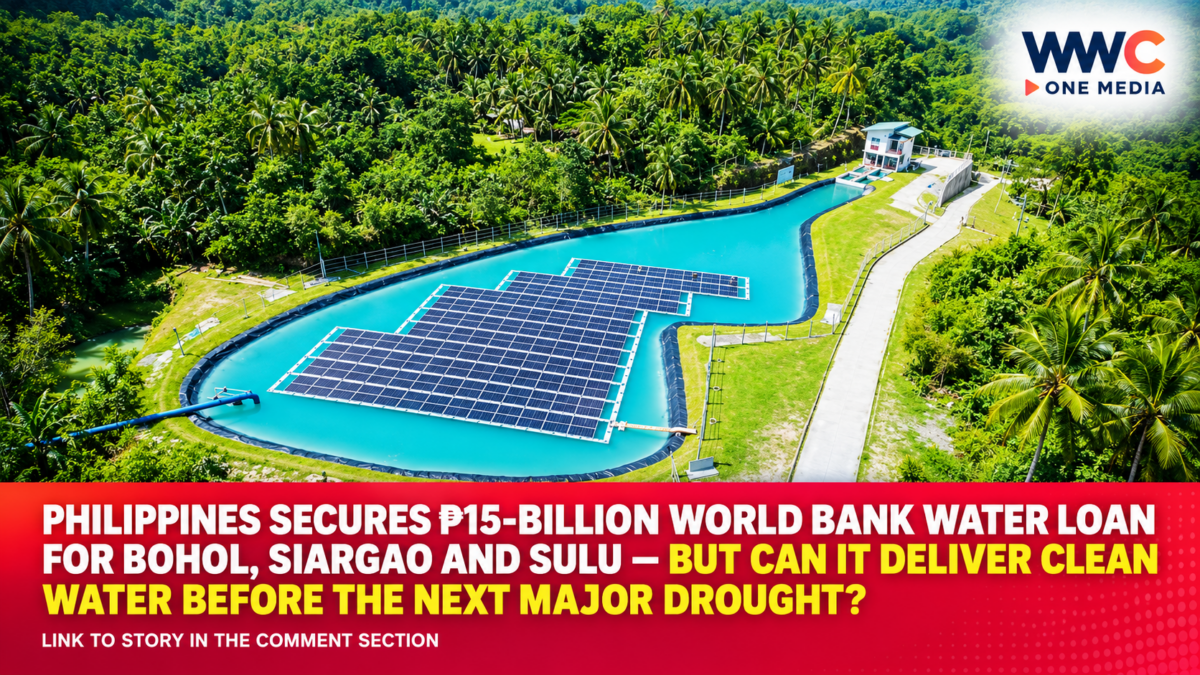
MANILA, Philippines — The Philippine government has secured nearly ₱15 billion in financing from the World Bank to strengthen water security, expand access to clean drinking water and improve sanitation in underserved communities across Bohol, Siargao and Sulu, marking a major investment in protecting vulnerable areas against worsening climate risks.
The €212.7-million loan, equivalent to approximately ₱14.98 billion, will finance water supply systems, treatment facilities and sanitation infrastructure under the Accelerated Water and Sanitation Project in Selected Areas (AWSPSA).
The initiative is intended to help communities struggling with inadequate water infrastructure while supporting public health, tourism, livelihoods and economic development.
But as the government prepares for the potential impact of a powerful El Niño and increasingly unpredictable weather conditions, a more urgent question is emerging: Can the Philippines turn billions in borrowed funds into reliable clean water before the next major drought threatens vulnerable communities?
World Bank Financing Targets Three Vulnerable Philippine Island Areas
The Department of Finance confirmed on October 9, 2026, that it had secured €212.7 million in financing from the World Bank’s International Bank for Reconstruction and Development (IBRD).
The financing agreement was signed on October 6 and will support water and sanitation improvements in three priority locations: Bohol, Siargao Island in Surigao del Norte, and Jolo and surrounding communities in Sulu.
The project will be implemented by the Department of Public Works and Highways (DPWH) and the Department of the Interior and Local Government (DILG).
Unlike infrastructure programs focused primarily on roads and transportation, this initiative targets one of the most essential requirements of everyday life: access to safe and reliable water.
The government aims to improve the availability of drinking water, strengthen sanitation services and help water utilities operate more efficiently.
These improvements are especially important for island communities where limited infrastructure, climate-related disruptions and investment constraints can make dependable water services difficult to maintain.
Bohol, Siargao and Sulu Set for Major Water Infrastructure Improvements
According to additional reporting by BusinessMirror, the water security project will involve different infrastructure investments depending on local conditions.
Bohol: Developing a More Reliable Water Supply
In Bohol, the project will support improvements in the Loboc Cluster, including a bulk water supply system sourced from the Loboc River.
The proposed infrastructure includes distribution networks and measures to protect surrounding watersheds.
The investment is intended to improve water availability and strengthen the reliability of supply in communities covered by the project.
Watershed protection is particularly important because damage to water sources can undermine the long-term sustainability of drinking water systems.
Siargao: Expanding Water Treatment and Sanitation
In Siargao, the project will develop and upgrade water sources, treatment facilities, storage systems and distribution networks in selected municipalities.
A centralized water-quality testing laboratory is also planned to strengthen monitoring of drinking water safety.
The project will include facilities for managing fecal sludge and collecting and transporting septage.
For a destination known internationally for surfing and tourism, improving sanitation and wastewater management could help protect local waterways while supporting the needs of residents and businesses.
Sulu: Strengthening Water Access in Jolo and Nearby Communities
In Jolo and selected communities in Indanan and Patikul, the project will support water source development, treatment facilities, pumping stations, storage facilities and distribution infrastructure.
These investments are intended to improve water accessibility and make essential services more resilient to climate-related disruptions.
The project will also establish or upgrade water, sanitation and hygiene facilities in selected public institutions, including schools, health centers and daycare centers.
World Bank Sees Thousands of Potential Jobs From Water Investments
Beyond improving basic services, the World Bank expects the project to generate economic opportunities.
In its July 31, 2026 announcement, the lender estimated that the initiative could support approximately 8,700 jobs within five years of project completion.
Over a 25-year period, the projected employment impact could rise to around 46,500 jobs as improved water services support wider economic activity.
These figures represent World Bank projections rather than employment already created.
Construction activity may generate near-term demand for workers, while more dependable water infrastructure could eventually benefit businesses, tourism operators and other local industries.
Reliable access to water can also reduce disruptions to households, educational institutions, healthcare facilities and commercial establishments.
For communities that currently experience inconsistent water supply, these improvements could create economic benefits extending well beyond the construction period.
However, the actual employment impact will depend on timely project completion, effective facility operations and the response of local businesses.
Philippines Faces Growing Water Security Challenges
The financing comes at a time when climate-related risks are placing additional pressure on water resources.
Droughts can reduce the availability of water, while intense rainfall and flooding can damage infrastructure and affect water quality.
Island communities are particularly exposed because they often depend on geographically limited water sources and distribution systems.
The Philippine government’s water security strategy therefore involves more than increasing supply capacity.
It also requires protecting watersheds, improving sanitation, reducing operational inefficiencies and ensuring that infrastructure can withstand extreme weather conditions.
The Department of Finance said the World Bank financing will support national preparations for the possible effects of a super El Niño.
However, the timing, strength and geographic impact of any future El Niño event remain uncertain.
The project is intended to strengthen long-term resilience rather than serve as a guarantee against shortages during the next dry season.
Finance Secretary Frederick Go Welcomes Major Water Investment
Finance Secretary Frederick D. Go described the financing as important support for the government’s efforts to improve water security and sanitation.
The Department of Finance said the agreement strengthens the Philippines’ partnership with the World Bank and supports reforms intended to provide more dependable public services.
The investment is aligned with the Philippine Development Plan 2023–2028, which prioritizes improved infrastructure, access to essential services and sustainable economic development.
Government officials view reliable water supply as a critical foundation for stronger communities and regional economic growth.
Water infrastructure supports not only households but also agriculture, healthcare, education, tourism and other sectors that depend on consistent access to safe water.
The ₱15-Billion Loan Is Part of a Bigger World Bank Water Program
The newly signed financing agreement forms part of the World Bank’s broader Water Security and Resilience in East Asia and Pacific Program.
The Philippines project was approved by the World Bank on July 31, 2026.
At approval, the World Bank identified a total project cost of approximately US$268.62 million, with US$250.87 million in World Bank financing and the remainder expected from Philippine government resources and private-sector equity.
The different currency figures reflect the financing information reported at separate stages of project preparation and agreement signing.
The latest Department of Finance announcement identifies the signed financing amount as €212.7 million, equivalent to around ₱14.98 billion.
The program also seeks to strengthen local water service providers and improve cooperation among national agencies, local governments and private-sector participants.
Its broader objective is to establish water systems that remain financially and operationally sustainable after construction.
Loan Repayments Will Extend Into the 2050s
The World Bank financing is a loan, not a grant.
According to BusinessMirror’s reporting on the loan agreement, the financing includes a front-end fee of 0.25% and a commitment charge of 0.25% annually on undisbursed balances.
The interest rate is based on a reference rate plus a variable spread, subject to the agreement’s provisions.
Principal repayments are scheduled to begin in 2037 and continue through 2055.
The project itself is scheduled to close on December 31, 2031.
This creates an important long-term financial responsibility for the Philippine government.
The economic and social benefits of the infrastructure will need to be sustained over many years, even as repayment obligations continue beyond the project’s construction and implementation period.
For taxpayers, this makes transparent spending, sound procurement and long-term maintenance essential.
Why Clean Water Matters for Tourism and Local Economic Growth
Reliable water infrastructure is especially important in destinations such as Bohol and Siargao, where tourism supports a range of local economic activities.
Hotels, restaurants, transportation businesses and other establishments depend on adequate water supply and sanitation.
Poor water infrastructure can raise operating costs, affect public health and make it harder for communities to accommodate business growth.
Improved sanitation can also help reduce pollution risks affecting rivers, coastal areas and other environmentally sensitive locations.
The same investment can benefit permanent residents who depend on these water systems every day.
However, tourism-related economic gains are not guaranteed simply because new infrastructure is constructed.
The projects must reach intended beneficiaries, operate reliably and remain accessible and affordable for local households.
But Will the Infrastructure Reach Communities on Time?
Despite the scale of the financing, several challenges could affect implementation.
Water infrastructure projects require detailed engineering, procurement, construction, coordination with local governments and continuing operational support.
Difficult geographic conditions, severe weather, cost increases and technical problems can delay construction or raise expenses.
Long-term maintenance is another concern.
Water supply systems require trained operators, working treatment equipment, adequate electricity, regular testing and sustainable funding.
Without effective management, even newly constructed facilities can eventually suffer interruptions or declining service quality.
This is why the project’s success cannot be measured solely by how much financing has been secured.
The more important indicators will include the number of people gaining reliable access to safe water, improvements in sanitation coverage, service affordability and whether facilities continue to function after completion.
Independent monitoring and public disclosure of progress would help determine whether the investment is producing the expected benefits.
The Bigger Picture: Water Security Is Becoming a National Economic Priority
The World Bank’s latest financing reflects growing recognition that water security is closely linked to public health, climate resilience and economic competitiveness.
Businesses require reliable utilities, while households depend on clean water for health, hygiene and everyday activities.
Schools and healthcare facilities also need dependable water and sanitation services to operate safely.
In June 2026, the World Bank approved separate financing supporting Philippine energy and water-sector reforms.
That broader policy operation highlighted the challenges facing local water service providers, including limited financing and institutional capacity.
The latest project takes a more direct approach by funding physical infrastructure and institutional improvements in selected communities.
Together, these initiatives illustrate an effort to combine policy reform with on-the-ground investment.
For Bohol, Siargao and Sulu, the proposed facilities could provide a foundation for stronger local development if construction, financing and long-term operations are managed effectively.
The Bottom Line: ₱15 Billion Is Only the Beginning
The Philippines has secured a major World Bank loan to address water shortages, improve sanitation and strengthen climate resilience in communities that need better essential services.
The initiative could benefit households, schools, healthcare institutions, local businesses and tourism destinations while creating employment opportunities.
But securing international financing is only the first step.
The real challenge is ensuring that water treatment facilities, supply networks and sanitation systems are built on schedule, maintained properly and made accessible to the people they are intended to serve.
For millions of Filipinos concerned about water security, the success of this investment will ultimately be measured not by the billions borrowed, but by whether clean and dependable water finally reaches the communities that need it most.