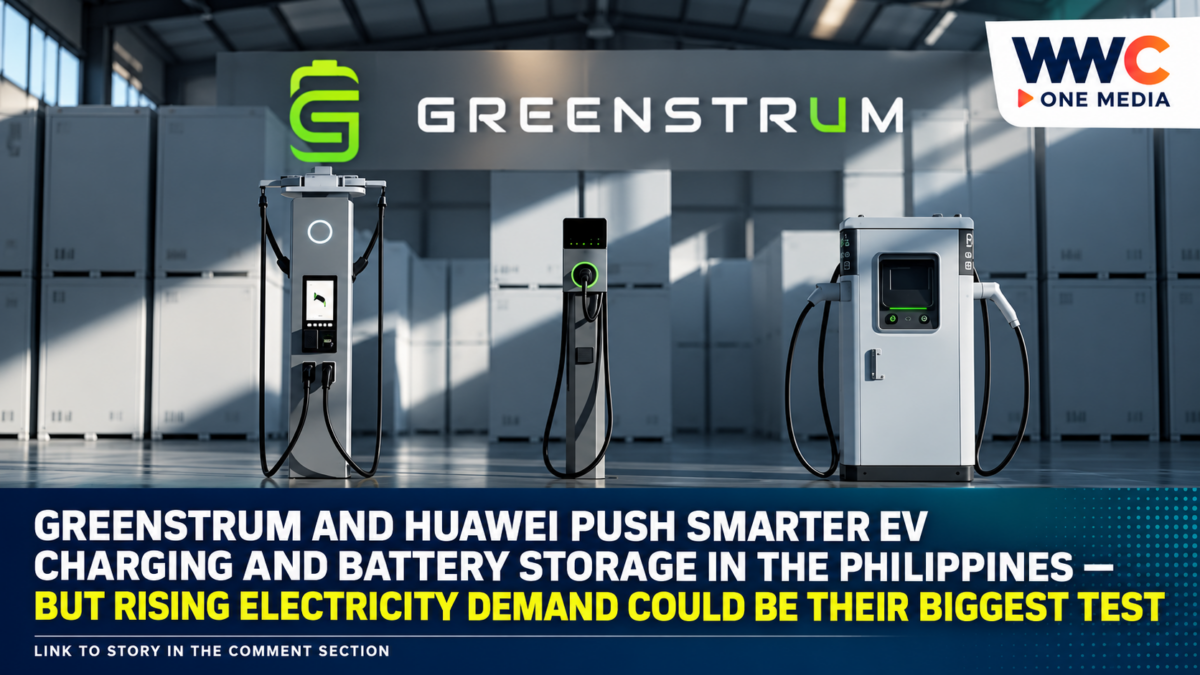
MANILA, Philippines — The Philippines’ shift toward electric mobility is entering a new phase as Greenstrum, the electric vehicle (EV) charging subsidiary of ACMobility, and global technology giant Huawei intensify efforts to help businesses manage electricity costs, expand charging infrastructure, and prepare for a future powered by electric vehicles.
The two companies are promoting an integrated approach that combines high-powered EV charging systems with advanced battery energy storage technology, offering Philippine businesses a potential way to handle growing electricity demand without immediately investing in expensive electrical infrastructure upgrades.
But behind the promise of faster charging, lower peak electricity demand, and improved energy resilience lies a bigger challenge: Can battery storage technology make large-scale EV adoption financially sustainable for Philippine businesses?
As electric vehicles become more common on Philippine roads, shopping malls, condominiums, logistics centers, and commercial establishments are facing increasing pressure to build charging facilities capable of supporting the transition.
For Greenstrum and Huawei, the opportunity goes beyond installing charging stations. It involves transforming how businesses manage and distribute electricity.
Greenstrum and Huawei Showcase Next-Generation Energy Solutions
The companies recently organized their first business-to-business showcase, titled “The New Energy Advantage,” at Huawei’s showroom in Bonifacio Global City.
The event gathered more than 20 participants representing five enterprises, including property developers and academic institutions.
The discussion centered on Huawei’s Battery Energy Storage System (BESS), a technology designed to store electricity during periods of relatively low demand and release it when electricity requirements increase.
When integrated with Greenstrum’s EV charging infrastructure, the technology could help commercial establishments reduce their peak electricity demand, improve the utilization of existing electrical capacity, and support operational resilience.
Instead of relying entirely on an immediate increase in grid-supplied power whenever several electric vehicles begin charging simultaneously, businesses could use stored electricity to help manage demand spikes.
This approach may be particularly valuable for large buildings, commercial properties, and fleet operators that need high-capacity charging systems.
However, the actual cost savings depend on electricity tariffs, battery size, charging patterns, installation costs, and how frequently the storage system is used.
Why Battery Storage Could Change the EV Charging Business
One of the biggest challenges facing commercial EV charging infrastructure is the amount of electricity required by high-powered charging equipment.
A charging station serving multiple vehicles can create substantial short-term electricity demand, particularly when several fast chargers operate simultaneously.
Without careful energy management, businesses may need additional transformers, electrical distribution equipment, or higher contracted power capacity.
Battery energy storage systems can help address the problem by storing electricity for later use.
Greenstrum is integrating Huawei’s LUNA2000 Smart Energy Storage System, which can act as an energy buffer for charging facilities.
The technology can support three important business objectives.
First, managing peak demand. Batteries can discharge electricity when charging demand rises, reducing the maximum amount of power that must be drawn from the grid.
Second, making better use of existing electrical infrastructure. By balancing power requirements, businesses may be able to accommodate additional charging activity without immediately expanding every component of their electrical systems.
Third, improving energy resilience. Properly designed storage systems can support selected electrical loads during disruptions, although backup capability depends on the system’s configuration and operating requirements.
Battery systems do not generate electricity themselves, and they are not guaranteed to reduce costs in every installation.
Their financial value depends on how effectively they are designed, operated, and integrated into a property’s energy requirements.
DMCI Homes Sees Potential for Condominium EV Charging
Among the businesses exploring these technologies is property developer DMCI Homes.
The company’s electrical engineer, Daniel Garcia, said the developer is incorporating EV charging facilities into its condominium developments.
As more residents eventually adopt electric vehicles, condominiums may need to support additional electricity demand beyond their original operating requirements.
Battery storage could provide a way to manage some of that demand while limiting pressure on a building’s contracted electrical capacity.
Garcia indicated that the information presented about battery storage and charging equipment was particularly relevant to the company’s planning.
Daiichi Properties purchasing officer Liezl Mico also identified potential long-term savings as equipment utilization increases.
The interest expressed by these property developers highlights an emerging challenge in Philippine real estate: future residential and commercial buildings may increasingly need to accommodate electric vehicle charging as part of their core infrastructure.
However, neither company’s participation in the showcase should be interpreted as confirmation of a finalized battery storage purchase or installation contract.
Huawei Brings Ultra-Fast EV Charging Technology to the Philippines
The latest energy storage initiative builds on a broader partnership between Greenstrum and Huawei Digital Power.
In March 2026, the companies announced a collaboration to accelerate the deployment of high-powered EV charging infrastructure nationwide.
Under the arrangement, Greenstrum serves as a certified service provider responsible for deploying and supporting Huawei’s charging technology in the Philippine market.
The partnership includes high-powered charging solutions such as 240-kilowatt SuperFast and 480-kilowatt UltraFast chargers.
For compatible vehicles under suitable operating conditions, the fastest systems can deliver substantial charging in approximately 10 to 15 minutes.
Actual charging speeds depend on the vehicle’s supported charging rate, battery temperature, state of charge, power availability, and other operating factors.
The companies are also promoting intelligent power-sharing systems that distribute available electricity across multiple charging points.
This can improve the use of available electrical capacity at sites serving several vehicles simultaneously.
Greenstrum’s commercial offerings include charging equipment ranging from 7 kilowatts to 480 kilowatts, supported by engineering, installation, and maintenance services.
Philippine Businesses Can Build Their Own EV Charging Networks
Another part of Greenstrum’s expansion strategy involves helping businesses establish privately owned EV charging networks.
Its enterprise offering allows property developers, commercial fleet operators, and automotive companies to develop charging facilities under their own branding while retaining ownership and operational control.
Greenstrum provides services covering system design, equipment supply, installation, and technical support.
According to the company, its charging installations are designed to comply with the Philippine Electrical Code and can be integrated with solar energy systems.
Some installations can also connect with ACMobility’s Evro application, which allows motorists to locate participating charging stations and manage charging sessions.
The business model could appeal to logistics operators preparing to electrify delivery fleets, property owners seeking to offer charging amenities, and companies considering EV charging as an additional source of revenue.
Yet prospective operators must still evaluate equipment costs, charging utilization, electricity prices, and maintenance expenses before determining whether charging infrastructure will generate acceptable returns.
Philippine EV Demand Is Accelerating as Fuel Prices Rise
Greenstrum and Huawei’s enterprise push comes as the Philippine electric vehicle market experiences stronger demand.
According to Reuters reporting published on October 8, 2026, EV registrations in the Philippines exceeded 67,000 during the first eight months of the year, representing approximately 130% growth compared with the same period in 2025.
The surge has been supported by higher gasoline prices, which have made electric vehicles more attractive to consumers and businesses looking to reduce their exposure to fuel costs.
Reuters also reported that the government is pursuing policies to encourage greater electric vehicle adoption, including efforts involving public-sector and taxi fleets.
For EV infrastructure providers, higher adoption creates opportunities to expand charging networks.
But it also raises questions about whether charging availability, grid capacity, and supporting electrical infrastructure can keep pace with growing demand.
Faster chargers alone will not solve these challenges if sites cannot consistently deliver sufficient electricity or if charging stations remain financially underutilized.
This is where Greenstrum and Huawei believe battery storage and intelligent energy management could become increasingly important.
The Bigger Opportunity: Hotels, Logistics, Utilities, and Commercial Properties
Greenstrum and Huawei plan to conduct additional enterprise showcases targeting property developers, hospitality businesses, utilities, and logistics operators.
These sectors have different but potentially significant energy requirements.
Hotels and commercial buildings may eventually need more EV charging facilities for customers and tenants.
Logistics operators could require charging capacity for electric delivery vehicles and corporate fleets.
Cold-storage facilities and other energy-intensive businesses may explore battery storage to manage peak electricity demand and improve selected aspects of their energy resilience.
Utilities and energy service providers may also assess the role of storage technology in supporting customer demand management.
By combining electrical engineering, charging infrastructure, and energy storage systems, Greenstrum and Huawei are seeking to position themselves as broader energy solutions providers rather than simply equipment suppliers.
But the Cost of Energy Storage Remains a Critical Question
Although battery energy storage technology offers operational advantages, widespread adoption among Philippine businesses is far from guaranteed.
Installing commercial batteries requires capital investment, technical assessments, electrical protection systems, and long-term maintenance planning.
Battery performance can also decline over time, making degradation and eventual replacement important considerations in project economics.
Businesses must determine whether expected savings from peak-demand management, operational flexibility, and potential infrastructure deferrals are sufficient to justify installation costs.
Electricity pricing structures will also influence the results.
A system that produces significant savings at one commercial establishment may deliver more limited benefits at another.
As the EV market expands, companies will need reliable financial models and performance data to assess the commercial value of energy storage systems.
Greenstrum and Huawei have highlighted the potential benefits of their integrated solutions, but the showcase did not establish independently verified savings percentages or guaranteed investment returns for participating businesses.
The Bigger Picture: Can the Philippines Power Its EV Future?
The growing collaboration between Greenstrum and Huawei reflects an important shift in the Philippine electric mobility industry.
Early investment in electric transportation infrastructure focused heavily on the number and speed of available charging stations.
The next stage increasingly involves ensuring those charging systems can operate efficiently within the electrical capacity available to homes, businesses, and commercial districts.
Battery energy storage could become one of the tools that help bridge the gap between growing demand and the practical limits of existing electrical infrastructure.
However, its contribution will depend on careful engineering, competitive costs, suitable electricity pricing, and successful deployment.
For Philippine businesses, the challenge is no longer simply deciding whether to install EV chargers.
It is determining how to power them efficiently, affordably, and reliably as electric mobility becomes more widespread.
THE BOTTOM LINE
Greenstrum and Huawei are betting that the Philippines’ electric vehicle future will require more than fast charging stations.
By integrating battery energy storage with EV infrastructure, the companies are offering enterprises a potential way to control peak electricity demand, improve existing power capacity utilization, and prepare for growing electric vehicle adoption.
But the real test will be whether these technologies can deliver measurable cost savings and operational benefits at a scale that Philippine businesses can afford.
As the country accelerates toward electric mobility, the biggest challenge may not be how fast vehicles can charge — but whether the nation’s commercial electricity infrastructure can keep up.