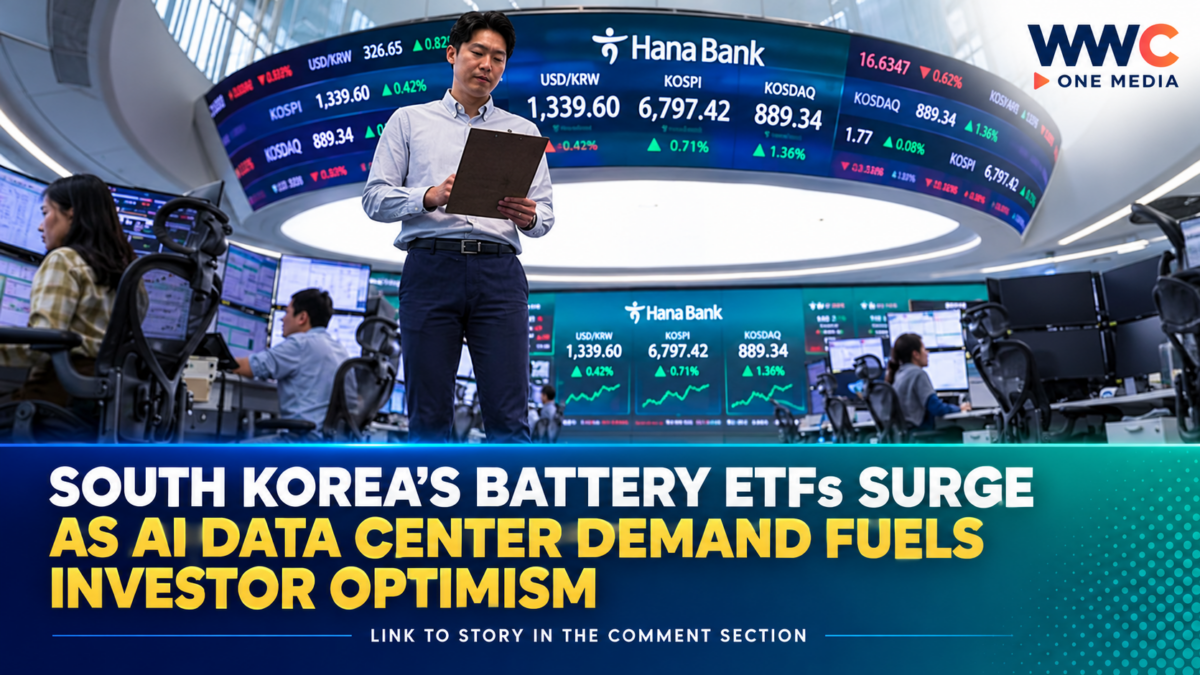
South Korea’s secondary battery exchange-traded funds (ETFs) have emerged as some of the stock market’s strongest performers in October, as investors increasingly look to energy storage technology to support the rapid expansion of artificial intelligence (AI) data centers.
According to market data reported by The Korea Times on October 9, eight of the 10 best-performing ETFs listed in South Korea during the first eight days of October were linked to the secondary battery industry. The figures point to renewed investor interest in battery manufacturers and related businesses as demand for energy storage systems grows.
The rally is drawing attention to a potential shift in South Korea’s technology investment landscape, where battery companies could benefit from rising electricity needs associated with AI infrastructure.
Battery ETFs Lead South Korea’s October Market Rally
The KODEX Secondary Battery Industry Leverage ETF recorded the strongest performance, climbing 19.94% from October 1 through October 8, according to Korea Exchange data cited in the report.
The TIGER KRX Second Battery Top10 Leverage ETF followed with an 18.45% gain over the same period. Both funds use leverage, which can amplify market movements and increase the risk of losses as well as gains.
Other battery-related funds also posted double-digit gains, reflecting growing enthusiasm for companies involved in battery materials, components and next-generation energy storage technologies.
The performance suggests investors are looking beyond the traditional electric vehicle market and paying closer attention to other potential sources of battery demand.
Why AI Data Centers Are Boosting Battery Stocks
A major factor behind the rally is the growing expectation that AI data centers will create new opportunities for the energy storage system (ESS) industry.
AI infrastructure requires substantial and reliable electricity supplies. ESS technology can help store energy and manage fluctuations in power demand, making battery systems an increasingly important part of the wider AI infrastructure market.
Market analysts expect this trend to support battery companies as demand for storage solutions expands. Kim Gwi-yeon of Daishin Securities maintained an “overweight” rating on the sector, pointing to the prospect of stronger ESS orders followed by improvements in sales and profitability.
The outlook is also drawing attention to LG Energy Solution, one of the country’s major battery producers.
According to Reuters, the company reported preliminary third-quarter operating profit of 756 billion won, up 25.7% from a year earlier. Its expansion into energy storage is part of its effort to address challenges in the electric vehicle battery market. However, the reported profit also included significant US production tax credits and a payment related to a North American automaker’s purchase commitments, making the underlying business performance important to assess.
A Powerful Rally, but Investors Face Risks
Despite the impressive gains, the battery ETF surge does not mean every fund or company in the sector is performing equally well.
Returns vary depending on the underlying holdings, investment strategy and exposure to specific battery technologies. Recent reporting has highlighted differences between funds focused on all-solid-state batteries and those concentrated on conventional battery materials and other parts of the supply chain.
Leveraged ETFs also carry additional risks because they seek to magnify market movements. Their returns can fluctuate sharply, particularly when stock prices reverse direction.
The next major test for the sector will be whether growing expectations for AI-related energy storage translate into confirmed supply contracts, higher production volumes and sustainable profits.
For South Korea’s battery industry, the opportunity extends beyond the latest market rally. The longer-term question is whether demand from AI infrastructure can become a meaningful and lasting source of business growth.
WWC ONE MEDIA G,A