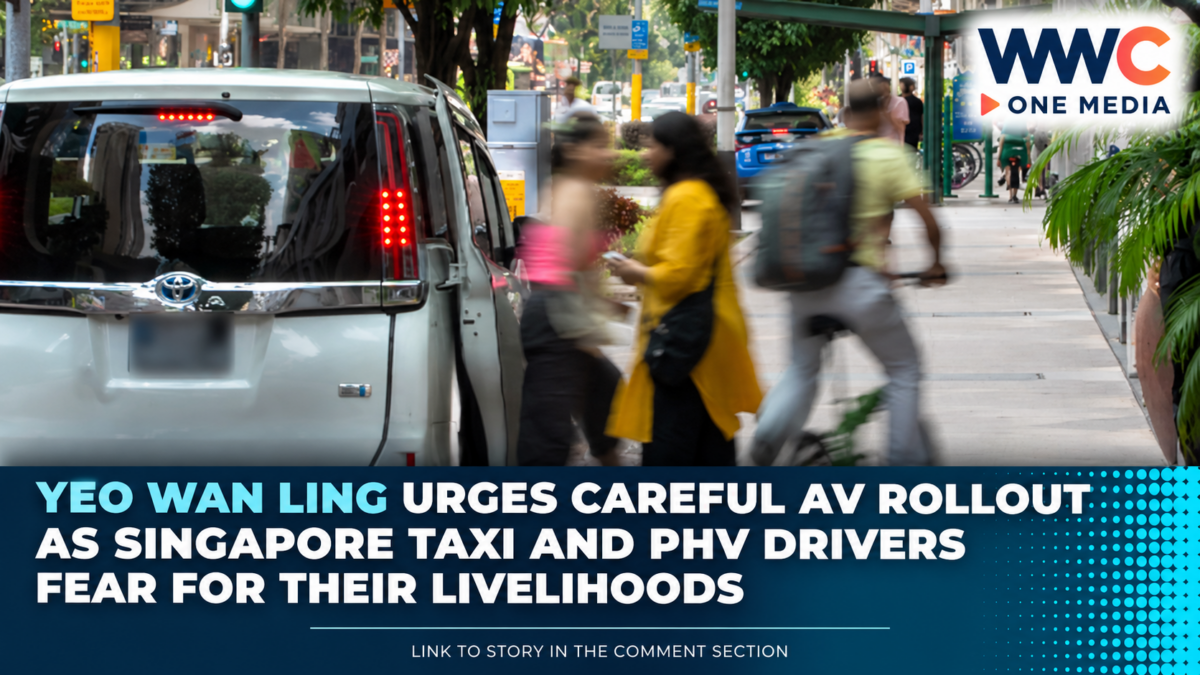
SINGAPORE — Singapore’s push towards autonomous vehicles is raising a difficult question for the more than 70,000 taxi and private-hire vehicle drivers who depend on driving for their income: when self-driving vehicles become commercially widespread, will there still be enough trips for human drivers to make a decent living?
Labour MP Yeo Wan Ling raised the concern in Parliament on Oct. 7 as lawmakers debated the Land Transport and Related Matters (No. 2) Bill, which supports the gradual expansion of autonomous-vehicle trials and deployments in Singapore.
Yeo, who is also assistant secretary-general of the National Trades Union Congress (NTUC) and executive secretary of the National Transport Workers’ Union (NTWU), said drivers need greater clarity about how the transition will affect their livelihoods.
She recounted speaking with a driver who had asked whether more than 10,000 rides already completed by autonomous shuttles in Punggol could eventually translate into 10,000 fewer jobs.
Yeo said those trial rides did not represent an equivalent number of displaced taxi or PHV trips today. But she argued that the underlying question was one policymakers would eventually have to answer: whether there would remain enough work for human drivers once AVs operate commercially at scale.
Driving remains an important employment option
Yeo described driving as an important “employment buffer” that has provided income opportunities for generations of Singaporeans.
She noted that some people turn to taxi or private-hire driving after losing another job, while between jobs, or because the flexibility allows them to care for children or ageing parents.
For these workers, she said, driving is not simply a form of employment but a livelihood that has remained accessible when other opportunities may have been less readily available.
“Driving has been an important employment buffer for generations of Singaporeans,” Yeo said in Parliament.
She therefore called for the transition to autonomous mobility to be managed carefully, with workers given a meaningful role in decisions that could affect their jobs.
Government says immediate job displacement is not expected
The Government has said it does not expect autonomous vehicles to have an immediate major effect on taxi and PHV drivers.
Minister of State for Transport Baey Yam Keng said during the Bill’s debate that Singapore is expected to have only several hundred autonomous vehicles by the end of 2028, compared with about 72,000 taxi and private-hire car drivers today.
The majority of point-to-point transport is therefore expected to continue being provided by human drivers for the foreseeable future.
Baey said AVs could also complement existing transport services by filling demand gaps in areas where human drivers are less willing to operate and by providing services at times when public transport is unavailable.
The Government is also studying the development of new jobs within the AV industry, including roles such as safety drivers, remote operators, software developers and cybersecurity engineers.
Waymo adds momentum to Singapore’s AV plans
Singapore’s autonomous-vehicle plans have also accelerated with the entry of new industry players.
In September, the Land Transport Authority announced that Waymo would become Singapore’s newest autonomous-vehicle operator, joining ComfortDelGro and Grab.
Waymo’s vehicles are expected to arrive in Singapore for initial preparations, with manual driving planned for 2027 and the company targeting commercial ride-hailing services in 2028.
LTA said the Government would continue helping drivers prepare for the transition and would not allow AV deployment to move ahead of efforts to retrain and support affected workers.
That timeline has made the workforce question more immediate for drivers and unions, even though widespread displacement is not expected in the near term.
Government has introduced transition support
Singapore has already begun putting measures in place to help taxi and PHV drivers adapt.
In July, the Ministry of Transport announced a manpower transition package developed with the Ministry of Manpower, NTUC, Grab Singapore and ComfortDelGro.
The package includes Career Conversion Programmes, training incentives and enhanced career guidance.
A new programme is also designed to help drivers move into AV-related roles, while other pathways allow drivers to explore careers outside the autonomous-vehicle sector.
The Government has also introduced a pathway for taxi and PHV drivers who want to become bus captains.
The programme allows drivers to train either part-time or full-time and generally takes between two and six months. Drivers who already hold a Class 4 licence can take a shorter training route.
The aim is to give drivers options without forcing them to abandon their income immediately while undergoing retraining.
Yeo says training alone may not be enough
For Yeo, however, the transition cannot be measured simply by the number of courses or new jobs made available.
She questioned what jobs workers would actually move into, how much those positions would pay and whether there would be enough openings for the number of people potentially affected.
She argued that career programmes should be designed around workers’ circumstances rather than expecting workers to adapt themselves to whatever programmes are available.
This includes considering the flexibility that attracted many people to taxi and PHV driving in the first place.
A worker supporting children or elderly parents, for example, may find it difficult to move into a conventional full-time job simply because that job is available.
NTUC study highlights workers’ concerns
The concerns raised in Parliament are also reflected in a recent NTUC study examining how autonomous vehicles could reshape Singapore’s transport workforce.
The report, “A Just Transition on the Road: Impact of Autonomous Vehicles on Singapore Workers,” found that different groups of transport workers face different challenges depending on their employment arrangements and the amount of economic and institutional support available to them.
It called for clearer transition pathways, stronger income and training support, and greater coordination among the Government, employers, unions and training providers.
The study reflects a broader issue surrounding automation: even when new jobs are created, workers may not automatically be able to move into them without sufficient training, income support and flexibility.
AV rollout will continue, but at a measured pace
Singapore’s transport authorities have stressed that autonomous vehicles are being introduced progressively rather than all at once.
The current regulatory framework allows AV companies to conduct trials while regulators study safety, operational and liability issues. The proposed extension of the regulatory sandbox to December 2028 is intended to give authorities more time to develop the rules needed for wider deployment.
Autonomous buses are also being approached more cautiously than passenger cars.
Baey said the public-bus environment is more complex, with diverse passenger needs and vehicle capacities that differ significantly from existing double-decker buses. Authorities are therefore exploring narrower use cases, including employee shuttles, rather than immediately moving towards fully autonomous public-bus operations.
The bigger question is who benefits from the transition
The debate over autonomous vehicles is ultimately about more than technology.
For commuters, driverless vehicles could offer additional transport options and potentially improve coverage at times or locations where conventional services are less available.
For companies, AVs could create new business models and a growing ecosystem of technology, operations and maintenance jobs.
But for existing drivers, the transition raises a more immediate concern: whether technological progress could eventually reduce the number of trips available to them and change the economics of driving.
Yeo said embracing technology and protecting workers do not have to be opposing goals.
But she stressed that drivers must be involved in the transition rather than treated as an afterthought.
With commercial autonomous ride-hailing services targeted for 2028 and Singapore expecting hundreds of AVs by the end of that year, the country still has time to prepare. The challenge will be ensuring that the transition creates new opportunities without leaving workers who built their livelihoods on the road behind.