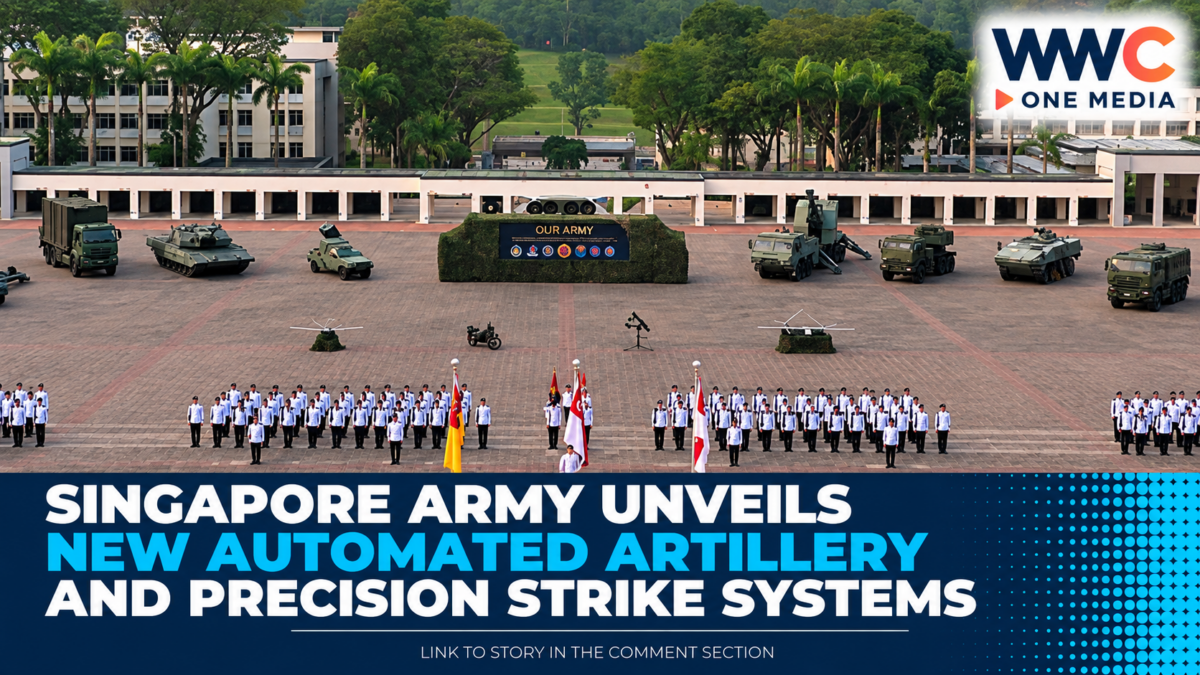
SINGAPORE — The Singapore Army has unveiled two previously undisclosed weapon systems as it continues to modernise its land forces, including a fully automated truck-mounted artillery system designed to become its next-generation howitzer and a new Precision Land Shooter intended to deliver faster, more precise strikes.
The systems were publicly revealed in photographs released by the Army’s 6th Singapore Division on Oct. 2 as the formation marked its 50th anniversary. The Ministry of Defence (MINDEF) subsequently confirmed their roles but has not publicly identified their manufacturers or released full technical specifications.
New truck-mounted gun to replace older artillery
MINDEF described the first system as a Truck Mounted Gun (TMG). It said the weapon is fully automated and will serve as the Singapore Army’s next-generation howitzer.
The TMG will be progressively introduced into service and eventually replace the Army’s Singapore Self-Propelled Howitzer Primus (SSPH Primus) and FH-2000, two existing 155mm artillery systems.
The Primus is a tracked 155mm self-propelled howitzer that entered Singapore service in 2003, while the FH-2000 is a 155mm towed artillery system developed by Singapore Technologies in the 1990s.
Singapore’s Army currently operates several artillery capabilities, including the Primus, FH-2000, Singapore Light-Weight Howitzer Pegasus and the High Mobility Artillery Rocket System (HIMARS).
The new gun appears similar to Elbit’s SIGMA
Although MINDEF has not officially named the TMG, photographs of the system have led defence publications to identify strong similarities with Elbit Systems’ SIGMA 155mm self-propelled howitzer.
The system shown in the Army’s photographs has a wheeled truck chassis, an enclosed crew compartment and a large 155mm gun mounted at the rear. The word “SIGMA” also appears to be visible on the front of the vehicle in photographs examined by AsiaOne.
Elbit announced in 2021 that it had secured a US$106 million contract from an unnamed Asia-Pacific country for fully automated self-propelled howitzer systems. The company did not identify the customer at the time.
Defence publications have subsequently linked that contract to Singapore, although MINDEF has not publicly confirmed the manufacturer or contract.
Asian Military Review reported that the system displayed in Singapore is consistent with the SIGMA 155mm truck-mounted howitzer. It reported that SIGMA can carry out automated loading and firing operations and can move between travelling and firing configurations rapidly.
However, specific performance figures for Singapore’s TMG should be treated cautiously until MINDEF releases official specifications.
Automation could reduce manpower demands
The move to a fully automated artillery system represents a significant change from Singapore’s older guns.
The Army’s existing FH-2000 requires a larger crew, while the Primus also depends on personnel to operate its various functions.
By contrast, the new system is designed around a high degree of automation, including automated loading and laying of the gun.
That could allow Singapore to maintain artillery firepower while reducing some of the manpower traditionally required to operate a large artillery piece.
The development is consistent with the SAF’s broader push towards greater automation, networking and integration of sensors and weapons.
In April, Prime Minister Lawrence Wong visited 6th Singapore Division and observed demonstrations of the Army’s Sense & Strike capabilities, which integrate intelligence, surveillance and reconnaissance assets with precision shooters.
New Precision Land Shooter also revealed
The second system unveiled by the Army is called the Precision Land Shooter (PLS).
Unlike the TMG, which is an artillery system, the PLS is described by MINDEF as a precision strike capability designed to give the Army greater precision and speed in increasingly complex and urbanised operating environments.
Photographs show the PLS mounted on an unarmoured military utility vehicle, with nine launch canisters arranged in a three-by-three configuration.
MINDEF has not disclosed what weapon is fired from the canisters, its range, warhead or guidance system.
That lack of official information has led defence analysts to examine the system’s appearance for clues.
What could the Precision Land Shooter be?
Janes noted that the launcher resembles systems associated with Rafael’s Spike Non-Line-of-Sight (NLOS) missile family.
Asian Military Review, meanwhile, assessed the weapon as appearing to be a loitering munition — a type of weapon that can remain in an area before engaging a target.
Neither identification has been officially confirmed by Singapore’s Ministry of Defence.
That distinction is important because the external appearance of a launcher alone does not establish what weapon or munition it carries.
For now, MINDEF’s official description is limited to calling the PLS a precision-strike capability.
Part of a wider shift towards networked warfare
The two systems are being introduced as Singapore’s Army develops a more integrated approach to finding and engaging targets.
In April, MINDEF said 6th Singapore Division was integrating capabilities across the Army’s intelligence and artillery domains, while also connecting Army capabilities with the Republic of Singapore Air Force and Digital and Intelligence Service.
During the demonstration, drone feeds were combined with artificial intelligence and computer-vision technology to generate actionable information that could be passed to precision shooters, including HIMARS, fighter aircraft and AH-64D Apache attack helicopters.
The concept means artillery and other weapons are increasingly being treated as part of a broader network rather than as standalone systems.
Sensors identify and track potential targets, while command-and-control systems help determine which available weapon is best positioned to respond.
HIMARS remains part of Singapore’s precision-fire capability
The new systems will complement rather than immediately replace Singapore’s existing long-range strike capabilities.
The Singapore Army already operates the HIMARS, which uses guided rockets and provides mobile precision fires.
Singapore recently demonstrated the system during Exercise Daring Warrior 2026 at Fort Sill, Oklahoma, where Singaporean and US Army personnel conducted combined live-fire training.
The exercise involved around 110 SAF personnel and 50 US Army personnel and ran from Aug. 29 to Sept. 28.
The addition of a new automated howitzer and precision land shooter therefore expands the Army’s range of options for responding to different battlefield situations.
Singapore’s artillery is entering a new phase
The unveiling of the two systems comes as militaries around the world reassess how land forces operate in increasingly complex battlefields.
Recent conflicts have highlighted the importance of mobile artillery, precision weapons, drones, surveillance systems and the ability to rapidly identify and engage targets.
Singapore’s Army has been pursuing similar integration through its Sense & Strike concept, combining sensors, intelligence and precision firepower.
The new Truck Mounted Gun and Precision Land Shooter fit into that broader transformation.
The TMG will gradually replace two of Singapore’s older artillery systems with a more automated platform, while the PLS introduces another precision-strike capability whose exact weapon and technical specifications remain undisclosed.
For now, the Army has revealed what the systems are intended to do — but not everything they can do.
As the two platforms enter service, further details about their range, firepower, deployment and integration with Singapore’s wider networked defence architecture are likely to emerge.