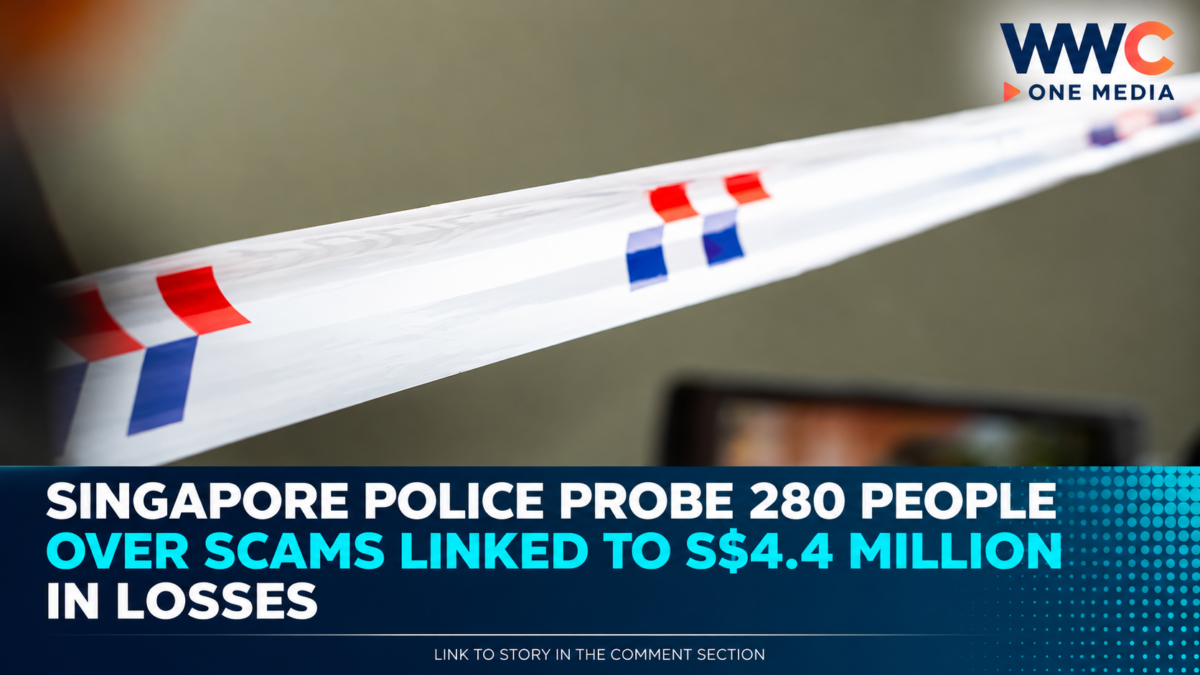
Singapore police are investigating 280 people, including a 15-year-old, over their alleged involvement in more than 633 scam cases that resulted in losses of about S$4.4 million.
The suspects — 189 men and 91 women aged between 15 and 81 — are believed to have acted as scammers or money mules, according to the Singapore Police Force.
The investigations followed a two-week islandwide enforcement operation conducted from Sept 24 to Oct 7 by officers from the Police Cyber Command and the seven police land divisions.
The latest operation comes after two other large-scale enforcement exercises in September, highlighting the continued effort by Singapore authorities to disrupt scam networks and target people who help move or conceal illicit proceeds.
More Than 633 Scam Cases Under Investigation
The cases linked to the 280 suspects include several common scam types, such as e-commerce scams, phishing scams, job scams, government official impersonation scams, investment scams and lucky draw scams.
Police said victims collectively lost around S$4.4 million.
The suspects are being investigated for alleged offences including cheating, money laundering and providing payment services without a licence. Being investigated does not mean that any of the individuals has been found guilty of an offence.
If convicted of cheating, an offender can face up to 10 years’ imprisonment and a fine. Money laundering offences can carry up to 10 years’ imprisonment, a fine of up to S$500,000, or both.
Those convicted of carrying on a business to provide payment services without a licence can face a fine of up to S$125,000, up to three years’ imprisonment, or both.
Authorities Raise Concern Over Youths Being Recruited
The involvement of young people has become a particular concern for Singapore authorities.
On Oct 6, Senior Minister K Shanmugam told Parliament that more than 1,000 youths had been investigated in connection with scam reports. He said authorities were particularly concerned about young people being recruited as money mules or otherwise being drawn into scam operations.
The issue has also prompted the Government to consider further legislative changes aimed at reinforcing deterrence for scam-related offences, including those involving young offenders.
Shanmugam said authorities cannot simply treat scam-related offending more leniently because a suspect is young, warning that scam syndicates could otherwise have an incentive to recruit more youths.
At the same time, Singapore’s criminal justice system considers factors including deterrence, prevention, retribution and rehabilitation when deciding how offenders should be dealt with.
Tougher Penalties for Scam Networks and Money Mules
Singapore strengthened its laws against scam-related offences at the end of 2025.
Scammers, as well as members and recruiters of scam syndicates, can face mandatory caning of between six and 24 strokes upon conviction for specified offences.
Money mules who assist scammers by laundering proceeds, providing SIM cards or supplying Singpass credentials can face discretionary caning of up to 12 strokes, depending on the offence.
Authorities can also impose restrictions on banking services and mobile-line subscriptions for individuals involved in mule-related offences under Singapore’s Facility Restriction Framework.
The framework can apply to people who are still under investigation and assessed to be at risk, as well as those who have received warnings, composition sums, prosecutions or convictions.
Scam Losses Continue to Mount
The latest police operation comes amid substantial financial losses from scams in Singapore.
According to figures reported by The Straits Times, scams resulted in S$410.6 million in losses during the first six months of 2026 alone. Police recovered more than S$97 million, including about S$8 million in cryptocurrency.
Government official impersonation scams remained a major concern, with 1,363 cases reported in the first half of the year and losses of about S$90.8 million.
Investment scams caused even larger losses during the same period, at approximately S$169.8 million.
The figures underline why authorities have increasingly focused not only on the people directly communicating with victims, but also on the wider networks that provide bank accounts, SIM cards, payment channels and other services used to move scam proceeds.
Police Warn That Anyone Involved May Face Consequences
Police reiterated that people found to be linked to scam-related offences will be held accountable.
The warning extends to individuals who may not consider themselves to be scammers but knowingly or otherwise facilitate criminal networks through their bank accounts, mobile lines or other services.
The authorities have urged members of the public to remain alert to recruitment approaches, particularly offers involving easy money or requests to receive and transfer funds on someone else’s behalf.
Singapore’s ScamShield helpline can be reached at 1799, while information on suspected scams can be provided to the police through their official reporting channels.
The investigation into the 280 suspects remains ongoing, and their eventual liability will depend on the evidence gathered and the outcome of any subsequent legal proceedings.