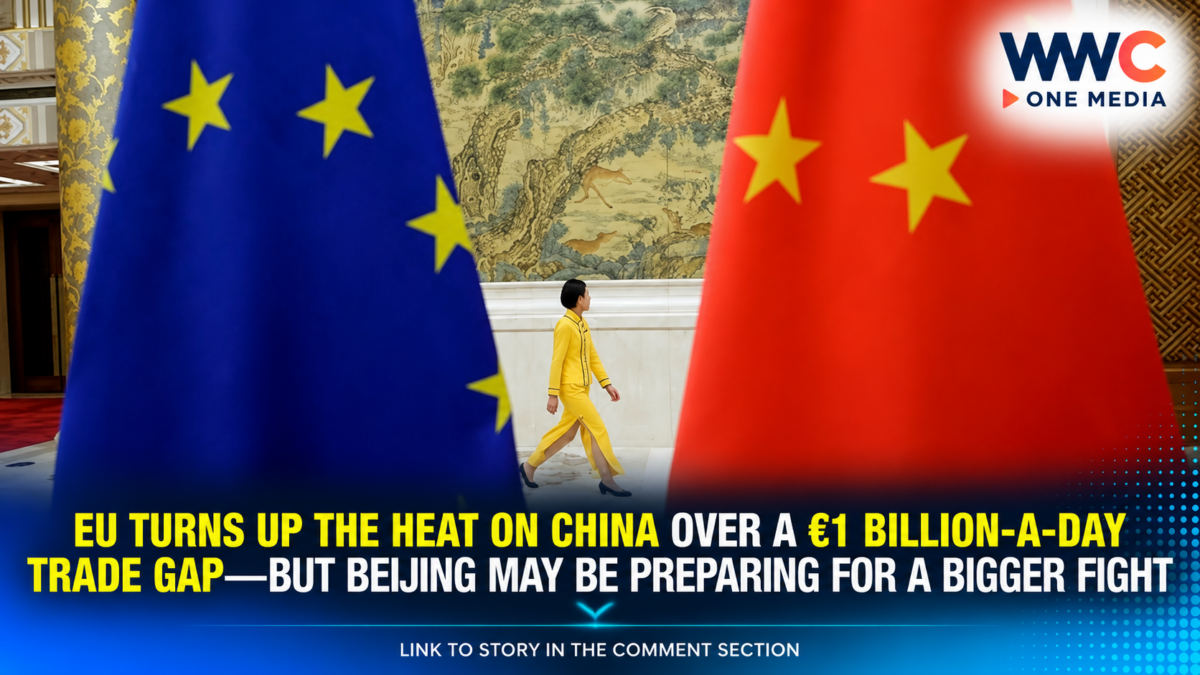
BRUSSELS — The European Union is running out of patience with China.
As EU Trade Commissioner Maroš Šefčovič arrives in Beijing for two days of high-stakes negotiations, Brussels is taking a markedly tougher position on the bloc’s enormous trade imbalance with China—and is increasingly prepared to use trade defenses if talks fail.
The numbers explain the urgency.
The EU’s goods trade deficit with China reached roughly €360 billion in 2025, according to European Commission data, while more recent reporting puts the imbalance at more than €1 billion a day.
And the deficit is not shrinking.
It is getting larger.
Now the EU wants Beijing to do something about it.
The question is whether China will make enough concessions to prevent Europe from moving from negotiation to protection.
The EU’s message to Beijing has changed
For years, Brussels tried to manage its economic relationship with China through dialogue while maintaining deep commercial ties.
That approach is becoming harder to sustain.
The EU says Chinese exports into Europe have surged across industries ranging from machinery and chemicals to textiles, batteries and automobiles, while European companies continue to face barriers to accessing the Chinese market.
The European Commission’s own data shows the scale of the imbalance.
In 2025, the EU exported about €199.5 billion in goods to China but imported approximately €559.5 billion, leaving a deficit of €359.9 billion.
EU imports from China rose 6.4% in 2025, while EU exports to China fell 6.5%.
That is exactly the direction Brussels does not want to see.
And the gap is getting worse
Eurostat data shows that the problem did not disappear in 2026.
In the second quarter of 2026, the EU’s goods deficit with China reached €103 billion, the highest quarterly deficit since the third quarter of 2022.
Chinese imports into the EU climbed to roughly €154 billion during the quarter.
The European Commission says China remains the EU’s largest source of goods imports.
And manufactured products dominate that relationship.
Machinery and vehicles accounted for more than half of EU manufactured imports from China in 2025.
That makes the dispute much bigger than electric vehicles.
It is increasingly about who controls Europe’s industrial future.
Brussels wants Beijing to help rebalance trade
Šefčovič’s trip to Beijing comes after months of technical discussions between European and Chinese officials.
The EU wants tangible commitments from Beijing to address the trade imbalance.
Its demands include:
- Greater access for European companies to the Chinese market
- Action on China’s growing exports into Europe
- Greater transparency around Chinese industrial policy
- Better access to critical Chinese raw materials
- Measures to prevent Chinese overcapacity from flooding European markets
- Potential export-management arrangements in sensitive sectors
Reuters reported that the EU is seeking commitments from China to begin addressing the trade gap, while Brussels has warned that progress needs to become concrete.
The EU has effectively set an October deadline for meaningful movement.
And that deadline is now arriving.
The automobile industry could become the first battlefield
The most immediate flashpoint is the automobile sector.
Chinese manufacturers have rapidly expanded their presence in Europe, particularly in electric and plug-in hybrid vehicles.
The EU already imposed additional duties on Chinese battery-electric vehicles following its anti-subsidy investigation.
But that policy created an unexpected problem.
Chinese manufacturers increasingly shifted toward plug-in hybrids, which were not covered by the same duties.
According to Reuters, EU imports of Chinese plug-in hybrids surged 86% over the past year, while battery-electric imports increased about 40%.
That has alarmed European automakers and policymakers.
Brussels now wants China to voluntarily manage some of those exports.
China has already rejected one major EU request
This is where the negotiations are getting much more difficult.
According to the Financial Times, China has rejected an EU proposal for voluntary restrictions on hybrid-car exports.
The European Commission had reportedly considered a mechanism that would limit Chinese hybrid vehicles to about 15% of the EU market, down from more than one-third currently, with additional trade restrictions potentially imposed beyond the threshold.
Reuters separately reported that China declined the voluntary request and that the European Commission was considering unilateral safeguard action. Reuters said it had not independently verified the FT’s underlying report.
That rejection is significant.
It suggests Beijing is not prepared to simply accept European demands for export restraints.
And Brussels now faces a choice:
Keep negotiating—or start protecting its market unilaterally.
The EU is preparing a “Plan B”
European officials have increasingly signaled that dialogue alone will not be enough.
The European Commission has been preparing possible safeguard measures to protect European industries from sudden surges of Chinese imports.
Such measures could be particularly important in sectors where European manufacturers argue that Chinese production capacity has grown far beyond domestic demand.
The EU’s trade-enforcement chief Denis Redonnet warned European lawmakers earlier this month that almost a quarter of EU imports were showing potentially worrying increases, with Chinese-origin goods identified as the main driver.
The Commission has already increased its use of trade-defense investigations.
Reuters reported that the EU launched 32 new trade-defense cases in 2025, compared with a historical annual average of about 12, and had already opened 27 new cases in 2026 by October.
That is a major shift.
Brussels is no longer treating China’s industrial expansion as a problem limited to one or two industries.
Germany and France are pushing Europe to get tougher
The politics inside Europe are changing too.
France has long advocated a stronger defensive position toward China.
But Germany’s position is particularly important because its economy is deeply tied to China through its automotive and industrial sectors.
German and French officials have increasingly pushed for stronger EU tools to respond to Chinese competition.
Reuters reported that European leaders have been debating tougher measures as the bloc’s China deficit continues to expand, with France favoring a harder approach while Germany and Spain have traditionally been more cautious.
That balance is shifting.
European industrial groups are increasingly worried that Chinese manufacturers are moving beyond low-cost goods and into technologically sophisticated sectors.
That is what some officials now describe as “China Shock 2.0.”
This is not just about cheap Chinese goods
The EU’s concern is evolving.
The first major wave of Chinese competition focused heavily on labor-intensive manufacturing and consumer goods.
The new wave is different.
Chinese companies are increasingly competitive in:
Electric vehicles.
Batteries.
Solar equipment.
Machinery.
Chemicals.
Industrial technology.
Telecommunications equipment.
Clean-energy technologies.
That means China is increasingly competing directly with the industries Europe considers strategically important.
CNA described the current conflict as a battle over China’s growing high-tech manufacturing capabilities and the threat they pose to traditional European industrial sectors.
The EU therefore faces a much harder question than simply whether Chinese imports are “too cheap.”
It has to decide whether Chinese industrial competitiveness represents healthy competition—or a strategic threat to Europe’s manufacturing base.
Beijing says Europe is being protectionist
China’s position is fundamentally different.
Beijing rejects the idea that its trade surplus is simply the product of unfair competition.
Chinese officials have repeatedly criticized European trade restrictions as protectionist and argue that Chinese companies have become competitive because of technology, scale, innovation and efficient manufacturing.
That creates a fundamental disagreement.
Brussels says China’s industrial policies and market barriers distort competition.
Beijing says Europe is trying to restrict successful Chinese companies because European manufacturers cannot compete.
Neither side appears willing to concede the central argument.
The rare-earth problem makes the talks even more dangerous
Cars are only one part of the negotiation.
Europe also wants reliable access to China’s critical minerals and rare-earth materials.
Those materials are essential for industries including:
- Electric vehicles
- Aerospace
- Defense
- Renewable energy
- Electronics
- Industrial machinery
- Semiconductors
China has already demonstrated that it can use export controls over critical materials as a geopolitical tool.
That makes European dependence a strategic vulnerability.
Euronews reported that the EU wants progress on Chinese restrictions affecting critical materials, with the issue becoming part of the broader trade negotiations.
Europe therefore has a difficult problem.
It wants to reduce its dependence on China.
But it also needs China.
The EU cannot easily decouple
This is the contradiction at the center of the entire dispute.
China is the EU’s largest source of goods imports.
European companies remain heavily invested in China.
The European Union’s investment stock in China stood at approximately €239.3 billion in 2024.
European manufacturers also rely on Chinese supply chains for components, raw materials and finished products.
So while Brussels can impose tariffs, quotas and safeguards, completely cutting economic ties would be enormously expensive.
The goal is therefore not necessarily decoupling.
It is increasingly de-risking.
Europe wants alternatives without destroying the economic relationship.
But China is also becoming harder to replace
That is where Beijing has leverage.
China possesses enormous manufacturing capacity, highly developed supplier networks and dominant positions in several strategic industries.
Replacing those capabilities elsewhere could take years—and cost far more.
That is why European policymakers face a delicate balancing act.
If they impose aggressive trade restrictions, European consumers and manufacturers could face higher costs.
If they do nothing, European companies fear losing market share and production capacity.
Either choice carries risks.
The €1 billion-a-day figure is becoming a political weapon
The EU’s growing trade deficit has now become more than an economic statistic.
European politicians are using it to argue that the relationship has become structurally unbalanced.
EU Industry Commissioner Stéphane Séjourné has called the situation “existential” for Europe and warned that thousands of jobs are at risk if the trade relationship is not rebalanced.
Euronews reported that Séjourné said the EU was losing thousands of industrial jobs every week and that Europe had already lost around 250,000 industrial jobs in the previous year.
That rhetoric shows how quickly trade policy is becoming industrial policy.
The bigger issue: China’s massive manufacturing surplus
The EU-China confrontation is also part of a much larger global argument over Chinese industrial overcapacity.
On Oct. 7, trade ministers from 15 market-oriented economies, including the US, EU and Japan, signed a US-led statement criticizing structural excess manufacturing capacity and policies that encourage overproduction.
China was not among the signatories.
The statement warned that countries could take defensive action if excess capacity and market distortions continue.
That means Europe is not fighting this battle alone.
Washington and other major economies are increasingly raising similar concerns.
But Europe has its own distinct problem:
China is simultaneously a critical supplier, a major customer and one of its biggest industrial competitors.
What happens if the talks fail?
The immediate deadline is political.
Šefčovič’s Beijing meetings will help shape discussions among EU leaders on Oct. 15–16, when China is expected to be high on the agenda.
If Beijing offers meaningful concessions, Europe could claim that negotiations are working.
If China refuses, pressure for trade-defense measures will almost certainly intensify.
Possible escalation could include:
- Safeguards on Chinese hybrid vehicles
- Additional trade-defense investigations
- Restrictions on imports in vulnerable sectors
- Stronger reciprocity requirements
- Greater scrutiny of Chinese investment
- More aggressive action against alleged dumping or subsidies
And once those measures begin, Beijing could retaliate.
China has already used trade investigations and duties against European products, including agricultural and chemical goods.
That is why both sides have a strong incentive to avoid a full-scale trade war.
Europe may be discovering that it has leverage too
For years, China was often perceived as holding greater economic leverage over Europe because of its manufacturing dominance.
That equation is changing.
The EU remains one of the world’s largest consumer markets.
Access to 450 million consumers gives Brussels considerable bargaining power.
European policymakers are increasingly willing to use that market access as leverage.
The message is essentially:
If Chinese companies want unrestricted access to Europe’s market, Europe wants more reciprocal access to China’s market.
That is a fundamentally different negotiating posture from the one Brussels used several years ago.
The danger of a trade war is still real
Despite the tougher rhetoric, neither side appears to want a full-scale economic confrontation.
China needs European demand.
Europe needs Chinese products and critical inputs.
European automakers also operate extensively in China.
Chinese companies increasingly depend on European markets as their global footprint expands.
A trade war would therefore hurt both sides.
But the risk is that individual measures create a chain reaction.
One safeguard leads to retaliation.
Retaliation leads to another EU measure.
More restrictions trigger further Chinese countermeasures.
Suddenly, a dispute that began with hybrid cars expands into chemicals, machinery, agriculture, minerals and technology.
That is how trade wars become difficult to stop.
Europe has reached the point where waiting is becoming harder
The central issue facing Brussels is no longer whether the EU has a trade deficit with China.
It does.
The issue is whether the deficit can be reduced through negotiation—or whether Europe will have to use increasingly aggressive trade tools.
The EU’s own numbers show why officials are alarmed: a €359.9 billion goods deficit in 2025, Chinese imports rising while European exports fell, and another enormous deficit recorded in the second quarter of 2026.
But China has already rejected the EU’s request for voluntary hybrid-car export curbs.
That makes the next few weeks critical.
The bottom line
The EU is not yet declaring a trade war on China—but Brussels is clearly preparing for the possibility.
The €1 billion-a-day trade imbalance has become politically impossible for many European governments to ignore.
Cars are the immediate flashpoint, but the deeper dispute is about industrial capacity, market access, critical minerals, subsidies and Europe’s ability to remain a major manufacturing power.
Beijing still has enormous leverage because Europe depends heavily on Chinese manufacturing and raw materials.
But Brussels has leverage of its own: access to one of the world’s largest consumer markets.
The question now is whether the two sides can turn that leverage into a deal—or whether Europe’s tougher stance becomes the opening shot of a new EU-China trade war.
And with EU leaders preparing to put China at the center of their October agenda, the next move from Beijing could determine just how far Europe is willing to go.