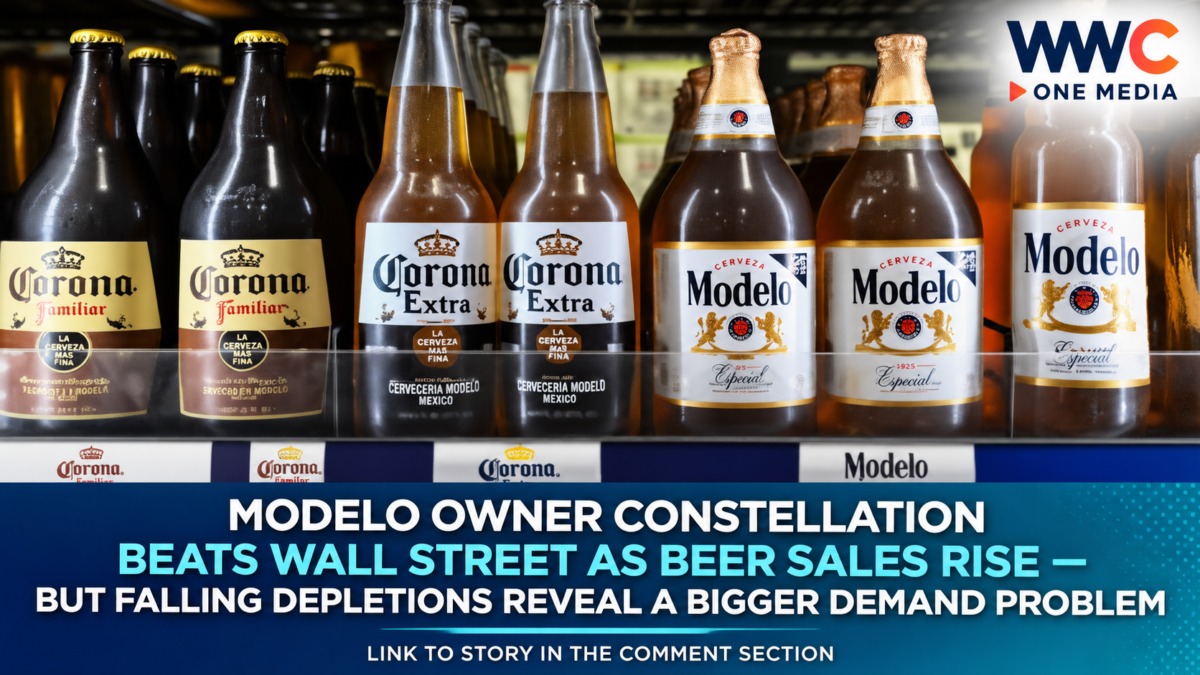
NEW YORK — Constellation Brands delivered a stronger-than-expected fiscal second quarter as sales of Modelo, Corona and other beverages helped revenue rise 6%, but the headline beat came with a warning investors could not ignore: underlying beer demand is still softer than shipment growth suggests.
The owner of Modelo Especial, Corona Extra, Pacifico and Victoria reported fiscal second-quarter 2027 net sales of $2.63 billion, up 6% from a year earlier. Comparable earnings reached $3.74 per share, beating Wall Street expectations of roughly $3.55 to $3.56.
Reported net income rose 21% to $565.8 million, or $3.32 per share, from $466 million, or $2.65 per share, a year earlier.
But the beer numbers were more complicated.
Beer revenue increased 5% to about $2.47 billion, while shipment volumes rose 5.5%. Yet beer depletions fell 0.6%, meaning distributors sold slightly less product through to retailers than a year ago.
That gap matters.
Shipments can rise when distributors rebuild inventories.
Depletions are often watched as a closer measure of actual end-market demand.
So while Constellation is shipping more beer, Americans are not necessarily drinking more of it at the same pace.
Modelo and Corona Are No Longer Carrying Everything
The quarter showed a clear split inside Constellation’s beer portfolio.
Modelo Especial depletions fell about 2%, while Corona Extra declined roughly 5%.
At the same time:
- Pacifico grew about 19%;
- Victoria increased around 15%;
- Modelo Chelada brands rose approximately 5%.
That means Constellation’s overall beer business is becoming more dependent on a broader set of brands rather than only its two biggest names.
Modelo Especial remains the No. 1 U.S. beer brand by dollar sales, while Pacifico recently entered the top 10 by dollar sales in tracked U.S. channels.
For management, that diversification is encouraging.
For investors, however, declines in Modelo and Corona still matter because those brands remain central to Constellation’s scale.
The U.S. Beer Market Itself Is Shrinking
Constellation’s problems are not happening in isolation.
The broader U.S. beer market has been under pressure as consumers drink less frequently, switch to spirits-based ready-to-drink beverages, choose non-alcoholic options or reduce discretionary spending.
CNBC cited Nielsen data showing the overall U.S. beer market contracted about 1.8% year-on-year over a recent two-week period ending September 19.
That means Constellation is still outperforming a weak category.
The company said its beer business was the No. 1 dollar and volume share gainer across Circana U.S. tracked channels during the quarter.
So the situation is not simply that Constellation is losing relevance.
It is gaining market share even while the total market is under pressure.
Consumers Are Treating Beer More Like an Occasion
CEO Nicholas Fink said consumer behavior is changing.
Rather than drinking beer as routinely as before, consumers are increasingly buying it around specific occasions such as sports, concerts and social gatherings.
That helps explain why Constellation has leaned heavily into major cultural and sporting events.
The 2026 FIFA World Cup, NBA Finals and other large gatherings helped support beer consumption earlier in the year. Reuters reported in July that Constellation saw stronger U.S. beer demand around major sporting occasions.
But event-driven consumption is less predictable than habitual consumption.
That makes marketing and brand activation more important.
Hispanic Consumers Remain Crucial
One of the biggest structural factors for Constellation is its exposure to Hispanic consumers.
The company has said Hispanic consumers account for roughly 40% of its beer revenue, significantly above their share of the overall U.S. beer category.
That creates both strength and risk.
Modelo and Corona have deep cultural relevance and strong loyalty among many Hispanic consumers.
But that same concentration makes Constellation more sensitive to employment, income and household-budget pressures affecting that demographic.
Earlier in 2026, management said cost-of-living pressure was hurting purchasing among Hispanic consumers, although the gap appeared to be narrowing.
If household finances continue improving, Constellation could benefit disproportionately.
If they worsen, beer demand could remain under pressure.
Constellation Avoided Aggressive Price Hikes
The company has deliberately kept price increases relatively restrained.
Management said pricing remained near the low end of its normal range because consumers are already cautious about spending.
That choice helps protect volumes.
But it limits one of the easiest ways consumer-goods companies can offset higher costs.
For years, many beverage companies relied heavily on price increases to support revenue growth.
Constellation is now leaning more heavily on volume and mix.
That makes genuine consumer demand more important.
Bars and Restaurants Helped Offset Retail Weakness
One bright spot came from on-premise consumption.
The Wall Street Journal reported that stronger demand in bars and restaurants helped offset softer sales in grocery and liquor stores.
That pattern is consistent with the idea that consumers increasingly drink beer around social occasions.
People may be buying fewer cases for home consumption while still ordering premium beer when they go out.
For Constellation, this changes where and how it needs to compete.
Distribution, restaurant placements and event marketing become increasingly valuable.
Wine and Spirits Had a Much Better Quarter
Beer gets most of the attention, but Constellation’s wine and spirits division also improved sharply.
Net sales in that segment rose 17% to $159.4 million.
Shipment volumes increased 15.4%.
Depletions rose 10.2%.
The business also swung to an operating profit of $6.1 million from a $19.8 million operating loss a year earlier.
Kim Crawford wine posted depletion growth of roughly 11%, while Mi CAMPO tequila surged about 51%.
That represents an important turnaround following Constellation’s earlier restructuring and wine divestitures.
Constellation Is Expanding Beyond Traditional Beer
The clearest sign of strategic change came with Constellation’s acquisition of SpikedAde, a spirit-based ready-to-drink beverage brand.
The company paid $75 million upfront for the business and could pay up to another $278 million over five years, depending on SpikedAde’s future performance.
The transaction gives Constellation another way to reach younger consumers who may prefer canned cocktails or flavored alcoholic beverages over traditional beer.
Management described ready-to-drink drinks as an attractive growth area with significant runway.
The acquisition does not change Constellation’s fiscal 2027 outlook.
Ready-to-Drink Cocktails Are Growing Much Faster Than Beer
The strategy makes sense when viewed against category growth.
CNBC cited industry data showing U.S. premixed cocktail sales reached about $3.8 billion in 2025, up 16.4%, making the segment one of the fastest-growing parts of the spirits business.
That creates a powerful incentive for beer companies to diversify.
Younger consumers increasingly move between beer, hard seltzer, cocktails and non-alcoholic drinks rather than staying loyal to one category.
Companies that remain tied to a single type of alcohol risk losing drinking occasions.
Constellation appears determined not to make that mistake.
Non-Alcoholic Drinks Are Another Growth Opportunity
Constellation is also experimenting with lower- and no-alcohol products.
Corona Non-Alcoholic has become an important part of the company’s effort to serve moderation-focused consumers.
The Wall Street Journal reported that management is looking for opportunities in non-alcoholic beverages as drinking habits change.
That trend is particularly important among younger consumers.
Wellness, moderation and changing social habits are reducing alcohol consumption frequency in some groups.
For traditional beverage companies, the solution may be to follow consumers rather than convince them to drink more alcohol.
Revenue Beat Wall Street Expectations
Constellation’s $2.633 billion in quarterly revenue exceeded consensus forecasts near $2.54 billion.
Comparable EPS of $3.74 also topped estimates around $3.55 to $3.56.
That makes the quarter a clear financial beat.
The market’s concern is not about whether the company exceeded Q2 expectations.
It is about whether the demand improvement is sustainable.
That is why investors focused heavily on beer depletions.
Shipments and Depletions Tell Different Stories
This is the most important analytical distinction in the quarter.
Beer shipments rose 5.5%.
Beer depletions fell 0.6%.
Why?
Management said distributors spent much of the first half rebuilding inventory.
That means some of the shipment growth reflected products moving into distributor warehouses rather than consumers buying more beer.
This is not necessarily negative.
Inventory normalization is part of healthy supply-chain management.
But it does mean investors should not treat the 5.5% shipment increase as equivalent to 5.5% underlying consumer demand growth.
September Trends Improved
Management offered one potentially encouraging sign.
Fink said beer depletion trends improved during September and that the improvement went beyond calendar effects from the timing of Labor Day.
If that improvement continues through the rest of the year, concerns about softer demand could fade.
If not, the Q2 shipment growth may look increasingly like inventory rebuilding rather than a true consumption recovery.
That makes the next quarter especially important.
Fiscal 2027 Sales Guidance Remains Cautious
Despite beating quarterly forecasts, Constellation did not suddenly become aggressive with its full-year outlook.
The company continues to expect fiscal 2027 organic net sales growth between negative 1% and positive 1%.
Beer net sales are also expected within the same minus-1%-to-plus-1% range.
That is a relatively cautious forecast given the 5% quarterly beer-sales increase.
It reflects management’s awareness that Q2 shipment growth may not continue at the same pace.
Comparable EPS Guidance Remains Unchanged
Constellation reaffirmed full-year comparable EPS guidance of $11.20 to $11.90.
Reported EPS guidance was raised to $11.85 to $12.55, from $11.50 to $12.20 previously.
The company also maintained:
- operating cash flow guidance of $2.4 billion to $2.5 billion;
- free cash flow guidance of $1.6 billion to $1.7 billion;
- capital expenditure of roughly $800 million.
The unchanged comparable outlook suggests management remains cautious despite the quarterly beat.
Beer Margins Remain Extremely Strong
Constellation’s beer business remains highly profitable.
Operating income increased 1% to approximately $964.2 million, while operating margin came in at 39%.
That is a very strong margin for a consumer beverage business.
However, the margin declined by 160 basis points from a year earlier because higher marketing and selling expenses outweighed benefits from lower tariff costs and favorable fixed-cost absorption.
That illustrates another challenge.
Supporting demand requires spending money.
Constellation may have to keep investing heavily in marketing if consumer drinking habits continue shifting.
Marketing Costs Are Becoming More Important
The company is putting more money behind its brands.
That includes sports partnerships, cultural events and broader consumer engagement.
This spending can protect brand relevance.
But it also reduces margins in the short term.
The strategic question is whether marketing spending generates enough additional volume to justify the cost.
If consumers are becoming more occasion-driven, companies may need to fight harder for each drinking occasion.
That could permanently increase the marketing intensity of the category.
Constellation Is Still Taking Market Share
Despite softer overall beer demand, Constellation remains one of the strongest large players in the U.S. beer market.
Its beer portfolio outperformed the total category by about 4 percentage points in both dollar and volume sales across Circana U.S. tracked channels.
The company had five brands among the top 15 dollar-share gainers.
That means the company’s issue is less about losing competitive position and more about operating inside a structurally weaker industry.
This distinction matters.
A company can gain market share and still experience slow volume growth if the overall market is shrinking.
The Mexican Beer Portfolio Remains a Major Advantage
Constellation owns the U.S. rights to some of the most powerful imported Mexican beer brands.
Modelo Especial became America’s top-selling beer by dollar sales after overtaking Bud Light several years ago.
Corona remains one of the world’s most recognizable beer brands.
Pacifico is growing rapidly.
Victoria is also gaining share.
That portfolio gives Constellation significant pricing and brand strength.
But imported beer is not immune to broader demographic and behavioral changes.
Even powerful brands must adapt when drinking frequency declines.
New CEO Nicholas Fink Is Facing an Early Test
Nicholas Fink is still relatively new in Constellation’s top job.
He inherited a company with strong beer brands but several strategic questions:
How quickly will U.S. beer consumption stabilize?
Can wine and spirits return to sustainable profitability?
Can Constellation build meaningful businesses in ready-to-drink and non-alcoholic products?
And can it continue growing without depending too heavily on Modelo and Corona?
The Q2 results provide some encouraging answers.
But none of those questions are fully settled.
Shareholder Returns Remain Strong
Constellation continues returning significant capital to investors.
The company said it returned another $400 million through dividends and share repurchases during the quarter.
Year-to-date share repurchases reached roughly $530 million through September.
The board also declared a quarterly dividend of $1.03 per share, payable November 13 to shareholders of record October 30.
Strong cash generation gives management flexibility to invest, make acquisitions and return money to investors simultaneously.
The Bigger Question Is Whether Beer Demand Is Structurally Changing
Constellation’s quarter exposes a much bigger issue facing the alcohol industry.
For decades, beverage companies could assume that a large share of consumers would drink beer regularly.
That assumption is becoming less reliable.
Younger adults may drink less frequently.
Some prefer cocktails.
Others choose cannabis or non-alcoholic beverages.
Health-conscious consumers may avoid alcohol entirely.
And households under financial pressure may simply buy less.
That does not mean beer disappears.
It means occasions become more competitive.
Constellation Is Preparing for a World Where Beer Is Only One Choice
The company’s strategy increasingly reflects that reality.
It still invests heavily behind Modelo, Corona, Pacifico and Victoria.
But it is also moving into:
- spirit-based RTDs;
- wine and tequila;
- flavored alcohol;
- non-alcoholic beer;
- and broader occasion-based consumption.
The SpikedAde acquisition is therefore more than a small M&A transaction.
It represents a hedge against changing drinking habits.
The Earnings Beat Does Not Fully Answer the Demand Question
Constellation Brands had a strong financial quarter.
Revenue beat forecasts.
Comparable EPS beat estimates.
Beer shipments increased.
Wine and spirits improved dramatically.
The company raised reported earnings guidance.
Yet the market is focused on a different figure:
beer depletions fell 0.6%.
That suggests consumer demand remains softer than shipment growth alone would imply.
Constellation is still gaining market share and outperforming a weak U.S. beer industry.
But the bigger question is whether Modelo, Corona and its newer brands can keep growing in a country where consumers increasingly treat alcohol as an occasional purchase rather than an automatic habit.
The company’s answer is becoming clear: if Americans drink less traditional beer, Constellation intends to follow them into whatever they drink next.