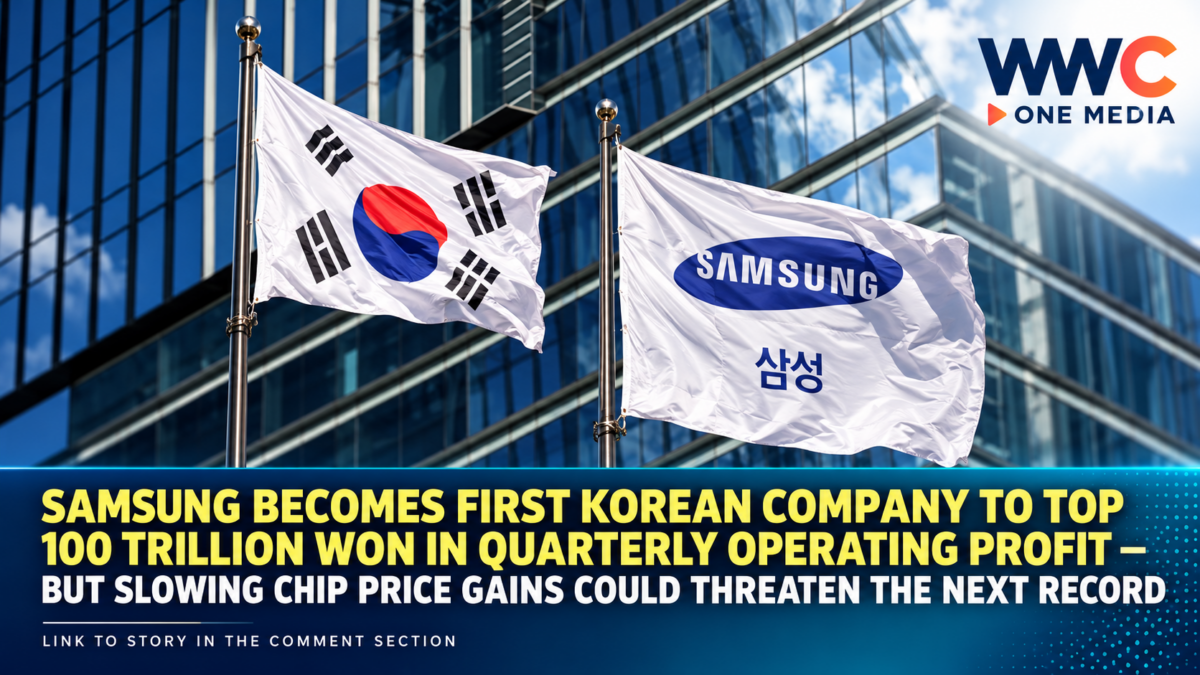
SEOUL, SOUTH KOREA — Samsung Electronics has just delivered one of the most extraordinary quarters in global technology history, estimating third-quarter operating profit of 107.4 trillion won, or about $80.2 billion, as artificial-intelligence demand sends memory-chip prices and semiconductor earnings soaring.
The preliminary figure represents a 782.5% increase from the same quarter a year earlier and marks the first time any South Korean company has surpassed 100 trillion won in quarterly operating profit.
Samsung also estimated third-quarter revenue of about 195 trillion won, up roughly 127% year-on-year, as the worldwide AI infrastructure boom continued driving intense demand for memory used in servers and data centers.
The numbers extend an extraordinary rebound for the world’s largest memory-chip maker.
But the headline profit figure tells only part of the story.
Memory prices are still rising, yet the pace of those increases is slowing. Samsung’s consumer-electronics businesses are also facing higher component costs, while its foundry operation remains under pressure.
That means the real question is no longer whether Samsung is benefiting from the AI boom.
It is whether this historically profitable memory cycle can remain strong enough to justify expectations already embedded in the company’s shares.
Samsung Smashes Through the 100-Trillion-Won Barrier
Samsung’s estimated third-quarter operating profit of 107.4 trillion won is unprecedented.
It exceeds the company’s previous quarterly record of about 89.5 trillion won, reported in the second quarter of 2026.
The result is also slightly above the approximately 106.1 trillion won consensus forecast cited before the earnings announcement.
That matters because analysts had already entered the quarter expecting another blockbuster performance.
Samsung still managed to exceed those expectations.
The preliminary guidance marks a fourth consecutive quarter of record earnings, highlighting just how powerful the current semiconductor cycle has become.
AI Is Driving an Extraordinary Memory Shortage
The primary engine is memory.
Artificial-intelligence data centers require enormous amounts of DRAM and high-bandwidth memory, or HBM, to feed advanced processors.
That surge in demand has collided with limited supply.
The result has been rapidly rising memory prices and unusually strong profitability for major chip manufacturers.
Samsung benefits because it remains one of the world’s largest producers of DRAM and NAND flash.
Its growing HBM business is also becoming increasingly important as the company works to narrow the technology and market-share gap with SK Hynix.
Reuters reports that Samsung’s HBM market share is expected to rise from around 20% to 34% during 2026.
If that happens, the company would capture a larger portion of one of the semiconductor industry’s most profitable product categories.
Samsung Is Closing the Gap With SK Hynix
For much of the early AI boom, SK Hynix enjoyed a major advantage in high-bandwidth memory.
Its early relationship with Nvidia helped establish the company as a leading supplier of HBM used in AI accelerators.
Samsung initially struggled to qualify some of its advanced HBM products for major customers.
But that competitive gap has been narrowing.
Samsung has made progress with next-generation HBM4 products and continues expanding production capacity.
The company is also exploring broader partnerships.
AMD Chief Executive Lisa Su said this week that AMD continues to examine potential collaboration with Samsung across both memory and foundry manufacturing.
That creates another potential growth avenue if Samsung can convert technological improvements into large commercial contracts.
The Memory Boom Is Becoming More Extreme
The semiconductor industry has always been cyclical.
When demand surges and supply is limited, chip prices rise sharply.
Manufacturers respond by increasing production.
Eventually, too much capacity can enter the market and prices fall.
What makes the current cycle unusual is the size of AI-related demand.
Technology companies are spending extraordinary amounts on data centers.
Nvidia, hyperscale cloud providers and AI developers continue ordering high-performance memory in massive volumes.
This has created shortages not just in premium HBM but also in more conventional memory products.
Reuters reported ahead of Samsung’s results that conventional DRAM contract prices were expected to increase another 10% to 15% sequentially, although that would be far slower than the approximately 60% jump in the second quarter.
That slowdown is the first important warning sign.
Prices are still rising.
They are simply no longer accelerating at the same extraordinary pace.
Why Slower Price Increases Matter
Samsung’s profitability depends not only on how many chips it sells but also on how much it earns on each unit.
Memory-chip margins can expand rapidly when prices rise faster than production costs.
But the reverse is also true.
If memory prices stop increasing while costs continue climbing, profit growth can slow quickly.
Analysts cited by Reuters expect Samsung’s memory operating margin to remain broadly flat near extraordinarily high levels.
That is hardly a weak result.
But it suggests the easy phase of margin expansion may be nearing its limit.
Future earnings growth may depend increasingly on shipment volumes, product mix and HBM market-share gains rather than repeated dramatic price increases.
Revenue Nearly Doubles
Samsung’s estimated 195 trillion won in third-quarter revenue is also remarkable.
That represents growth of roughly 126.6% year-on-year.
The expansion demonstrates how dramatically the memory cycle has changed from 2025.
During the previous downturn, oversupply and weak consumer-electronics demand pressured chip prices.
The current environment is almost the opposite.
AI infrastructure has become a dominant source of semiconductor demand.
The resulting shortage has allowed manufacturers to raise prices sharply.
Samsung’s quarterly sales are now more than double their level from a year earlier.
Samsung’s Shares Have More Than Doubled This Year
Investors have already rewarded the company heavily.
Samsung Electronics’ market value has more than doubled during 2026, reaching approximately $1.3 trillion, according to the Financial Times.
The rally reflects optimism that AI demand will support memory earnings for an extended period.
However, the stock had fallen around 25% from its June peak before the latest results, even though it remained far above its level at the beginning of the year.
That volatility shows how demanding investor expectations have become.
Record profits may no longer be enough.
Markets increasingly want evidence that those profits can persist.
Samsung Is Making More Money Than Some Entire Industries
An operating profit above $80 billion in a single quarter places Samsung in extraordinary financial territory.
It exceeds the annual profit of many major multinational companies.
Reuters described it as the highest quarterly operating profit ever reported by a technology company.
The scale reflects both Samsung’s industrial reach and the unusual economics of the current semiconductor market.
When memory demand is strong and capacity is constrained, incremental revenue can generate enormous profit.
But these economics can reverse quickly if supply catches up.
That historical volatility is why investors remain cautious despite the headline numbers.
Consumer Electronics Are Feeling the Other Side of the Chip Boom
The same memory shortage benefiting Samsung’s semiconductor business is creating problems elsewhere inside the company.
Samsung also manufactures smartphones, televisions and home appliances.
Those businesses must purchase memory and other components.
When chip prices rise sharply, production costs increase.
The Financial Times reported that Samsung’s consumer-electronics operations suffered more than 1 trillion won in losses during the quarter due partly to higher semiconductor costs and currency effects.
That demonstrates an unusual internal tension.
Samsung benefits enormously as a chipmaker while simultaneously paying more for chips used in its finished products.
The semiconductor division is currently large enough to overwhelm those pressures.
But weaker consumer-device margins remain an important part of the overall picture.
Smartphone Demand Is Also Under Pressure
The global smartphone market has struggled with higher component costs.
Counterpoint Research reported that worldwide smartphone shipments declined around 7% year-on-year in the second quarter of 2026 as the memory shortage intensified.
Higher memory prices can force phone manufacturers to raise prices, reduce specifications or accept lower margins.
Samsung faces those same choices in its Galaxy smartphone business.
The company benefits from producing much of its own memory, but internal transfer pricing does not eliminate the underlying economic cost.
If consumers resist higher smartphone prices, Samsung’s mobile division could face additional pressure even while its semiconductor business continues booming.
Foundry Remains Samsung’s Weak Spot
Another major challenge is Samsung’s contract chip-manufacturing business.
The foundry division competes with Taiwan Semiconductor Manufacturing Company to manufacture advanced processors designed by other companies.
TSMC remains the dominant player globally.
Samsung has struggled to achieve comparable profitability and utilization rates in its foundry operation.
Reuters says the business remains loss-making, although analysts expect conditions to improve as demand for advanced manufacturing grows.
Potential cooperation with AMD could help.
But discussions about a partnership should not be confused with a confirmed large foundry order.
Samsung still has to prove that it can consistently attract major customers at leading-edge process nodes.
HBM4 Could Become the Next Major Battleground
The next generation of high-bandwidth memory may be especially important.
HBM4 is designed to provide even greater bandwidth for advanced AI processors.
As AI models become larger and more computationally intensive, demand for premium memory is expected to increase.
Samsung is working aggressively to strengthen its HBM4 position.
Success could allow the company to capture a larger share of AI-related profits.
Failure would leave more of that lucrative market to SK Hynix and Micron.
This is why investors increasingly look beyond aggregate memory sales.
The composition of those sales matters.
HBM is far more strategically valuable than traditional commodity memory.
Supply Could Remain Tight Through 2028
One of the most bullish arguments is that the current shortage may last much longer than a typical memory cycle.
Analysts cited by Reuters expect the supply-demand imbalance to persist through at least 2028.
Long construction periods for semiconductor fabs make it difficult to add capacity quickly.
HBM manufacturing is also technically complex and consumes more wafer capacity than conventional DRAM.
This means even aggressive investment may not eliminate shortages immediately.
If AI infrastructure spending remains strong, Samsung could continue benefiting from favorable pricing for several more years.
That is the optimistic scenario.
But the Semiconductor Industry Has Seen This Movie Before
Memory-chip history is filled with booms followed by painful corrections.
High prices encourage aggressive investment.
Manufacturers add capacity.
Demand eventually slows.
Inventories build.
Prices collapse.
Companies then cut investment until supply tightens again.
This cycle has repeated for decades.
The difference today is AI.
Supporters argue that artificial intelligence represents a structural change large enough to extend the cycle far longer than usual.
Skeptics argue that even transformative technologies can be overbuilt.
The current profit numbers do not resolve that debate.
They simply show how powerful the boom has become.
AI Data-Center Spending Is Doing the Heavy Lifting
Samsung’s record profit cannot be separated from the global AI infrastructure race.
Technology companies are spending hundreds of billions of dollars building data centers, purchasing accelerators and securing electricity.
Those systems require enormous quantities of memory.
As long as hyperscaler capital expenditure keeps expanding, semiconductor suppliers benefit.
But that also creates concentration risk.
If major AI companies slow investment, the memory market could weaken rapidly.
This is why investors follow Microsoft, Amazon, Google, Meta and other large technology companies almost as closely as they follow Samsung itself.
Their spending plans influence semiconductor demand across the entire supply chain.
China Is Another Long-Term Risk
Samsung also faces growing competition from Chinese memory manufacturers.
China has invested heavily in building domestic semiconductor capacity.
U.S. export restrictions have limited some Chinese companies’ access to advanced manufacturing equipment.
But Chinese producers continue improving.
Reuters notes that increasing competition from Chinese manufacturers remains a strategic risk for Samsung.
The biggest near-term threat is likely in conventional memory rather than the most advanced HBM.
If Chinese companies add large quantities of commodity DRAM or NAND capacity, they could eventually pressure global pricing.
That would make Samsung even more dependent on maintaining technological leadership in premium products.
A Stronger Korean Won Can Reduce Reported Earnings
Currency movements are another complication.
Samsung sells much of its output internationally.
A stronger South Korean won can reduce the value of overseas revenue when converted back into local currency.
Analysts cut their third-quarter estimates ahead of the announcement partly because of won appreciation.
The company still exceeded expectations.
But currency fluctuations can become increasingly important when quarterly earnings are this large.
Even small changes in exchange rates can produce substantial differences in reported results.
Final Results Are Still Coming
The numbers released on October 8 are preliminary earnings guidance, not Samsung’s complete financial statements.
The company has not yet provided the detailed profit breakdown by division.
Full third-quarter results are expected on October 29.
That release will be closely watched for semiconductor margins, HBM shipments, foundry losses, smartphone profitability and capital expenditure.
Investors will also look for guidance about memory pricing in the fourth quarter and into 2027.
Those details may ultimately matter more to the stock than the headline profit figure announced today.
Shareholder Returns Could Become the Next Question
With earnings reaching unprecedented levels, investors are increasingly asking how Samsung will use the cash.
Possible options include higher dividends, share repurchases, semiconductor investment and strategic acquisitions.
Reuters says investors will watch the October 29 earnings release for additional information about shareholder returns.
This creates another balancing act.
Samsung needs to reward shareholders.
But it also needs to invest aggressively enough to defend its position in HBM and advanced chip manufacturing.
Spending too little could sacrifice future market share.
Spending too much could recreate the oversupply problems that historically caused memory downturns.
South Korea Is Benefiting From the Semiconductor Boom
Samsung’s surge is also important for the wider South Korean economy.
Semiconductors are among the country’s most important exports.
Strong chip sales support trade surpluses, industrial production and corporate tax revenue.
Samsung and SK Hynix have become major beneficiaries of the global AI race.
That has also helped South Korean financial markets.
But the country’s increasing dependence on semiconductor strength creates vulnerability.
A major chip downturn could affect the wider economy.
For now, however, the sector is producing extraordinary profits.
Samsung’s Biggest Problem May Be Success Itself
The current numbers are so strong that maintaining investor enthusiasm becomes increasingly difficult.
A company growing from weak profits can impress markets relatively easily.
A company already earning more than $80 billion in a quarter faces a different challenge.
Expectations rise with every record.
Investors begin treating extraordinary performance as normal.
That creates the possibility that future results could disappoint even if they remain historically excellent.
Samsung’s challenge is therefore not simply to remain profitable.
It must convince the market that the current AI-driven earnings power is sustainable.
The Bigger Question Is How Long the Supercycle Lasts
Samsung’s preliminary third-quarter figures confirm that the AI boom has transformed the company’s financial position.
Operating profit has surged almost ninefold.
Revenue has more than doubled.
HBM demand is expanding.
Memory shortages remain severe.
And Samsung is regaining ground against competitors.
But several risks are becoming more visible.
Memory price increases are slowing.
Consumer-device margins are under pressure.
Foundry remains weak.
Chinese competitors are improving.
And the entire semiconductor boom remains tied to enormous AI capital spending.
Samsung has just delivered the most profitable quarter in its history and one of the biggest quarterly profit figures ever recorded by a technology company.
But the next chapter will depend on something far harder than breaking another earnings record: proving that today’s extraordinary AI-driven memory shortage is a durable structural shift rather than the peak of another semiconductor cycle.