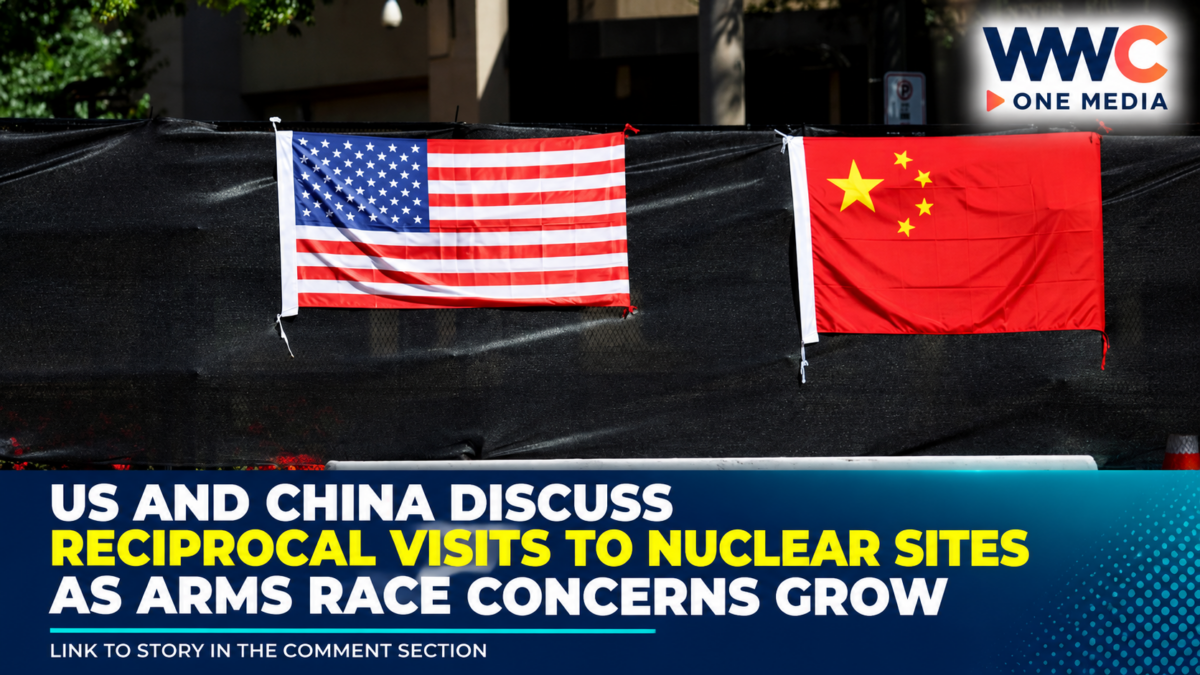
The United States and China are discussing the possibility of allowing officials to make reciprocal visits to each other’s nuclear facilities, in a potentially significant confidence-building measure as concerns grow over Beijing’s expanding nuclear arsenal.
The discussions are still at an early and informal stage, with the idea reportedly first raised by Chinese officials during meetings with their US counterparts earlier this year. According to CNN, the talks have included the possibility of visits to US Department of Energy national laboratories and corresponding facilities in China.
The proposal would not amount to a formal arms-control agreement or require either country to disclose the full size or deployment of its nuclear arsenal. Instead, reciprocal access could provide a limited degree of transparency between two countries that have long struggled to establish trust over nuclear weapons and military capabilities.
China Reportedly Put the Idea Forward
According to sources familiar with the discussions cited by CNN, Chinese officials initially suggested reciprocal nuclear-site visits during diplomatic exchanges with the US.
The discussions have mainly taken place on the sidelines of meetings involving the five permanent members of the United Nations Security Council — the US, China, Russia, Britain and France — rather than through formal arms-control negotiations.
US officials are now expected to continue pursuing the idea during additional meetings with Chinese counterparts over the coming months.
CNN reported that Washington is considering potential access for Chinese officials to US Department of Energy laboratories and possibly nuclear testing sites, while US officials could seek comparable access to Chinese facilities.
The talks remain preliminary, however, and there is no agreement yet to conduct the visits.
Why the Nuclear Discussions Matter
The proposal comes as the US raises concerns about the rapid expansion of China’s nuclear capabilities.
CNN reported that China currently has roughly 600 nuclear warheads, compared with around 5,000 attributed to the United States. US officials expect China’s arsenal to continue growing substantially over the next decade.
Washington has also been tracking the construction and expansion of Chinese nuclear infrastructure, including through satellite imagery.
Beijing, meanwhile, has repeatedly argued that its nuclear arsenal remains far smaller than those of the US and Russia and that this makes it difficult to justify joining arms-control negotiations designed around the much larger stockpiles of the two established nuclear powers.
That position has been one of the biggest obstacles to efforts to establish three-way arms-control negotiations.
A Possible Confidence-Building Measure
Allowing controlled visits to nuclear-related facilities could therefore offer a less politically sensitive starting point.
Such visits could give each side a limited opportunity to observe facilities and verify certain information without immediately requiring negotiations over warhead numbers, deployment arrangements or reductions.
Experts and officials have increasingly viewed confidence-building measures as important at a time when communication between major nuclear powers is complicated by broader military and geopolitical tensions.
The proposal is particularly notable because it originated, according to CNN’s sources, with China rather than solely with Washington.
Still, any eventual visits would likely involve strict restrictions over what foreign officials could see, where they could go and what information could be disclosed.
Trump Has Pushed for Wider Arms-Control Talks
US President Donald Trump has previously called for nuclear arms-control negotiations involving the United States, Russia and China.
When Trump met Chinese President Xi Jinping last month, Trump advocated trilateral negotiations, according to the White House. But the two leaders did not specifically discuss reciprocal visits to nuclear sites during that meeting, CNN reported.
Xi has previously resisted entering such negotiations, with Beijing arguing that China’s nuclear forces remain considerably smaller than those of Washington and Moscow.
The lack of an existing three-way framework has made progress difficult.
At the same time, the last remaining US-Russia strategic arms-control treaty expired in 2025, leaving the world’s two largest nuclear powers without the same formal limits that existed for decades.
That has added urgency to discussions about how to prevent further deterioration in nuclear stability.
More Trump-Xi Meetings Expected
The nuclear-site proposal could gain greater significance if Washington and Beijing manage to make progress before Trump and Xi meet again.
Another meeting between the two leaders is widely expected later this year, potentially on the sidelines of the Asia-Pacific Economic Cooperation summit in China in November or the Group of 20 meetings in the United States in December.
Before then, US and Chinese officials are expected to meet several times at lower levels.
CNN reported that Washington intends to keep raising the nuclear-site proposal during those discussions to determine whether a reciprocal arrangement is realistically possible.
No Deal Has Been Reached
Despite the potentially significant implications, officials have yet to announce a formal agreement.
Reuters said it could not independently verify CNN’s report, while the White House and the Chinese Embassy in Washington did not immediately respond to requests for comment.
The distinction is important: the countries are discussing a possible confidence-building mechanism, not yet conducting reciprocal inspections or negotiating a nuclear treaty.
For now, the talks offer a rare indication that Washington and Beijing may be willing to explore limited forms of transparency despite their broader strategic rivalry.
Whether that tentative opening develops into actual visits — and whether those visits can eventually contribute to broader arms-control negotiations — will depend on how much access each side is prepared to offer and whether the two governments can overcome their longstanding differences over the size and purpose of their nuclear arsenals.