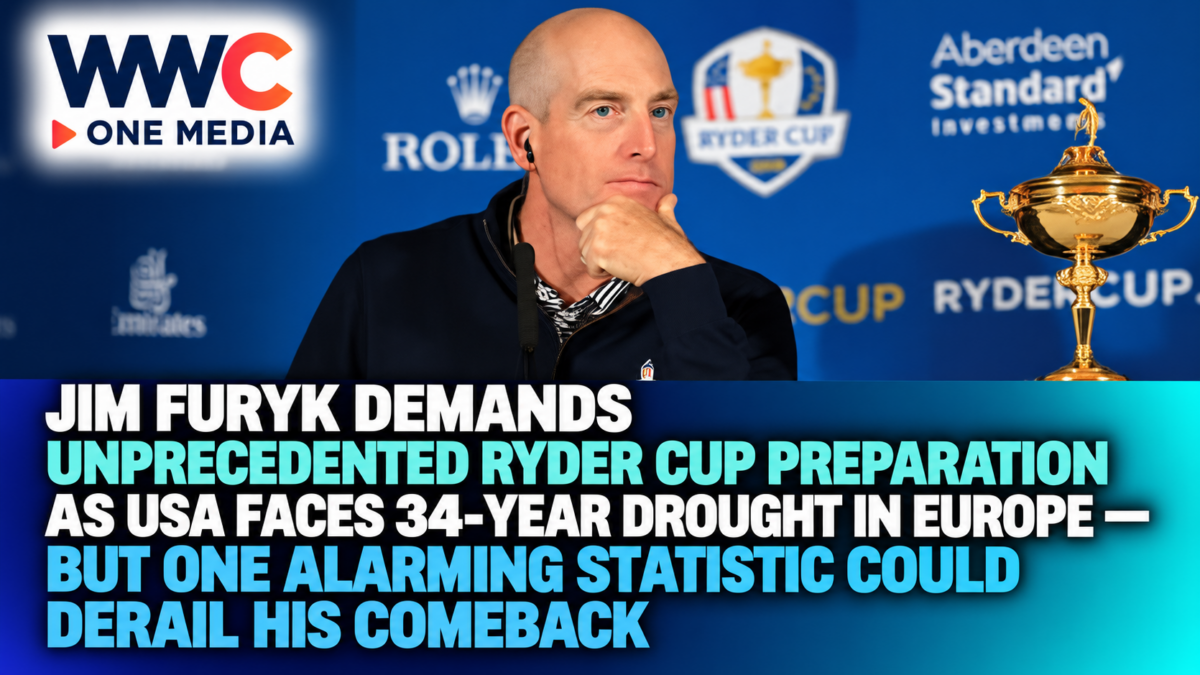
LIMERICK, IRELAND — United States Ryder Cup captain Jim Furyk has delivered a warning to America’s top golfers: individual talent will no longer be enough to defeat Europe.
With the 2027 Ryder Cup approaching, Furyk is demanding a greater commitment from his players as the Americans attempt to end one of the longest losing streaks in international golf.
Speaking alongside European captain Luke Donald at Adare Manor on October 6, Furyk outlined plans to overhaul the United States’ preparation, qualification process and team strategy.
The former U.S. Open champion believes the Americans must work harder than previous generations if they hope to win the trophy on European soil for the first time in 34 years.
But the biggest obstacle may not be the course, the crowd or even Europe’s impressive recent record.
It could be an alarming weakness in one particular format of team golf—one that Furyk believes American captains have failed to address adequately.
Furyk Issues a Strong Warning to Team USA
Furyk has made it clear that preparing for the 2027 Ryder Cup will require more than arriving in Ireland a few days before the tournament.
The 56-year-old captain wants his players to understand Adare Manor, develop stronger partnerships and embrace a more demanding preparation schedule.
During the tournament’s official one-year countdown, Furyk declared:
“I’m going to ask this team to do more than any other United States team has in the past.”
It was a powerful statement from a captain who knows the consequences of arriving at the Ryder Cup without an effective strategy.
Furyk previously captained the United States during its defeat to Europe at Le Golf National in France in 2018.
Now he has a second opportunity to lead the Americans.
But the expectations are enormous.
The United States boasts some of the world’s highest-ranked golfers, yet its recent Ryder Cup record outside America remains deeply disappointing.
Furyk is determined to change that.
The Statistic That Should Alarm American Golf Fans
One number explains why Furyk is demanding major adjustments.
The United States has won only three of its last 16 foursomes matches against Europe across the 2023 and 2025 Ryder Cups.
Europe won the other 13.
Foursomes, also known as alternate-shot golf, requires two players to compete as a team while taking turns hitting the same ball.
Unlike traditional stroke play, individual brilliance is not enough.
Partners must understand each other’s strengths, adapt to different playing styles and make decisions together.
The Americans have repeatedly struggled in this format.
Their problems extend beyond the Ryder Cup.
Across the last two Ryder Cups and last two Presidents Cups combined, American teams have recorded eight wins and 26 losses in foursomes.
That record suggests a recurring weakness rather than an isolated disappointing session.
Furyk acknowledged that changes are necessary.
For a team filled with elite players, such results are difficult to justify.
Why America’s Best Golfers Keep Struggling Together
The United States frequently enters the Ryder Cup with an impressive collection of individual talent.
American players regularly contend for major championships and occupy leading positions in the world rankings.
Yet foursomes requires a different approach.
A pairing featuring two outstanding golfers will not necessarily become an outstanding team.
Players must understand each other’s preferred distances, shot shapes and putting tendencies.
They also need to decide which player should tee off on particular holes.
Mistakes can create additional pressure because one player’s poor shot becomes the other player’s problem.
Europe has historically placed considerable emphasis on developing compatible partnerships and preparing players for the unique demands of team competition.
Furyk now wants the Americans to address those same details more effectively.
The challenge is not simply choosing the 12 best golfers.
It is finding the combinations capable of producing the best collective performance.
New Analytics Team Could Change American Strategy
One of Furyk’s first major decisions has been to strengthen the United States’ analytical approach.
The captain has introduced a new analytics team to help evaluate player performance and team combinations.
The changes are intended to support decisions involving qualification, partnerships and match strategy.
Statistical analysis can help identify which players may complement one another.
It can also reveal strengths and weaknesses that are less obvious from tournament results alone.
However, analytics cannot guarantee victories.
Players must still execute shots under intense pressure.
And the Ryder Cup presents psychological challenges that are difficult to capture entirely through statistics.
The real test will be whether the Americans can turn additional information into better decisions on the course.
Players Expected to Visit Adare Manor Before the Tournament
Furyk also wants prospective team members to become familiar with the 2027 venue well before competition begins.
Adare Manor is a 7,509-yard, par-72 championship course designed by Tom Fazio.
Located in County Limerick, Ireland, the venue will host the Ryder Cup from September 13 to 19, 2027.
Understanding its layout could become important when deciding player pairings and match tactics.
Furyk expects players to make serious efforts to visit the course ahead of the event.
The captain wants his team to study the playing conditions, develop familiarity with the surroundings and reduce uncertainty before the opening matches.
For American players accustomed to competing primarily on the PGA Tour, an organized advance visit could provide valuable preparation.
But it will also require scheduling commitments during an already demanding professional season.
Europe Has Already Started Preparing
The Americans are not the only team taking preparation seriously.
European captain Luke Donald has already begun familiarizing his players with Adare Manor.
In September 2026, Donald organized a practice visit involving 15 European golfers.
The group included 10 players from Europe’s victorious 2025 Ryder Cup team, along with returning contenders and potential newcomers.
The players completed a practice round and participated in team activities.
The visit provided an opportunity to examine the course while strengthening relationships ahead of next year’s competition.
It also demonstrated how far in advance Europe is preparing.
Furyk’s plans can therefore be understood partly as a response to an opponent that has already established a successful team-building system.
Luke Donald Is Chasing Ryder Cup History
Standing in Furyk’s way is one of the most successful European Ryder Cup captains of the modern era.
Luke Donald guided Europe to victory in Rome in 2023.
He then led his team to another win at Bethpage Black in New York in 2025.
Now Donald is preparing for his third consecutive captaincy.
If Europe wins again in 2027, he would become the first captain to lead the European team to three consecutive Ryder Cup victories.
That would represent a remarkable achievement.
Donald has built his reputation around preparation, leadership and attention to detail.
His players have repeatedly demonstrated their ability to perform effectively in team formats.
But the European captain is not underestimating the Americans.
He recognizes the depth of talent available to Furyk and expects the United States to arrive in Ireland with a stronger plan.
America’s European Ryder Cup Drought Dates Back to 1993
The United States last won the Ryder Cup on European soil at The Belfry in England in 1993.
Since then, American teams have repeatedly failed to overcome Europe away from home.
The losing streak includes Furyk’s own 2018 experience in France.
At that event, Europe defeated the United States 17½–10½.
The defeat exposed weaknesses in America’s performance and preparation.
For Furyk, returning as captain presents an opportunity to apply lessons learned from that experience.
However, history also increases the pressure.
The United States will enter the 2027 contest knowing that an entire generation of American golfers has never experienced a Ryder Cup victory in Europe.
Ending that drought would carry enormous significance.
Europe’s Recent Dominance Adds to the Pressure
Europe has won the last two Ryder Cups.
More broadly, European teams have captured nine of the 12 editions played since 2002.
That record illustrates how consistently Europe has performed in the competition.
The Ryder Cup features 12 players from each side competing across three days.
The tournament includes foursomes, four-ball and singles matches.
Each format rewards different skills.
Success requires a combination of individual ability, strong partnerships, strategic planning and emotional resilience.
The Americans have frequently possessed enough talent to compete.
But Europe’s stronger performances in team formats have repeatedly made the difference.
Furyk’s challenge is to prevent that pattern from continuing.
Presidents Cup Success Offers Encouragement—and a Warning
The United States recently secured a Presidents Cup victory against the International Team.
The Americans won the competition 17–13 after a dominant performance in singles matches.
Captain Brandt Snedeker expressed confidence that the players could pose a serious challenge to Europe.
However, the Presidents Cup also exposed familiar weaknesses.
The Americans struggled in foursomes before recovering in singles.
That makes the result both encouraging and concerning.
The victory demonstrated America’s ability to respond under pressure.
But the poor alternate-shot performance reinforced Furyk’s central argument.
The United States cannot rely on singles matches to rescue every team competition.
Against Europe, falling behind early could prove particularly costly.
Could Scottie Scheffler Lead the American Comeback?
Furyk is expected to have access to several established American stars when selecting his 2027 team.
Players such as Scottie Scheffler, Xander Schauffele and Collin Morikawa could be important contributors if their performances earn them places.
Scheffler’s consistency and major-championship success make him an obvious figure of interest.
Schauffele brings experience and a strong competitive record.
Morikawa’s precise iron play could prove valuable in team formats.
However, none should be described as a confirmed member of the 2027 team.
Qualification remains ongoing, and form, health and selection decisions will determine the final lineup.
Furyk’s challenge is to identify players who can perform effectively together rather than relying exclusively on individual rankings.
Furyk Is Changing How the Team Will Be Selected
The captain is also introducing changes to the American qualification system.
The revised approach is intended to help build a team capable of competing successfully across every Ryder Cup format.
Qualification points remain important, but Furyk wants the selection process to support the broader needs of the team.
That could influence how prospective players approach the coming season.
Golfers hoping to represent the United States will need strong individual performances.
Those considered for captain’s selections may also need to demonstrate qualities valuable in team competition.
The changes reflect Furyk’s determination to address problems before the team arrives in Ireland.
However, the final impact cannot be assessed until the roster is selected and the matches are played.
Why Ryder Cup Preparation Is Different From Major Championships
Winning a major championship requires individual excellence.
Winning the Ryder Cup demands a different set of abilities.
Players compete for their teammates and their country or continent.
They face intense crowds, shifting momentum and rapidly changing match situations.
A golfer can produce an outstanding individual performance and still lose a team match if the partnership is ineffective.
Captains must decide who plays together, who sits out and which pairings are best suited to specific opponents.
They also need to manage personalities and maintain confidence when results turn against the team.
That makes preparation essential.
Furyk’s focus on course visits, analytics and stronger player commitment is intended to improve the Americans’ collective performance.
The approach recognizes that talent is necessary but not sufficient.
Adare Manor Could Provide Europe With Another Advantage
The 2027 tournament will be played in Ireland, where European players are expected to enjoy passionate home support.
Ryder Cup crowds can create an intense atmosphere.
Every important putt, difficult recovery shot and match-winning moment attracts enormous attention.
The home team also benefits from familiarity with the environment.
For the United States, managing that pressure will be another challenge.
The Americans must prepare not only for the physical demands of Adare Manor but also for the psychological intensity of competing against Europe on its home continent.
Furyk’s previous experience as captain could help him anticipate those challenges.
But his ability to turn experience into better results remains unproven.
Furyk’s Second Chance Could Define His Captaincy Legacy
The 2027 Ryder Cup offers Furyk an opportunity to change the narrative surrounding his leadership.
His first captaincy ended in defeat.
His second comes against a European team seeking a historic third consecutive victory.
He has already acknowledged that the Americans must improve their preparation.
He has promised changes to qualification and analytics.
And he wants a greater commitment from his players.
Those decisions demonstrate a willingness to challenge established approaches.
But Ryder Cup history will ultimately judge him on results.
If the United States wins in Ireland, Furyk could become the captain who ended a 34-year drought.
If America loses again, questions about the team’s preparation and strategic decisions will inevitably return.
The Bigger Battle Is About Changing America’s Ryder Cup Culture
Furyk’s plans extend beyond one tournament.
They reflect a broader effort to change how American golfers approach international team competition.
The United States has the individual talent to challenge any opponent.
But its poor record in foursomes suggests that identifying elite golfers is only part of the equation.
Successful teams require shared preparation, compatible playing styles and a commitment to collective performance.
Europe has demonstrated the effectiveness of that approach repeatedly.
Furyk now wants the Americans to close the gap.
The introduction of new analytics, revised qualification procedures and advance course preparation represents an attempt to create a more coordinated system.
Whether those changes are enough remains uncertain.
But Furyk clearly believes the previous approach needs improvement.
Can Team USA End Europe’s Dominance in 2027?
With less than a year remaining before the Ryder Cup, the pressure is building.
Europe is pursuing a third consecutive victory.
Donald is chasing a place in golf history.
The United States is trying to end a losing streak on European soil that began after its 1993 victory.
And Furyk is attempting to repair an alarming record in alternate-shot competition.
The stakes could hardly be higher.
The Americans have won only three of their last 16 Ryder Cup foursomes matches.
That weakness has contributed to their recent defeats.
Furyk believes better preparation can help reverse the trend.
But plans and promises must eventually translate into points on the scoreboard.
Jim Furyk is demanding more from Team USA than any American Ryder Cup captain before him.
He is introducing new strategies, emphasizing teamwork and pushing players to prepare months ahead of the tournament.
But the bigger question is whether those changes can finally end Europe’s dominance—or whether America’s disastrous foursomes record will once again prove too difficult to overcome.