
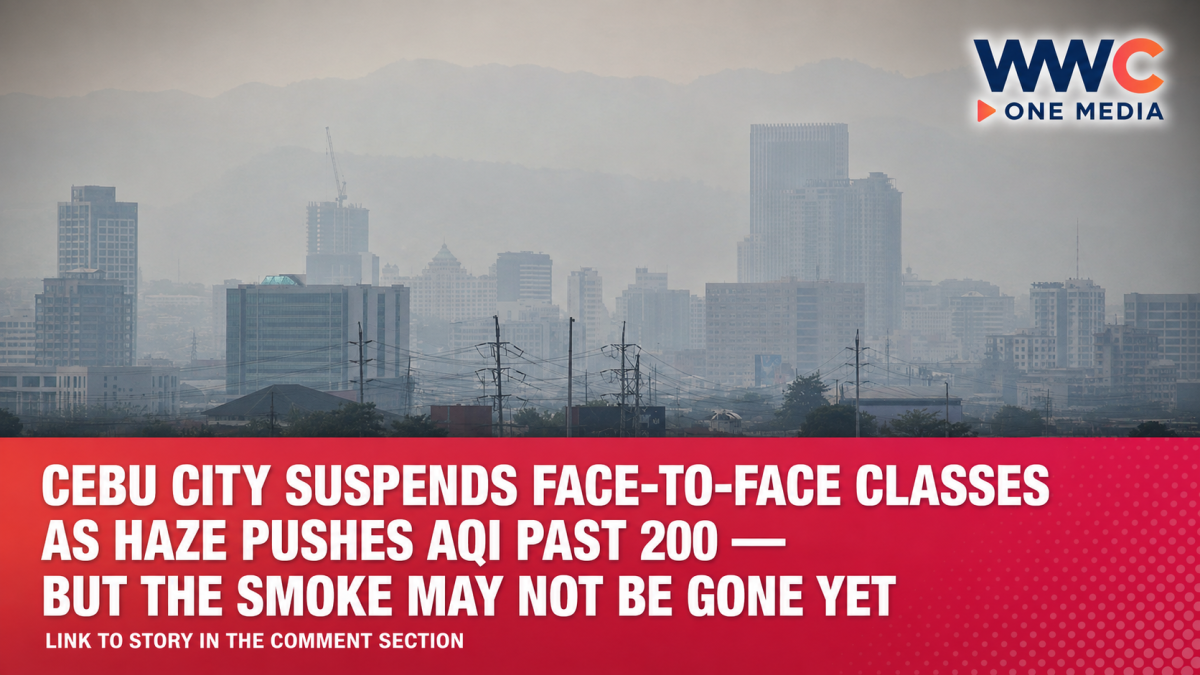
CEBU CITY — Cebu City has suspended face-to-face classes as worsening haze from forest fires in Indonesia pushed air pollution across Metro Cebu into levels considered dangerous to public health, turning what initially appeared to be a hazy morning into a wider health and education concern.
The suspension covers in-person classes at all levels in public and private schools in Cebu City as authorities move to reduce students’ exposure to elevated concentrations of fine particulate matter.
The decision came as air-quality conditions deteriorated sharply.
Data from the Department of Environment and Natural Resources-Environmental Management Bureau in Central Visayas showed Metro Cebu’s Air Quality Index climbing to 203 on Wednesday, September 2, up from 173 the previous day.
An AQI reading above 200 falls under the Philippines’ “Acutely Unhealthy” classification — a level at which exposure is no longer only a concern for people with existing medical conditions.
The main pollutant driving the deterioration is PM2.5, or fine particulate matter measuring 2.5 micrometers or smaller.
Because these particles are extremely small, they can travel deep into the lungs. Health officials have warned that prolonged or heavy exposure may trigger coughing, difficulty breathing, irritation of the nose and throat, and worsening asthma and other respiratory illnesses.
Children, senior citizens, pregnant women, and people with asthma, chronic obstructive pulmonary disease, heart disease or other respiratory and cardiovascular conditions face greater risks.
The pollution did not originate in Cebu
Environmental authorities say the haze blanketing Cebu and other parts of the Philippines is linked to ongoing forest fires in Kalimantan, Indonesia.
Smoke and fine particles from the fires have been transported hundreds of kilometers across Southeast Asia by the southwest monsoon, or Habagat, creating what officials describe as transboundary air pollution.
The same weather system has carried the haze toward portions of Luzon and the Visayas, with unhealthy air-quality readings also reported in Metro Manila and other areas.
DENR-EMB officials have warned that the situation depends heavily on two factors Cebu cannot control: whether the fires in Indonesia continue burning and whether prevailing winds keep carrying their smoke toward the Philippines.
That means the class suspension may address the immediate exposure of students, but it does not eliminate the larger environmental threat.
How long could the haze last?
DENR-EMB earlier said smoke from Kalimantan could continue affecting parts of the Philippines from September 1 to September 3 while the fires remain active and Habagat winds continue transporting pollutants northward.
There is, however, a possible source of relief.
Rain can remove suspended particles from the atmosphere, effectively washing some PM2.5 pollution out of the air. Environmental officials said conditions could gradually improve between September 4 and September 6 if widespread rainfall develops or wind patterns change.
If the fires remain active and winds continue blowing toward the Philippines, however, the haze could linger or return.
Health authorities prepare for possible respiratory cases
Despite Cebu’s deteriorating air quality, the Department of Health in Central Visayas said that as of Wednesday there had been no reported hospital admissions directly linked to the haze.
That does not mean the health risk has passed.
Local health units have been told to prepare for a possible increase in consultations, particularly among people suffering from asthma and other chronic respiratory conditions.
Health officials are urging people with breathing problems not to wait for symptoms to become severe before seeking medical attention.
The DOH has advised residents to limit unnecessary outdoor exposure and use an N95 or similarly protective respirator when going outside.
Residents are also encouraged to keep doors and windows closed where possible, avoid strenuous outdoor exercise and regularly monitor official air-quality advisories.
Motorists should take additional precautions because heavy haze can also reduce visibility, particularly in poor lighting conditions.
Cebu’s AQI jumped dramatically in just one day
The speed of the deterioration is one of the most concerning parts of the episode.
Monitoring in Metro Cebu showed AQI readings rising throughout September 1 — from around 152 early in the day to 172 around midday and 173 later in the afternoon.
Those figures were already classified as “Very Unhealthy.”
By September 2, the AQI had reached 203, crossing into the next and more serious pollution category.
The numbers illustrate why authorities are treating the situation as more than an ordinary spell of hazy weather.
Unlike mist or fog, the haze contains microscopic pollution particles capable of entering the respiratory system.
And while the haze may look less dramatic from one neighborhood to another, environmental authorities have stressed that readings from monitoring stations can reflect conditions affecting the broader Metro Cebu airshed rather than only the immediate location of a sensor.
A regional problem reaches Cebu classrooms
The Cebu situation also highlights how an environmental emergency hundreds of kilometers away can quickly become a local public-health problem.
Wildfires burning in another country have now contributed to polluted skies in the Philippines, health warnings for millions of residents and disrupted classroom learning in Cebu City.
Similar transboundary haze episodes have affected Southeast Asia before, including the severe regional haze crisis of 2015.
For Cebu families, however, the immediate question is simpler: When will the air be safe enough for normal activities to resume?
That answer will depend less on what happens inside Cebu City than on what happens over the next several days in the skies between Indonesia and the Philippines.
For now, authorities are urging residents to reduce exposure, wear appropriate masks outdoors and follow official DENR, DOH, PAGASA and local government advisories as air-quality conditions continue to change.
WWC ONE MEDIA MJE




Leave a Reply