
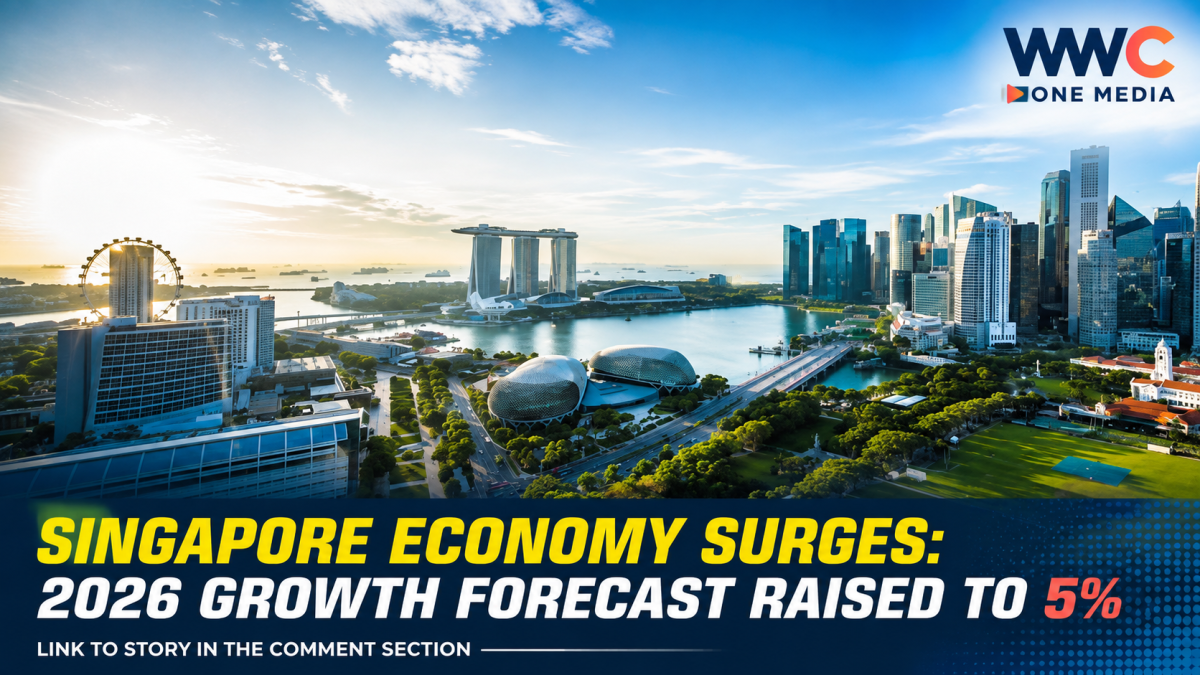
Private-sector economists have dramatically upgraded their outlook for Singapore’s economy, raising the 2026 GDP growth forecast to 5% from 3.5% as artificial-intelligence demand, exports and manufacturing continue to outperform expectations.
The latest forecast comes from the Monetary Authority of Singapore’s (MAS) Survey of Professional Forecasters, released on September 2, with 21 economists and analysts participating.
AI boom pushes Singapore growth higher
The upgrade follows surprisingly strong economic performance during the first half of the year.
Singapore’s economy expanded 5.9% year-on-year in the second quarter of 2026, beating the 4.3% growth economists had previously expected. GDP had expanded 6.3% in the first quarter, putting first-half growth at around 6.1%.
The government has also raised its own 2026 GDP forecast. Singapore’s Ministry of Trade and Industry (MTI) now expects growth of 4.5% to 5.5%, up sharply from its earlier 2% to 4% range. MTI attributed the stronger outlook partly to accelerating global investment in AI-related technologies.
Manufacturing has been a major part of that story. Strong demand for semiconductors and semiconductor-manufacturing equipment, particularly those linked to AI, has helped drive industrial activity.
But economists don’t expect the boom to last forever
The MAS survey projects growth to moderate later this year.
Economists expect Singapore’s economy to expand by 4.6% in the third quarter and 3.6% in the fourth quarter. For 2027, the median growth forecast is 3.1%.
That suggests the current surge is powerful but could gradually return toward a more normal growth rate.
And there is another major question hanging over the outlook: How long can the AI-driven technology cycle continue?
All respondents identified a sustained AI-driven upturn as an important upside risk. But an AI bubble bursting, with spillovers into financial markets, was also among the most frequently cited threats to Singapore’s economy.
Inflation outlook improves — for now
There is some relief on the inflation front.
Economists lowered their 2026 median forecast for headline inflation to 2.1% from 2.3%, while the forecast for core inflation was reduced to 1.9% from 2%.
In the second quarter, headline inflation averaged 1.8%, while core inflation was 1.5%, both below what economists had previously anticipated.
However, inflation remains a key issue because Singapore is highly dependent on global trade, imported energy and international supply chains.
MTI’s latest indicators show consumer prices were up 2.2% year-on-year in July 2026.
MAS policy could become the next big story
The stronger economy and continuing price pressures could also put monetary policy back into focus.
According to the MAS survey, 45% of economists expect the central bank to tighten monetary policy in October by increasing the slope of the Singapore dollar nominal effective exchange rate (S$NEER) policy band, up from 30% in the previous survey.
Almost all respondents, however, expect the monetary policy stance to remain unchanged in January 2027.
This comes after Singapore’s central bank unexpectedly tightened its monetary policy settings in July, citing persistent inflation risks.
The bigger threat may be outside Singapore
Economists remain particularly concerned about developments beyond Singapore’s borders.
A prolonged or escalating Middle East conflict could weaken global growth and push energy prices higher, while a sharp reversal in the AI investment boom could hit Singapore’s technology and manufacturing sectors.
Singapore’s MTI has previously warned that geopolitical disruptions can affect energy, manufacturing, transport, tourism and domestic businesses because of the country’s dependence on international trade and imported energy.
That creates an unusual economic picture for Singapore: growth is accelerating at the same time that policymakers must remain alert to inflation, geopolitical shocks and the possibility of an AI-driven downturn.
What this means
The latest numbers paint a considerably stronger picture of Singapore’s economy than earlier in 2026.
2026 GDP forecast: 5.0%
Previous economist forecast: 3.5%
MTI official forecast: 4.5%–5.5%
Q1 2026 growth: 6.3%
Q2 2026 growth: 5.9%
2026 headline inflation forecast: 2.1%
2026 core inflation forecast: 1.9%
2027 GDP forecast: 3.1%
The immediate message is positive: Singapore is outperforming expectations.
But the next chapter could depend heavily on whether the global AI investment boom remains intact — and whether geopolitical tensions reignite inflation.
WWC ONE MEDIA MJE




Leave a Reply