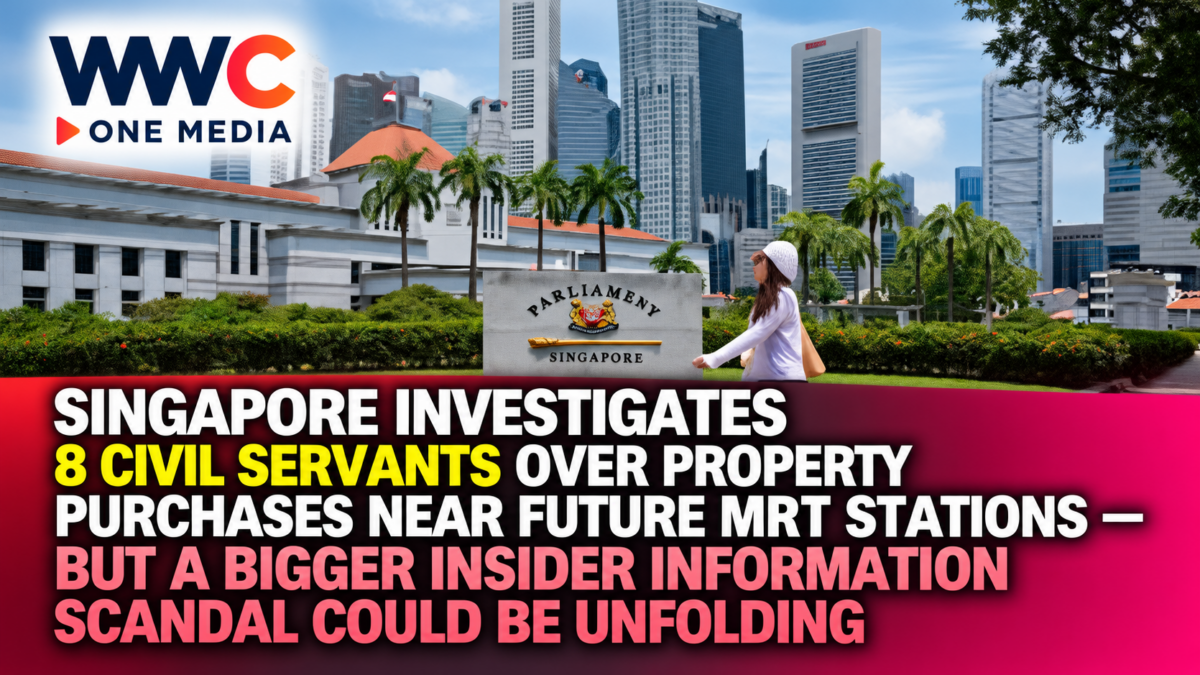
SINGAPORE — Eight Singapore public officers have been referred to police after a government review uncovered property transactions near future MRT stations that warrant further investigation, raising questions about whether confidential infrastructure plans may have influenced private investment decisions.
The announcement was made on October 6, 2026, by Coordinating Minister for Public Services Chan Chun Sing during a parliamentary session.
According to Chan, the Public Service Division examined property purchases involving 191 officers who worked in government agencies connected to rail planning.
The transactions occurred between 2007 and 2014, before or around announcements of future MRT station locations.
Eight cases were identified for further examination.
The referrals followed a September academic study suggesting that some public officers had purchased properties near planned railway stations before the public knew where they would be built.
But investigators have not established that the eight officers deliberately used confidential information for personal financial gain.
The central question is whether the purchases reflected ordinary investment decisions—or whether some government employees had access to information that gave them an unfair advantage over other property buyers.
Eight Officers Referred to Police After Review of 191 Cases
The Public Service Division began examining the allegations after researchers identified unusual patterns in property transactions associated with certain public employees.
The government reviewed transactions involving 191 officers who worked in agencies connected to rail planning.
Investigators examined the employees’ responsibilities, the timing of their purchases, the locations of the properties and whether they could have accessed relevant non-public information.
Eight cases required further examination.
Some were flagged because of circumstances surrounding the purchases.
Others could not be excluded from further scrutiny because the available information was insufficient.
Chan stressed that referring the cases to police does not establish that misconduct occurred.
The police will conduct independent investigations, and the officers are entitled to due process.
The government has also indicated that additional administrative checks remain ongoing.
The Allegations Began With a US Academic Study
The investigation was prompted by research published in September 2026 through the US-based National Bureau of Economic Research.
The working paper, titled Do Social Norms Substitute for Enforcement? Evidence from Public Officials’ Home Purchases in Singapore, examined whether government employees had unusual patterns of property purchases around future MRT developments.
The researchers were Tomasz Piskorski, Amit Seru, Jian Zhang and Chun Zhao.
They compared the purchasing behavior of individuals identified as civil servants with that of other buyers sharing similar demographic characteristics.
Their analysis focused on properties located near planned MRT stations before the government publicly announced those stations.
The study found that people classified as civil servants working in relevant agencies were disproportionately represented among buyers near future stations.
The statistical difference was particularly noticeable one to two years before the official announcements.
After the announcements, the researchers found that purchasing patterns became more similar.
The authors interpreted the results as evidence consistent with the possible use of privileged planning information.
However, the paper’s statistical findings do not prove that any particular officer possessed or misused confidential information.
Why Buying Property Near an MRT Station Can Be Valuable
In Singapore, proximity to public transportation is an important consideration for homebuyers and property investors.
MRT stations provide access to employment centers, shopping districts, schools and other essential services.
Properties located near convenient transportation links can therefore be attractive to buyers.
A future station announcement may also influence expectations about development and accessibility.
For example, a buyer purchasing a property before an MRT station is announced might benefit if the planned infrastructure subsequently increases demand in the neighborhood.
But those gains are not guaranteed.
Property values depend on market conditions, housing supply, development plans and numerous other factors.
Research published by The Straits Times in March 2026 found that the relationship between train-station proximity and HDB resale prices varies by town.
That distinction matters because the current investigation concerns whether certain purchases were influenced by information unavailable to other buyers—not whether every home near a station automatically appreciates.
Researchers Estimated S$138 Million in Associated Property Purchases
One of the academic study’s most striking findings concerns the estimated value of additional property purchases.
Using statistical modeling, researchers estimated that the observed purchasing patterns corresponded to approximately 50 additional transactions two years before station announcements and another 63 purchases one year before.
They estimated the combined gross acquisition value associated with these excess purchases at approximately S$138 million.
The figure has attracted attention because of its potential financial implications.
However, the S$138 million does not represent confirmed illicit profits.
It is not an amount that investigators have established was stolen or improperly earned.
Nor does it represent the value of properties purchased by the eight officers referred to police.
It is a research estimate based on statistical differences between groups of buyers.
Singapore’s government has also questioned whether the research data and matching methods can independently establish misconduct.
Government Extended Its Investigation Beyond the Study Period
The original academic research focused on unusual purchasing patterns associated with station announcements in or before 2011.
But Singapore’s government decided to conduct a broader review.
PSD examined relevant property transactions from 2007 through 2014.
Officials explained that additional MRT station locations continued to be announced after 2011.
Extending the review allowed investigators to consider a wider period while examining the study’s underlying concerns.
The government relied on official administrative records rather than simply adopting the researchers’ classifications.
This was important because the academic study used different datasets to identify public employees and compare property purchases.
Government officials said some limitations remained concerning the representativeness of the research data and the accuracy of matches between individuals.
The administrative review therefore represents a separate examination of the allegations.
Why the Study Focused on Mid-Level Officials
The research suggested that the unusual purchasing patterns were concentrated among mid-level government employees.
The researchers proposed several possible explanations.
Senior officials may face greater scrutiny because of their public visibility.
Junior employees may have fewer financial resources to purchase private property.
Mid-level employees could potentially occupy positions involving access to operational information while attracting less public attention.
However, these are interpretations of statistical patterns.
They do not establish that mid-level civil servants generally engage in misconduct.
Nor does the study prove that any particular individual made a purchase based on confidential plans.
The government must establish the facts of each case separately.
Singapore Already Requires Property Declarations
The investigation has renewed attention on Singapore’s public-sector integrity rules.
According to Chan, all public officers have been required since the 1990s to declare purchases of private property.
They must also make annual declarations concerning properties they own but do not occupy themselves.
The requirements have been progressively strengthened.
Under existing rules, officers who possess relevant non-public information must obtain approval from their agency head before proceeding with affected transactions.
The rules also address purchases involving spouses and financially dependent children.
Officers are prohibited from passing confidential government information to relatives, friends or other individuals for private gain.
Depending on the circumstances, unauthorized disclosure or misuse of official information may breach civil-service rules or applicable laws, including the Official Secrets Act.
Could Relatives Have Benefited From Inside Information?
The academic study also examined possible purchasing patterns involving relatives of public officials.
Researchers reported findings consistent with the possibility that information had reached family members.
That creates an important enforcement challenge.
Even if a government employee does not personally purchase a property, confidential information could potentially benefit someone else.
Such arrangements can be harder to detect because the property may not appear under the employee’s own name.
However, the study’s findings do not establish that specific relatives received or acted upon unlawfully disclosed information.
Singapore’s existing rules already prohibit officers from sharing confidential information for private gain.
The latest controversy may prompt policymakers to examine whether those safeguards are sufficiently effective.
Police Investigation Could Determine What Happened
The referral of eight cases marks a significant development because the matter has moved beyond academic analysis and internal administrative review.
Police investigators can examine the circumstances surrounding individual transactions.
Relevant questions could include whether an officer had access to confidential station-location plans, when the information became available and whether it influenced the purchase.
Investigators may also need to establish whether any applicable rules or laws were breached.
But no criminal charges or convictions were announced in the October 6 parliamentary statement.
The eight officers have not been publicly identified in the official announcement reviewed for this article.
It would therefore be premature to describe them as corrupt, guilty of insider trading or participants in a proven property scheme.
Will Singapore Tighten Its Property Declaration Rules?
Members of Parliament have questioned whether existing safeguards should be strengthened.
Proposals raised in the parliamentary discussion included more systematic checks of property transactions, broader declaration requirements and additional oversight of officers who can access sensitive infrastructure plans.
Some lawmakers also questioned whether monitoring should extend to family members or people living with public officials.
The government has not announced an immediate expansion of all those requirements.
Chan said officials would study whether the investigation revealed weaknesses in existing safeguards.
Any additional measures would need to be practical and proportionate to the risks.
The government also emphasized that employees must remain able to conduct legitimate personal transactions.
The objective is to prevent abuse of confidential information without treating every civil servant who invests in property as a suspect.
Why the Investigation Matters to Singapore’s Reputation
Singapore is widely recognized for its emphasis on public-sector integrity, regulatory predictability and strong institutions.
Those characteristics contribute to its attractiveness as an international financial and business center.
Companies and investors value confidence that government decisions are administered fairly.
Public infrastructure planning is particularly sensitive because announcements can influence land values and commercial activity.
If government employees were able to profit from confidential plans, that could undermine public confidence in the fairness of the property market.
But the government’s willingness to investigate allegations also represents an important test of institutional accountability.
A credible process requires independent examination, protection of individual rights and appropriate action where misconduct is established.
The outcome could therefore matter beyond the eight cases.
The Study’s Findings Have Important Limitations
The academic paper is a working paper rather than a peer-reviewed final publication.
Its findings should be evaluated accordingly.
The researchers reported statistical associations suggesting unusual purchasing behavior.
But an association does not automatically establish that confidential information caused those purchases.
There could be other explanations, including legitimate knowledge of neighborhood development, publicly available planning information or differences between groups of buyers.
Singapore’s government has specifically highlighted limitations involving the study’s proprietary data and matching methodology.
The findings nonetheless warranted investigation because of the seriousness of the possibility being raised.
The academic research identified a pattern. The police investigation must establish whether that pattern reflects actual misconduct in any of the referred cases.
Could Other Infrastructure Projects Face Similar Scrutiny?
The case also raises questions about government planning information beyond MRT projects.
Announcements concerning roads, schools, commercial developments and other infrastructure can influence property demand.
Officials working on those projects may have access to information before it becomes public.
During the parliamentary discussion, lawmakers asked whether retrospective checks should be extended to other categories of government decisions.
Chan said the current investigation focused on the specific MRT-related allegations.
The government had not launched a wider review of other infrastructure projects at that stage.
However, officials indicated that credible concerns arising in other contexts would also be examined.
That leaves open the possibility of further scrutiny if additional evidence emerges.
Singapore Faces a Major Test of Public Trust
The property-purchase investigation has attracted international attention because it involves allegations concerning access to government planning information.
The facts established so far are significant.
An academic study identified unusual purchasing patterns near future MRT stations.
The government reviewed transactions involving 191 public officers.
Eight cases were referred to police.
And officials have acknowledged that the investigation may reveal areas where safeguards need improvement.
But the most important questions remain unanswered.
Did any of the officers actually possess confidential information about future MRT station locations?
Did that information influence their property purchases?
Were any laws or public-service rules violated?
And are the existing safeguards sufficient to prevent similar concerns in the future?
Only further investigation can resolve those issues.
The Bigger Question: Who Knew Before Everyone Else?
The controversy illustrates how valuable government planning information can become in a densely developed property market.
Advance knowledge of major infrastructure projects could potentially influence investment decisions.
That makes the protection of confidential information particularly important.
Singapore’s public service already operates under rules intended to prevent officials from exploiting their positions.
But the latest investigation will test how effectively those rules have worked in practice.
Eight public officers are now facing independent police scrutiny over property purchases near future MRT stations.
The government has not established that any of them committed wrongdoing.
But the bigger question is whether the investigation will uncover misuse of privileged information—or demonstrate that suspicious statistical patterns can have legitimate explanations.
For Singapore, the outcome will be about more than property transactions. It will be a test of whether public confidence in government integrity can withstand serious allegations while the authorities establish the facts.