
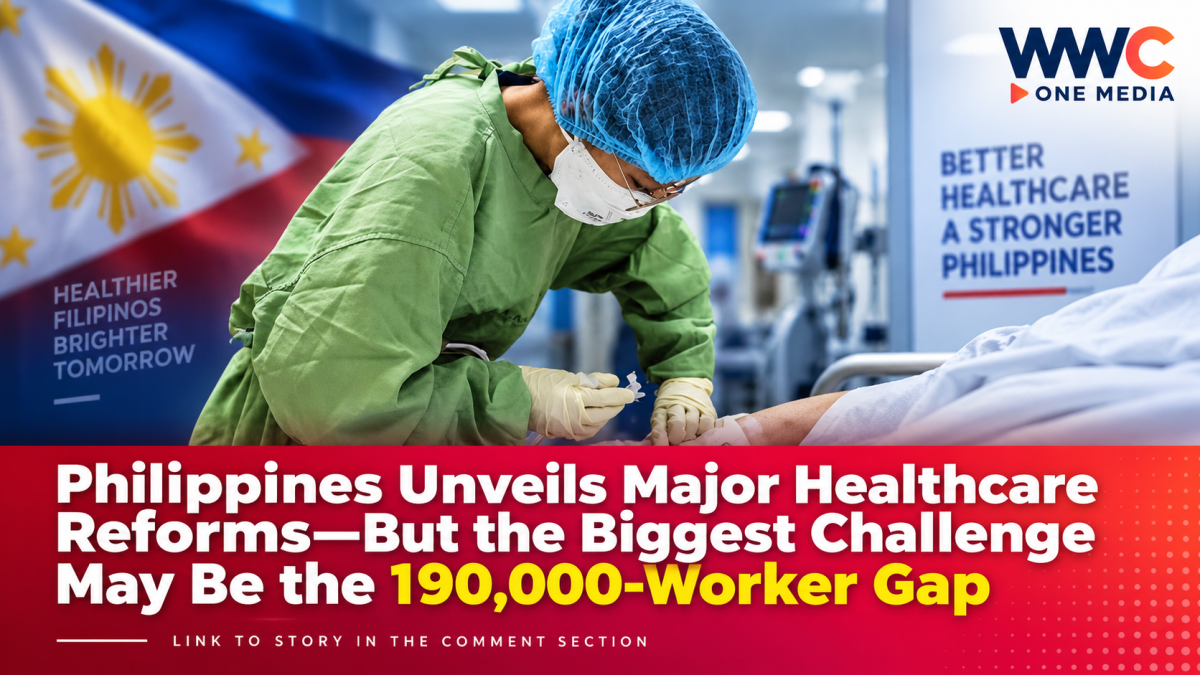
MANILA, Philippines — The Philippine government has laid out an ambitious plan to reshape healthcare delivery, with greater emphasis on primary care, preventive medicine, digital health services and bringing diagnostics closer to communities far from major hospitals.
The reforms discussed by then-Health Secretary Teodoro Herbosa with President Ferdinand Marcos Jr. in May 2024 also exposed one of the healthcare system’s biggest obstacles: the country needed an estimated 190,000 additional healthcare workers to fill gaps across the health system.
The figure included doctors, nurses and other health professionals, while accounting for the movement of workers abroad and the number of new graduates entering the profession. GMA News and the Philippine News Agency separately reported Herbosa’s estimate following a Palace briefing.
The government’s response was not simply to restrict healthcare workers from leaving the country.
Instead, Herbosa said the administration intended to expand the domestic supply of health professionals while exploring benefits such as insurance and housing assistance to make staying in the Philippines more attractive.
Primary care takes center stage
At the heart of the proposed reforms was a shift toward primary healthcare and disease prevention.
Herbosa argued that the country spends substantial resources on specialty hospitals even though many of the illnesses that cause deaths among Filipinos can be prevented or managed earlier through stronger primary care.
The plan presented to Marcos focused on three broad areas: health promotion and disease prevention, acute care, and women’s health.
The approach is consistent with the Department of Health’s broader 8-Point Action Agenda, which calls for safe and quality healthcare, faster services through technology, crisis preparedness, disease prevention, mental-health support, protection of healthcare workers and pandemic preparedness.
BUCAS centers aim to bring hospital-level services closer
One of the most visible pieces of the strategy is the expansion of Bagong Urgent Care and Ambulatory Services (BUCAS) Centers.
These facilities are designed to provide mid-level diagnostic and therapeutic services closer to communities, particularly areas that are more than two hours away from a regional hospital.
In May 2024, Herbosa said 10 BUCAS centers were already operational and that the government expected to open more. The original target was as many as 28 during the administration, although the DOH had already received substantially more proposals from regional offices.
The program subsequently expanded. By the end of 2024, the government reported 42 BUCAS centers nationwide—20 in Luzon, eight in the Visayas and 14 in Mindanao.
That expansion reflects the government’s broader effort to reduce the need for patients to travel long distances simply to receive basic urgent care, diagnostics or outpatient services.
Mobile clinics bring diagnostics to remote communities
Another major component is the deployment of mobile clinics to geographically isolated and disadvantaged areas.
The Department of Health eventually procured 83 Bagong Pilipinas Mobile Clinics, intended to serve provinces across the country.
The units were equipped with medical and diagnostic equipment, including digital X-ray, ultrasound, hematology analyzers, microscopes, ophthalmic equipment and telemedicine capabilities.
By July 2024, 37 of the 83 mobile clinics had already been deployed across Luzon, with the remaining units scheduled for the Visayas and Mindanao.
The initiative was designed to address a basic problem in Philippine healthcare: having a health program is not enough if patients cannot physically reach the facility providing it.
The plan also reaches below the barangay level
The proposed reforms included Purok Kalusugan, intended to strengthen primary healthcare at the community or purok level.
The program complements fixed health facilities and mobile services by taking preventive healthcare deeper into communities.
By the end of 2024, the DOH reported that 14 PuroKalusugan centers were operational, providing services including maternal and child health, immunization, nutrition, water, sanitation and hygiene interventions.
Healthcare worker shortage remains a critical hurdle
Perhaps the biggest challenge to the reform agenda is manpower.
Herbosa said the country needed approximately 190,000 additional healthcare workers to fill gaps in the overall health system.
The government considered measures such as insurance and housing assistance to encourage health professionals to remain in the Philippines.
At the same time, Herbosa rejected the idea of imposing a new deployment cap on Filipino healthcare workers seeking jobs overseas. His argument was that the solution was to produce more health professionals, rather than limit the country’s ability to train and export them.
The government also pointed to an increase in state universities and colleges offering medical education, from eight in the previous administration to 20 at the time of the 2024 announcement.
Women’s health gets a stronger focus
Women’s health was another major component of the reforms.
The government identified areas such as breast cancer treatment, HPV vaccination and other women’s health services as priorities.
The rationale was broader than treating individual patients: women frequently play central roles in managing the health of their families, meaning improvements in women’s health can have effects across households and communities.
Digital technology becomes part of the healthcare strategy
The reforms also envisioned greater use of technology to connect patients, healthcare providers and facilities.
The DOH has been pursuing electronic referral systems and broader health-information interoperability, while PhilHealth’s National Health Data Repository framework is intended to support the standardized collection and exchange of health-related information.
The broader objective is to make health information more useful for patient care, planning and resource allocation while maintaining data-protection safeguards.
PhilHealth reforms reinforce the same direction
The healthcare overhaul has also continued through expanded PhilHealth benefits.
By 2026, PhilHealth had expanded its Yaman ng Kalusugan (YAKAP) primary-care program and its GAMOT outpatient medicines program. The government said GAMOT covered 75 essential medicines with an annual benefit limit of up to ₱20,000 per member, while YAKAP was being expanded through additional accredited providers.
PhilHealth has also continued expanding benefit packages and working with private hospitals.
In August 2026, PhilHealth and St. Luke’s Medical Center–Global City formalized a partnership involving healthcare reforms, performance-based incentives and access to basic accommodation under PhilHealth’s No Co-Pay policy for eligible members and covered services.
Meanwhile, Dr. Beverly Ho took over as PhilHealth’s acting president and CEO in August 2026 and said the corporation would continue the reform direction, with particular emphasis on expanding access points, improving benefit packages and strengthening healthcare quality.
From reform proposals to a wider healthcare transformation
What began as a proposal to strengthen primary care has evolved into a broader effort involving community clinics, mobile diagnostics, PhilHealth benefits, digital health systems, specialty centers and healthcare workforce development.
The fundamental challenge, however, remains unchanged: healthcare reform only works when patients can actually access the services and qualified professionals they need.
For millions of Filipinos living far from major hospitals, the success of these reforms will ultimately be measured not by the number of policies announced, but by whether a doctor, diagnostic service, medicine or emergency facility is available when and where it is needed.
And that is where the government’s ambitious healthcare agenda faces its biggest test: turning a nationwide reform blueprint into reliable care on the ground.
WWC ONE MEDIA M.J.E




Leave a Reply