
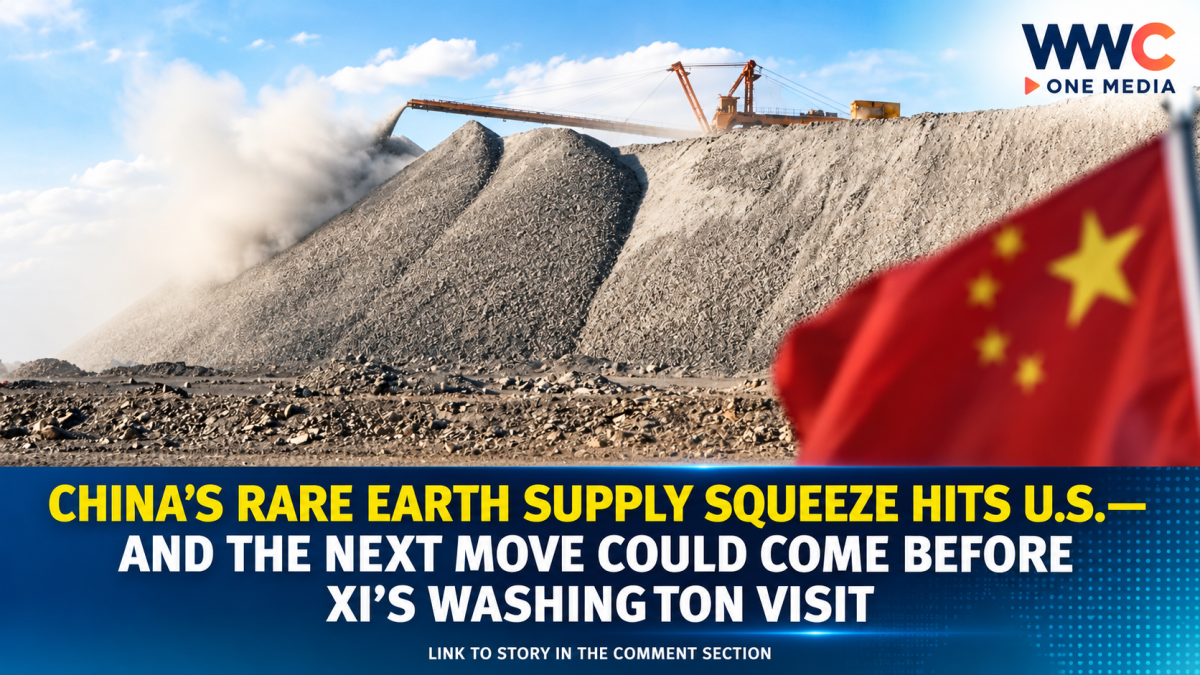
BEIJING/WASHINGTON — China’s grip on the global supply of critical minerals is once again becoming a major pressure point in its economic relationship with the United States, with some Chinese rare earth suppliers reportedly declining to ship materials to U.S. customers amid fears of repercussions from Beijing.
The development comes just weeks before Chinese President Xi Jinping is expected to visit Washington, putting rare earth supplies back at the center of the U.S.-China trade and national-security conversation.
According to sources cited by Reuters, a handful of Chinese suppliers have refused to fulfill some U.S.-bound orders since early August. The companies are reportedly concerned that complying with certain U.S.-linked mineral supply-chain auditing requirements could expose them to sanctions or other consequences from Beijing.
The issue intensified after China imposed sanctions in August on the Responsible Business Alliance (RBA), a U.S.-based supply-chain watchdog. The RBA is connected to the Responsible Minerals Initiative, whose due-diligence framework is used to assess mineral supply chains.
The sources told Reuters that some Chinese companies are increasingly cautious about transactions involving U.S. customers because of the rapidly changing rules surrounding critical minerals.
Reuters could not determine exactly how many Chinese suppliers have refused shipments to U.S. companies.
Rare earth exports remain a pressure point
The latest shipment disruptions highlight a problem that has persisted even after some rare earth exports began recovering from restrictions imposed by China in 2025.
Rare earth elements and other critical materials are essential to industries ranging from electronics and semiconductors to renewable energy, medical equipment, aerospace and defense.
Materials including yttrium, gallium, tungsten and other specialized inputs are particularly sensitive because of their applications in advanced manufacturing and strategic industries.
U.S. companies have reportedly faced lengthy waits for export licenses, with some businesses waiting more than six months for approvals.
Chinese customs data cited by Reuters also shows that U.S. imports of yttrium have increased this year but remain roughly half of 2024 levels.
China did resume some yttrium shipments after a two-month interruption. In July, about 27 tons of yttrium were shipped to the United States, marking the second-highest monthly volume since January 2025.
That suggests the situation is not a complete shutdown of China’s rare earth exports to the U.S. Rather, companies are facing a combination of licensing delays, tighter scrutiny and growing geopolitical uncertainty.
Japan is facing an even tighter squeeze
The pressure is not limited to American buyers.
Chinese exports of several critical minerals to Japan have also fallen sharply, according to Chinese customs figures cited by Reuters.
From January through August, China recorded no terbium exports to Japan, compared with about 20 tons during the same period last year.
Gallium shipments to Japan fell by roughly 65%, while yttrium exports plunged by approximately 98% over the same period.
These materials are important components in high-performance technologies, including advanced magnets and semiconductor-related applications.
Japan has previously complained about delays in obtaining permits and extended customs inspections for critical minerals.
Why this matters for Washington
The latest developments demonstrate why rare earths have become far more than a mining issue.
China occupies a dominant position across much of the global rare earth supply chain, particularly in processing and refining. That gives Beijing considerable leverage when trade relations deteriorate.
The United States has been trying to reduce its dependence on Chinese critical minerals by developing domestic production and encouraging alternative suppliers.
But building mines and processing facilities takes years, meaning supply-chain diversification cannot happen overnight.
That leaves manufacturers vulnerable to disruptions whenever export licenses are delayed or geopolitical tensions escalate.
A geopolitical strategist cited by Reuters said China’s control over supply-chain chokepoints can place pressure on U.S. agencies responsible for enforcing restrictions on Chinese technology and other strategic industries.
A bigger issue before the Xi-Trump meeting
The timing could be significant.
U.S. officials have repeatedly urged Beijing to honor commitments reached during earlier U.S.-China discussions aimed at keeping critical-mineral exports flowing.
The continuing licensing problems are now reportedly part of Washington’s preparations ahead of Xi’s expected September 24 visit.
At the same time, Beijing has argued that its actions against certain U.S.-linked organizations are responses to restrictions imposed by Washington on Chinese companies and industries.
China’s foreign ministry has said Beijing remains committed to maintaining global critical-mineral supply chains.
That leaves both sides with competing priorities: Washington wants predictable access to strategically important materials, while Beijing is increasingly using trade and regulatory tools as leverage in its broader confrontation with the United States.
The supply chain nobody can ignore
The immediate issue is not that China has completely cut off rare earth supplies to the United States.
Instead, the bigger concern is uncertainty.
When companies cannot predict whether a shipment will receive an export license, how long approval will take, or whether complying with another country’s supply-chain requirements could trigger retaliation, businesses are forced to rethink sourcing, inventories and production plans.
The European Chamber of Commerce in China has also called for a more transparent and predictable licensing process, saying companies continue to face problems with implementation despite some streamlining.
For Washington, the episode reinforces the urgency of building alternative critical-mineral supply chains.
For Beijing, meanwhile, rare earths remain one of the most powerful economic tools available in an increasingly competitive relationship with the United States.
And with Xi’s expected Washington visit approaching, the question is no longer simply whether rare earth shipments will resume.
The bigger question is what China will demand in return for keeping the critical-mineral pipeline open.
WWC ONE MEDIA J.M.S




Leave a Reply