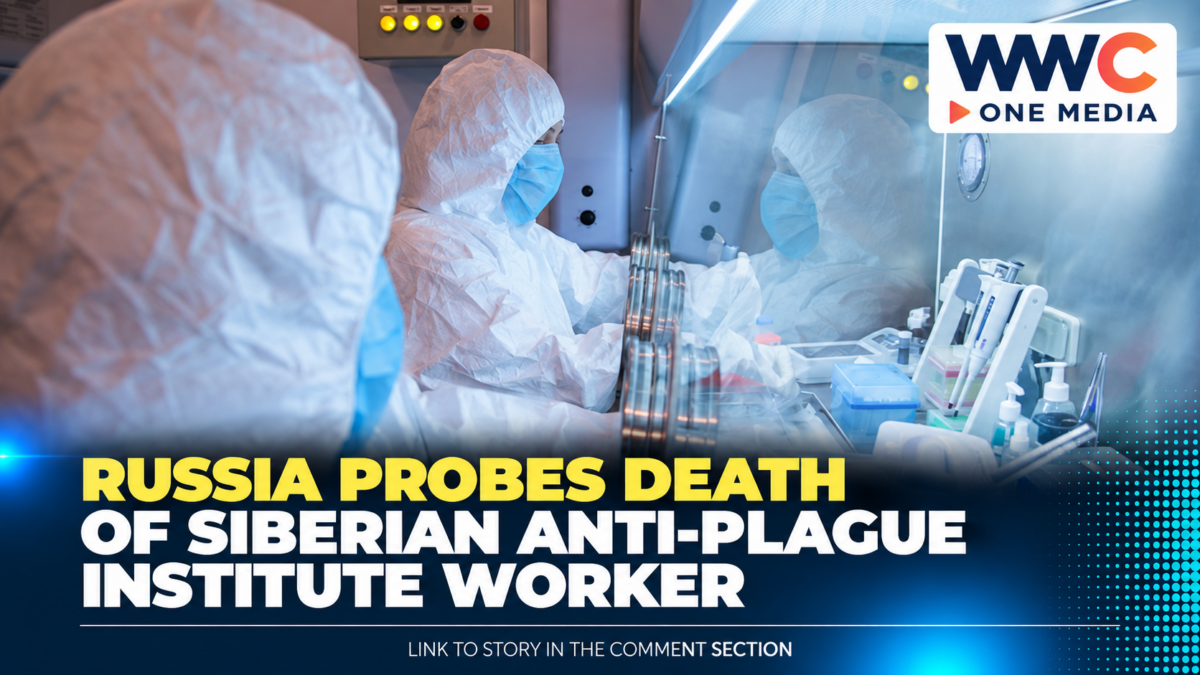
Russian authorities are investigating the death of a laboratory worker at an anti-plague research institute in Siberia after she developed pneumonia of unknown origin, prompting quarantine measures and heightened public concern over a possible plague infection.
The woman, identified by Russian and international media as 28-year-old Darya Shipilova, worked at the Irkutsk Anti-Plague Research Institute of Siberia and the Far East. She died at a hospital in Shelekhov after falling ill in late September.
Russian health authorities have stressed that there is currently no confirmed evidence that she died from plague or that her illness was caused by a pathogen associated with her work.
Worker died after unexplained pneumonia
Russia’s public-health watchdog, Rospotrebnadzor, said Shipilova was diagnosed with “pneumonia of unknown etiology”, meaning that doctors had not established the cause of the illness.
The agency said extensive testing found no microorganisms associated with the patient’s professional activities.
Authorities also said they found no evidence of an accident involving pathogenic microorganisms at the institute.
The findings have not stopped speculation because Shipilova worked at a facility dedicated to researching some of the world’s most dangerous infectious diseases, including plague.
Reports of possible plague exposure remain unconfirmed
Unverified reports circulating in Russian and regional media have suggested that Shipilova may have been exposed to Yersinia pestis, the bacterium that causes plague.
One reported account alleged that a test tube containing plague bacteria was accidentally broken at the institute. However, Russian authorities have not confirmed that such an accident occurred.
Rospotrebnadzor has specifically said that no incidents involving the handling of pathogenic microorganisms were detected at the institute.
The distinction is important: plague has not been established as the cause of Shipilova’s death.
Contacts placed under medical supervision
Despite the official position, authorities have introduced precautionary measures.
People who had contact with Shipilova have been identified, examined and placed under medical supervision. Dozens of people were quarantined, while parts of the hospital in Shelekhov where she died were restricted.
CNA, citing Reuters, reported that around 200 people who had contact with the woman were quarantined.
Testing among contacts reportedly identified two cases of Covid-19 and two rhinovirus infections, while no other infectious diseases were detected.
More than 60 employees of the anti-plague institute were also reported to have been isolated as authorities investigated the situation.
Russian authorities say situation is under control
Irkutsk Governor Igor Kobzev said the sanitary and epidemiological situation remained stable.
He said all known contacts had been identified and placed under medical observation, while no new cases among staff at the anti-plague institute had been reported.
Rospotrebnadzor chief Anna Popova travelled to the Irkutsk region for an emergency meeting as officials continued their investigation.
Authorities have also urged residents to rely on official information rather than rumours circulating online.
WHO says public-health risk appears low
The World Health Organization said that, based on the information available, the public-health risk to the general population appears to be low.
The assessment could change if additional information becomes available, but there is currently no confirmed evidence of a wider plague outbreak connected to the death.
Plague is caused by the bacterium Yersinia pestis. Pneumonic plague affects the lungs and can spread between people through respiratory droplets. It is potentially fatal if untreated, but can be treated effectively with antibiotics when identified promptly.
International officials monitoring the case
The unusual circumstances have attracted international attention.
US Secretary of State Marco Rubio said Washington was monitoring the situation closely, while President Donald Trump said the United States was willing to help Russia if assistance was needed.
The international monitoring reflects concern over the unusual setting of the death, but does not mean that a plague outbreak has been confirmed.
For now, Russian officials maintain that the woman’s death was caused by pneumonia of unknown origin and that there is no established connection to her work at the anti-plague institute.