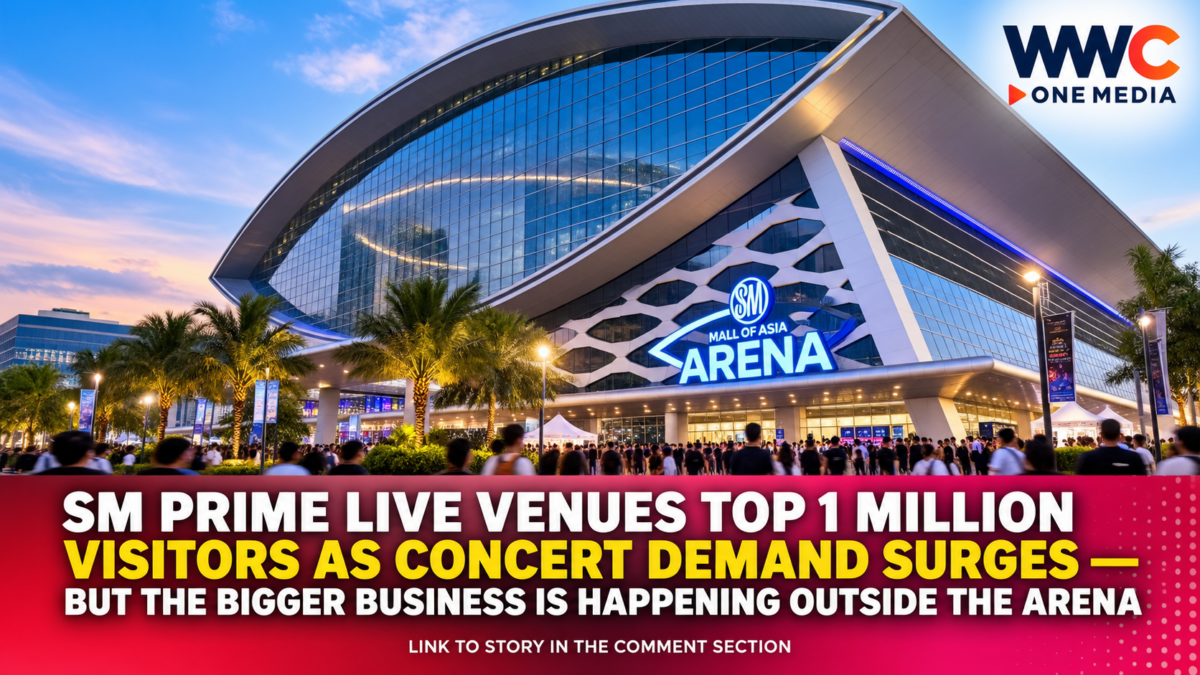
MANILA, Philippines — More than one million people packed SM Prime Holdings Inc.’s major live entertainment venues in the first eight months of 2026, as concerts, sporting events and family shows turned arenas and festival grounds into increasingly powerful traffic generators for the property giant.
SM Prime said the SM Mall of Asia Arena, SM Seaside Cebu Arena and SMDC Festival Grounds welcomed more than 1 million visitors as of August, up 52% from roughly 710,000 visitors during the same period in 2025.
The growth reflects the continued rebound—and expansion—of live entertainment in the Philippines.
But for SM Prime, the opportunity goes far beyond selling tickets.
Every major concert or sporting event can also send thousands of customers into nearby restaurants, shops, hotels, parking facilities and other businesses within SM’s mixed-use developments.
That makes live entertainment increasingly valuable not just as an attraction, but as part of SM Prime’s broader property strategy.
MOA Arena staged more than 110 shows in eight months
The strongest contributor remains SM Mall of Asia Arena in Pasay City.
From January through August 2026, the venue staged more than 110 shows, representing an increase of as much as 20% from the comparable period in 2025.
The arena has become one of the Philippines’ dominant venues for major concerts, sports competitions and family entertainment.
In 2025 alone, MOA Arena hosted more than 200 events and over 1.1 million attendees, a 10% increase in attendance from the previous year.
Since opening in 2012, the roughly 15,000-seat arena has hosted more than 2,400 shows, including concerts by global performers and major international sports tournaments.
That history gives SM Prime a powerful advantage in the increasingly competitive Philippine live-events market.
Promoters already know the venue.
Audiences already know how to reach it.
And the surrounding Mall of Asia complex gives concertgoers places to eat, shop and spend time before and after events.
The event calendar remains packed
SM Prime expects the momentum to continue through the rest of 2026.
MOA Arena’s lineup includes performances by artists such as Regine Velasquez, Silent Sanctuary, Jason Mraz, 5 Seconds of Summer, Wave to Earth and LE SSERAFIM.
Disney On Ice is also scheduled for 34 performances at the venue.
The pipeline is already extending well into 2027.
Upcoming announced acts include Westlife, Maroon 5 and The Script, while BIGBANG is scheduled to perform at the SMDC Festival Grounds.
The Script’s Manila schedule spans three shows in March 2027, while Westlife is booked for two anniversary-tour performances in January.
A calendar filled months in advance gives SM Prime more predictable event traffic across its properties.
Cebu is opening a second major front
Perhaps the biggest change in 2026 is the opening of SM Seaside Cebu Arena.
The venue officially began operations in July and quickly recorded sold-out opening concerts by BINI and IV of Spades.
SM Prime earlier said more than 20 major events had already been lined up for the venue during its launch year, including concerts, sports and family shows.
The company sees Cebu as an important opportunity to decentralize the Philippine concert market.
For years, fans from the Visayas and Mindanao often had to fly to Metro Manila to watch major international acts.
A large-scale venue in Cebu could allow promoters to add a second Philippine stop instead.
That potentially shifts some of the spending associated with live entertainment—airfare, hotels, dining and transportation—into Cebu.
SM Prime President Jeffrey C. Lim has explicitly described that as part of the strategy, saying major events can benefit tourism, hospitality, transportation, retail and local services beyond the venue itself.
Cebu Arena is much larger than MOA Arena
The new Cebu facility also gives SM Prime significantly more event capacity.
SM Prime previously described the seven-storey SM Seaside Cebu Arena as having capacity for as many as 25,000 people, depending on event configuration.
That makes it one of the largest indoor entertainment venues in the Philippines.
Its flexible event bowl is designed to accommodate both full-scale concerts and smaller configurations.
That versatility matters.
Large arenas cannot depend exclusively on international concerts.
To maximize utilization, operators need sports, conventions, local shows, corporate functions and family entertainment throughout the year.
The Cebu calendar already includes Premier Volleyball League, Spikers’ Turf, East Asia Super League, LANY, Disney On Ice and other events.
The FIBA Women’s Asia Cup is also scheduled for Cebu in 2027.
SM Prime is betting on the “concert economy”
SM Prime has increasingly used the term concert economy to describe the economic spillover created by large live events.
The logic is straightforward.
A concert ticket may be the reason a visitor enters an SM development.
But the customer might also:
eat at a restaurant,
shop before the event,
pay for parking,
stay at a nearby hotel,
buy food and beverages,
or return for other entertainment afterward.
SM Prime President Jeffrey Lim said the company wants audiences to have an experience extending before, during and after the event, with retail, dining and entertainment within easy reach.
That makes the arena almost like a giant customer-acquisition engine for the surrounding property.
SM’s financial results already show why foot traffic matters
The live-events strategy fits closely with SM Prime’s financial structure.
In the first half of 2026, the company reported ₱71.7 billion in total revenue, up 5% year on year.
Rental income from malls, offices, hospitality and meetings and conventions generated 61% of total revenue.
Mall revenue alone rose 8% to ₱41.8 billion, supported by stronger tenant sales, higher occupancy and improved operations.
That relationship is important.
SM Prime does not need to earn all the economic value of a concert directly through the arena.
If a large event increases sales for restaurants and retailers, the surrounding mall ecosystem can also benefit.
In the first quarter, SM Prime specifically cited sustained interest in experiential offerings as one factor behind its mall performance.
That helps explain why concerts and other experiences are becoming strategically important in an era when consumers can increasingly purchase ordinary goods online.
Experiences give physical malls something e-commerce cannot reproduce
Shopping centers around the world have faced the same structural challenge.
Consumers can buy clothing, electronics and household products without entering a mall.
But an online platform cannot fully replicate:
a concert,
a basketball game,
a fan meeting,
Disney On Ice,
a convention,
or a large social gathering.
That gives property owners an incentive to turn malls and mixed-use developments into places for experiences rather than simply collections of stores.
SM Prime’s growing venue portfolio fits that model.
The arena brings people.
The mall gives them somewhere to stay.
Restaurants and retailers give them more reasons to spend.
And hotels or transportation links can extend the economic impact further.
The strategy extends beyond entertainment venues
SM Prime is seeing similar growth in its convention business.
Its SMX Convention Centers welcomed 4.3 million visitors in the first half of 2026, an 18% increase from 3.6 million a year earlier.
The network hosted 807 booked events during the period.
SMX Manila alone attracted more than 2.5 million visitors.
That followed a record 2025, when SMX’s eight convention properties hosted 1,632 events and 8.54 million visitors, with attendance rising 34%.
Together, the numbers show that concerts are only part of a much broader shift toward event-led traffic.
Trade shows, exhibitions, conferences and conventions are creating similar benefits for hotels, malls and surrounding commercial districts.
Ticketmaster’s Philippine entry could strengthen the ecosystem
SM Prime has also expanded further into ticketing.
In May 2026, the company partnered with Ticketmaster to launch SM Ticketmaster, marking the global ticketing company’s entry into the Philippines.
The service is designed to support concerts, sports and other live events and builds on the operations previously offered through SM Tickets.
Ticketing technology has become an increasingly important part of the live-entertainment business.
Promoters need systems capable of handling massive demand.
Fans want reliable transactions.
Venues need tools for access control and customer management.
And fraud involving fake tickets remains a recurring issue globally.
By combining venues and ticketing infrastructure, SM Prime gains another connection to the live-event ecosystem.
But rapid growth creates new challenges
A booming concert market also brings pressure.
Ticket prices can be high.
Popular shows can sell out almost instantly.
Traffic around major venues can become severe.
Hotels and flights can become expensive during major events.
And large-scale events require significant security, crowd-control and transport coordination.
Cebu’s growth will create a similar test.
A 20,000-plus-person audience leaving an arena at roughly the same time puts enormous pressure on surrounding roads and transportation services.
The success of the concert economy therefore depends partly on infrastructure outside the venue.
Fans may enjoy a world-class show inside the arena but judge the overall experience by how difficult it was to arrive and get home.
Not every event guarantees strong returns
High attendance should also not automatically be interpreted as high profitability.
Large entertainment venues carry considerable fixed costs.
They require maintenance, electricity, security, staffing, technology and constant upgrades.
Event promoters also shoulder large production expenses and guarantees for artists.
A sold-out event can be lucrative.
But attendance alone does not show the margins earned by the venue, promoter or artist.
SM Prime does not separately disclose detailed arena profitability in the visitor announcement, so the one-million-attendee milestone is best understood as a traffic and demand indicator, rather than proof of a specific profit level.
That distinction is important for investors.
Yet the broader property strategy is becoming clear
SM Prime’s approach increasingly connects several businesses that would otherwise appear separate:
malls,
arenas,
festival grounds,
convention centers,
hotels,
restaurants,
cinemas,
and ticketing.
A single event can interact with many of them.
That is what makes live entertainment more valuable to a diversified property company than to a standalone venue operator.
SM Prime can potentially capture spending at several stages of a customer’s trip rather than only at the arena door.
The company itself summarized the strategy when Lim said nearby amenities allow SM to extend the experience while creating more value across its properties.
The next phase could shift more major events outside Manila
The Cebu expansion may ultimately be the most significant development.
Metro Manila has historically dominated the country’s biggest concerts and sporting events because it had the largest venues, population base and corporate market.
But if Cebu consistently sells out large shows, promoters gain stronger evidence that major tours can support multiple Philippine stops.
That would create more opportunities for regional tourism and reduce the need for fans outside Luzon to travel to Manila.
It could also encourage other developers to invest in larger entertainment infrastructure.
Competition would benefit promoters and audiences by creating more venue choices.
The real value of one million visitors
Crossing one million visitors is an impressive headline.
But it may not be the most important number.
The bigger question is how much economic activity those visitors create across the wider SM ecosystem.
If a concert attendee buys dinner, shops at the mall, books a hotel room and attends the show, one event has generated spending across several businesses.
Multiply that by hundreds of events and millions of visitors, and live entertainment begins to look less like a side business and more like part of the core strategy of a modern property company.
That is why the surge in event attendance matters.
SM Prime is not merely filling arenas. It is using concerts, sports and live experiences to keep millions of consumers spending time—and potentially more money—inside its expanding network of properties.
And if the company’s 2027 calendar is any indication, the battle for the Philippine concert economy is only getting bigger.